
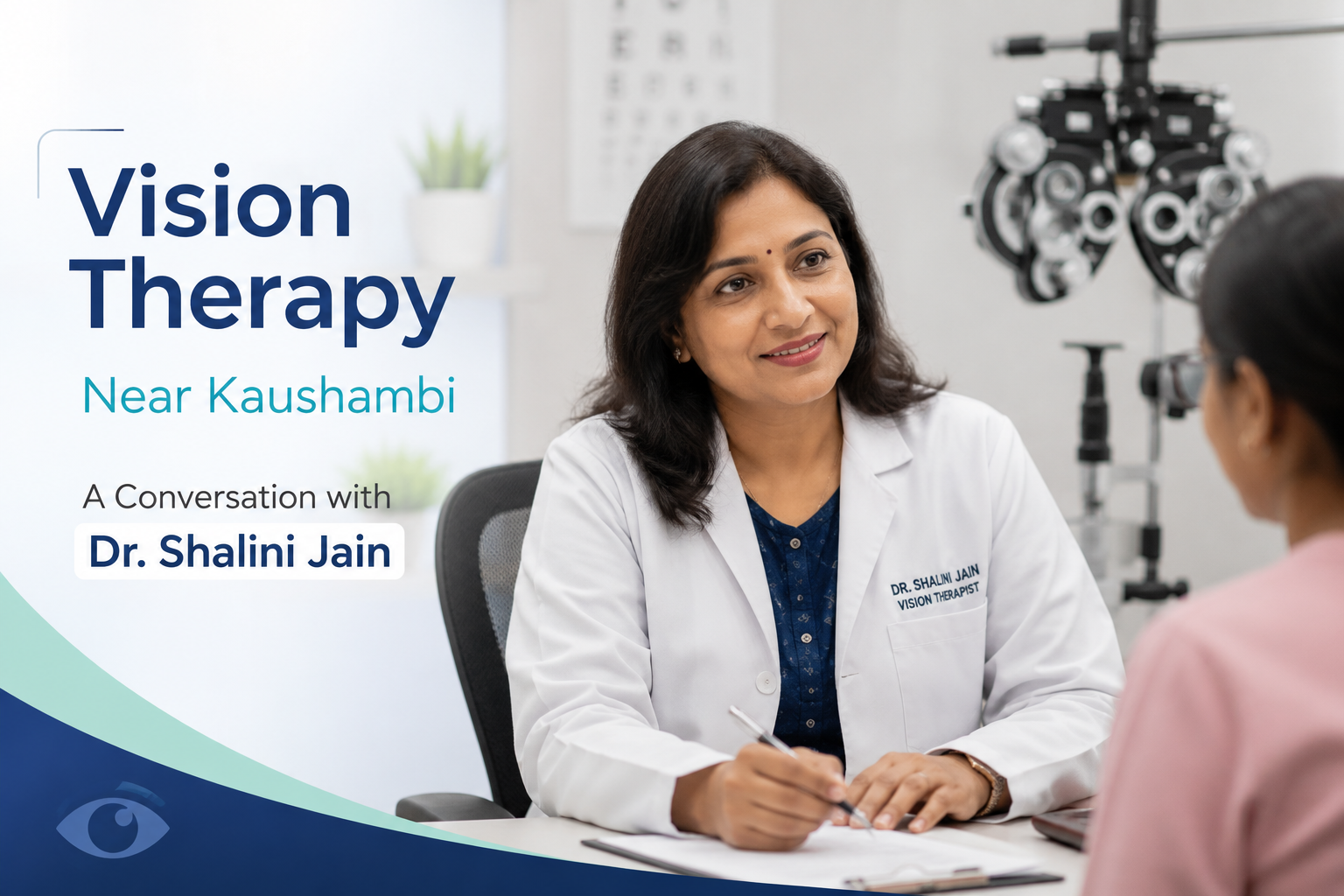
Vision Therapy Near Kaushambi: A Conversation with Dr. Shalini Jain
Many parents arrive at our clinic frustrated. Their child is bright, engaged, and curious — yet struggles with reading, loses their place constantly, complains of headaches after homework, or avoids close work altogether. Teachers suggest attention problems. Tutors recommend more practice. But the real issue often lies not in the brain's processing power, but in how the eyes and brain work together.
We sat down with Dr. Shalini Jain to discuss vision therapy — what it is, who benefits, and why families near Kaushambi and throughout Ghaziabad are discovering this transformative approach to visual rehabilitation. As the best eye specialist near Kaushambi, she has helped hundreds of patients overcome visual challenges that glasses alone couldn't solve.
Q: What exactly is vision therapy?
Dr. Jain: Vision therapy is a customised programme of visual activities designed to improve how the eyes and brain work together. Think of it as physiotherapy for the visual system. Just as physical therapy strengthens muscles and improves coordination after an injury, vision therapy trains the neural pathways that control eye movement, focusing, and visual processing.
It's not about making eyes stronger in the muscular sense. It's about improving the brain's ability to control the eyes precisely, process visual information efficiently, and integrate what we see with other senses. These skills aren't automatic — they develop through experience, and sometimes they don't develop properly.
Q: Who needs vision therapy?
Dr. Jain: The most common candidates are children with learning-related vision problems. These children often have 20/20 sight — they can read the eye chart perfectly — but struggle with the visual skills needed for sustained reading and learning. They might have trouble tracking across a line of text, focusing from far to near, or using both eyes together as a team.
We also see adults with convergence insufficiency — difficulty bringing the eyes together for near work — which causes headaches, double vision, and fatigue when reading or using computers. Patients recovering from concussions often need vision therapy to address post-traumatic visual dysfunction. And of course, vision therapy in Kaushambi is essential for treating amblyopia (lazy eye) and strabismus (eye turn), particularly when caught early.
Q: How do you identify these problems?
Dr. Jain: Standard eye exams test whether you can see clearly at a distance — the classic eye chart test. But they don't evaluate how the eyes work together, how quickly they can change focus, how accurately they track moving objects, or how the brain processes what the eyes see.
A comprehensive visual skills evaluation takes much longer — sometimes an hour or more. We assess eye teaming, tracking, focusing flexibility, depth perception, visual-motor integration, and visual processing speed. These tests reveal problems that routine screenings miss entirely. The eye care clinic near Kaushambi provides these thorough evaluations for children and adults alike.
Q: What does a vision therapy programme involve?
Dr. Jain: Each programme is individualised based on the evaluation findings. Typically, patients attend in-office sessions weekly or fortnightly, supplemented by daily home exercises. Sessions use specialised equipment — prisms, lenses, computer programmes, balance boards, and various therapeutic tools — to challenge and develop specific visual skills.
The key is progressive difficulty. We start where the patient can succeed, then gradually increase challenges as skills improve. A child who can't track smoothly across a page begins with simple eye movement exercises, progresses to more complex tracking tasks, and eventually integrates these skills with reading activities.
Programme duration varies. Some conditions improve in 12-16 weeks. Others require six months or longer. We set realistic expectations upfront and monitor progress throughout.
Q: Does vision therapy actually work?
Dr. Jain: For appropriate conditions, absolutely. The research is particularly strong for convergence insufficiency — multiple randomised controlled trials show office-based vision therapy significantly outperforms home exercises alone or reading glasses. For amblyopia, vision therapy combined with patching or atropine produces better outcomes than patching alone, especially in older children previously considered untreatable.
What I find most compelling is watching children transform. A child who avoided reading becomes engaged with books. A student whose grades were falling despite intelligence and effort suddenly thrives. Parents tell me their child seems like a different person. These changes happen because we've addressed the underlying visual dysfunction that was holding them back.
Wondering if vision therapy could help your child? Contact the best eye specialist near Kaushambi at 98999 60700 to schedule a visual skills evaluation.
Q: At what age is vision therapy most effective?
Dr. Jain: Earlier is generally better, particularly for conditions like amblyopia, where the visual system is still developing. But the brain retains plasticity throughout life — adults can and do improve with vision therapy. I've treated patients in their 40s and 50s who finally found relief from lifelong visual discomfort.
For children, the ideal time is often when visual demands increase — around school entry, when reading becomes central to learning. If a child is struggling academically despite adequate intelligence and effort, a comprehensive visual evaluation should be part of the assessment.
Frequently Asked Questions
How is vision therapy different from eye exercises found online?
Generic eye exercises lack the diagnostic foundation and progressive structure of clinical vision therapy. Without proper evaluation, you don't know which skills need development. Without professional guidance, exercises may be performed incorrectly or at inappropriate difficulty levels. Clinical vision therapy is a medical treatment, not a generic wellness activity.
Will my child need glasses after vision therapy?
Vision therapy doesn't replace glasses for refractive errors like myopia or hyperopia. If your child needs glasses for clear sight, they'll still need them afterwards. What changes is how efficiently their visual system functions — better eye teaming, tracking, and focusing, regardless of whether glasses are worn.
How long before we see improvement?
Some improvements appear within weeks. Parents often notice their child reading longer without complaints, or homework taking less time. Full programme completion typically takes 3-9 months, depending on the condition and severity. Compliance with home exercises significantly affects outcomes.
Is vision therapy covered by insurance?
Coverage varies by policy. Some insurance plans cover vision therapy for specific diagnoses like amblyopia or strabismus. We can provide documentation for insurance claims. Many families find the investment worthwhile given the long-term academic and quality-of-life benefits.
Where can I find vision therapy services near Kaushambi?
Samyak Eye Care offers comprehensive vision therapy near Kaushambi, serving patients from Indirapuram, Vaishali, Surya Nagar, and throughout Ghaziabad. The clinic at Gaur Heights, Sector 4, Vaishali, is easily accessible from Kaushambi. Visit our clinic for evaluation.
Can adults benefit from vision therapy?
Absolutely. Adults with convergence insufficiency, post-concussion visual problems, or lifelong visual discomfort can improve significantly. The brain's plasticity allows change at any age, though children may progress faster due to developmental flexibility.
See the Difference
Vision is more than seeing clearly — it's processing, integrating, and responding to the visual world efficiently. When these skills don't develop properly, no amount of willpower or effort compensates. Vision therapy addresses the root cause, giving children and adults the visual foundation they need to succeed.
SCHEDULE YOUR VISION THERAPY EVALUATION
Call: 98999 60700
Website: www.samyakeyecare.com
Location: Gaur Heights, Sector 4, Vaishali, Ghaziabad
Serving patients from Kaushambi | Vaishali | Indirapuram | Surya Nagar | Ghaziabad


