
Understanding Scleral Lenses: Benefits for Patients with Corneal Disorders
"I've tried every type of contact lens. They all pop out, dry up, or just don't give me a clear vision. Is there anything else I can try?"
For patients with corneal disorders, this frustration is all too familiar. Standard glasses don't correct the irregular astigmatism. Soft contacts can't conform to an irregular surface. Rigid gas-permeable lenses may work, but are often uncomfortable or unstable.
Enter Scleral lenses -- a specialised solution that's transforming vision for patients who thought they'd run out of options.
What Makes Scleral Lenses Special?
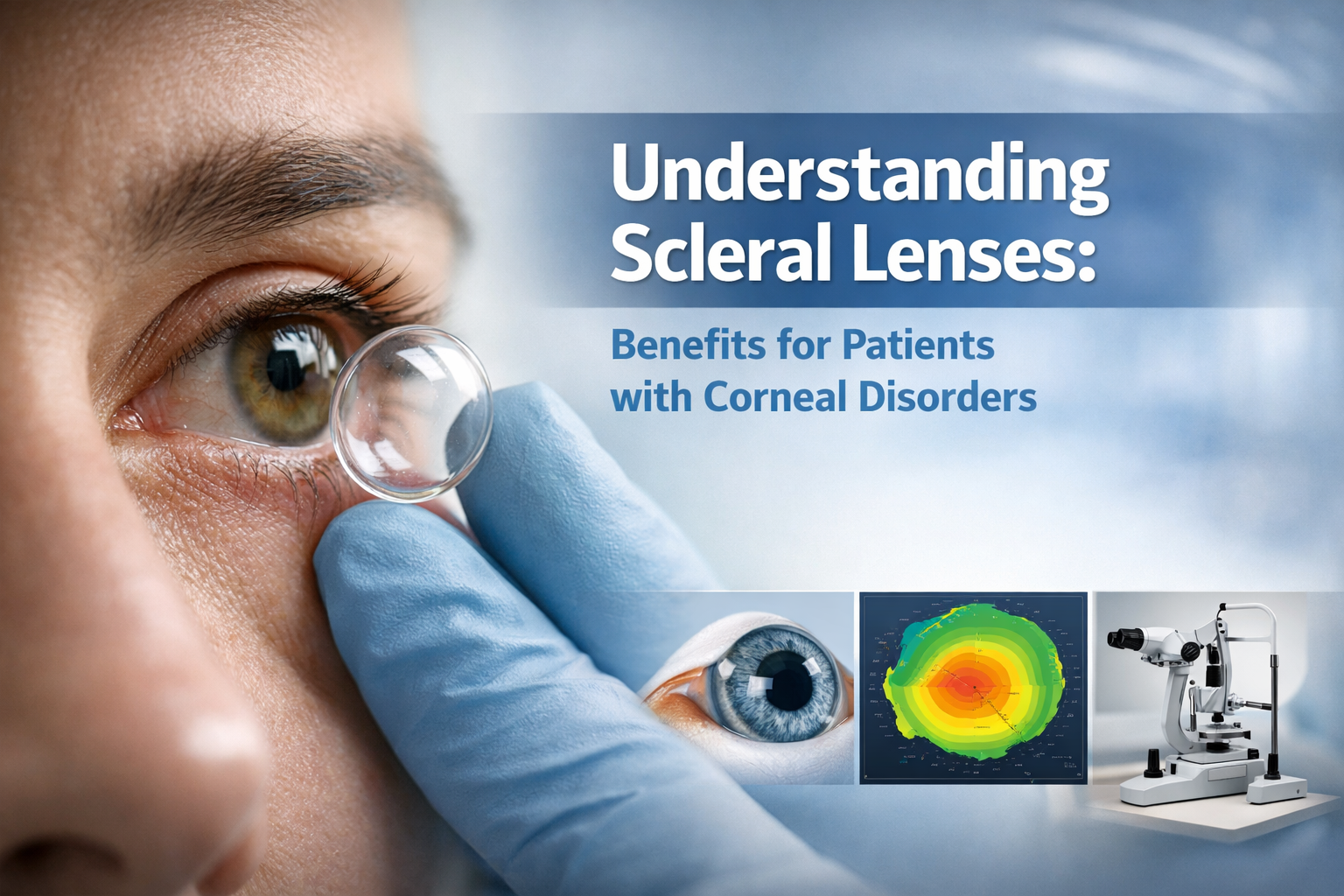
Scleral lenses are large-diameter, rigid gas-permeable contact lenses that vault completely over the cornea and rest on the white part of the eye (the sclera). Unlike standard contacts that sit directly on the cornea, Sclerals create a tear-filled reservoir between the lens and the eye's surface.
This design provides several unique advantages:
A new optical surface: The smooth front of the lens creates a perfect optical surface, regardless of how irregular your cornea has become. Light passes through this smooth surface rather than your distorted cornea.
Constant hydration: The saline reservoir keeps your cornea bathed in fluid throughout wear. This is particularly beneficial for patients with severe dry eye who can't tolerate other contact types.
No corneal touch: Because the lens vaults over the cornea without touching it, there's no mechanical irritation. The sclera, where the lens rests, is less sensitive than the cornea.
Exceptional stability: The large diameter means the lens doesn't move around or pop out during activities. Once in place, it stays put.
Struggling with vision despite trying multiple options? Call 98999 60700 to explore if Scleral lenses could help.
Conditions That Benefit from Scleral Lenses
Keratoconus: The most common reason patients seek Scleral lenses. As the cornea progressively thins and bulges in keratoconus, glasses become ineffective. Scleral lenses provide stable, clear vision even in advanced cases.
Pellucid Marginal Degeneration: Similar to keratoconus but affecting a different part of the cornea. The irregular astigmatism responds excellently to Scleral lens correction.
Post-LASIK Complications: Some patients develop corneal ectasia or irregular astigmatism after refractive surgery. Scleral lenses can restore quality vision when other options fail.
Corneal Transplant: After corneal transplant surgery, the new cornea often has irregular astigmatism that glasses can't correct. Scleral lenses can mask this irregularity.
Severe Dry Eye Syndrome: For patients with conditions like Sjögren's syndrome, graft-versus-host disease, or other causes of severe dryness, the fluid reservoir provides continuous lubrication.
Corneal Scarring: Scars from injuries, infections, or other conditions create irregular surfaces that Scleral lenses can optically bypass.
The Comfort Question
"Won't such large lenses be uncomfortable?"
This is the most common concern, and understandably so. Counter-intuitively, most patients find Scleral lenses more comfortable than smaller rigid lenses they may have tried previously.
The reasons: The sclera is far less sensitive than the cornea. The lens doesn't move with each blink like smaller contacts. And the fluid cushion eliminates any rubbing sensation.
Many patients report being able to wear Scleral lenses comfortably for 12-16 hours daily -- longer than they could wear other contact types. Some even forget they're wearing them.
The Fitting Process
Scleral lens fitting is more complex than standard contact lens fitting and requires specialised expertise. The process typically involves:
• Detailed corneal and scleral mapping using advanced topography
• Assessment of tear quality and quantity
• Trial lens evaluation to determine optimal fit
• Custom lens ordering based on your specific measurements
• Fitting verification and adjustments if needed
• Training on insertion, removal, and care
A comprehensive eye examination establishes the baseline, and multiple visits are typically needed to optimise the fit.
Daily Care and Maintenance
Scleral lenses require proper care, but the routine is straightforward:
• Fill the lens bowl with preservative-free saline before insertion
• Clean lenses daily with appropriate solutions
• Store in proper disinfecting solution overnight
• Replace cases regularly to prevent contamination
• Attend regular follow-up appointments
With proper care, Scleral lenses typically last 1-2 years before needing replacement.
Expert Scleral Lens Fitting in Delhi NCR
At Samyak Eye Care Clinic, Dr. Shalini Jain has over 25 years of experience in speciality contact lens fitting, including complex Scleral lens cases. We use US FDA-approved diagnostic equipment and work with leading Scleral lens manufacturers.
Patients travel from across Delhi NCR -- and sometimes from other states -- specifically for our expertise in fitting these advanced lenses. Visit our Vaishali clinic to discuss whether Scleral lenses could restore the clear, comfortable vision you've been missing.
BOOK YOUR SCLERAL LENS CONSULTATION TODAY
Call: 98999 60700
Website: www.samyakeyecare.com
Location: Gaur Heights, Sector 4, Vaishali, Ghaziabad
Serving patients from across India | Delhi NCR | Vaishali | Ghaziabad | Indirapuram | Kaushambi | Noida


