
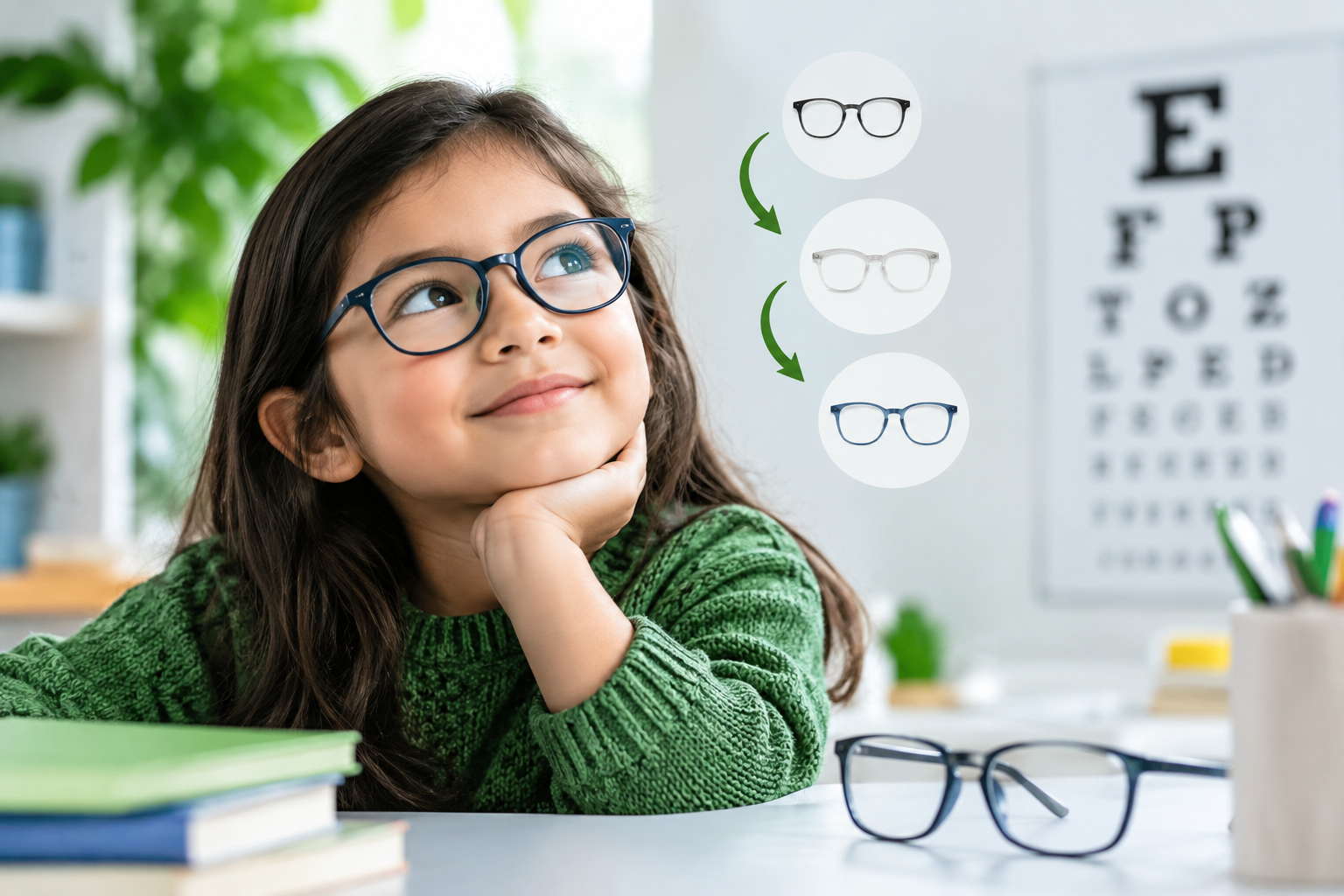
Why Your Child's Glasses Prescription Keeps Changing Every Year
Most parents who bring a child to Samyak Eye Care Clinic from Indirapuram or Ghaziabad with myopia have had the same experience. They get a prescription. They buy glasses. A year later, the prescription has changed. They update the glasses. A year later, it has changed again. Nobody has explained why this is happening. Nobody has told them whether it will stop. And critically, nobody has told them that this annual prescription increase is not something they simply have to accept.
The assumption that myopia progression is inevitable and unmanageable is one of the most consequential misconceptions I encounter in paediatric eye care. It leads families to update prescriptions year after year without ever questioning whether the trajectory can be altered. In many cases, it can. The key is understanding what is actually happening when a prescription changes, and what that means for your child's long-term visual health.
As an eye specialist in Indirapuram and Ghaziabad, I want to explain what is actually happening when your child's prescription increases, why some children progress faster than others, and what the evidence says about slowing it down.
What Is Actually Changing When a Prescription Increases
When a myopia prescription increases from -1.50 to -2.00 dioptres, most parents understand this as the eyes getting worse. What they do not usually know is the physical mechanism behind that change.
Myopia occurs because the eyeball has grown too long. Light entering the eye focuses in front of the retina instead of on it, producing the blurred distance vision that drives children to squint. When a prescription increases, it is because the eyeball has physically elongated further. The lens prescription has to be made stronger to compensate for an eye that is now physically longer than it was the previous year.
This elongation, measured as axial length in millimetres, is permanent. An eye that has grown to a certain length does not shorten again. This is why myopia, once established, cannot be reversed. The prescription can be corrected optically, but the underlying elongation is structural and permanent. This is also why the risks associated with high myopia, including retinal detachment, myopic maculopathy, and glaucoma, persist even if a person later has laser surgery. The surgery changes the refraction but not the axial length.
Why Some Children's Prescriptions Change More Than Others
Parents in Indirapuram sometimes ask why their child's prescription changes so much faster than a sibling or classmate. The answer is that myopia progression is driven by a combination of genetic susceptibility and environmental exposure, and both vary significantly between children.
Genetic factors
Children with two myopic parents have approximately six times the risk of developing myopia compared to children with no myopic parents. Family history does not determine outcome, but it establishes baseline susceptibility. A child with two highly myopic parents who spends significant time on near work with little outdoor time is at substantially higher risk of rapid progression than a child with no family history in the same environment.
Age at onset
Children who develop myopia younger tend to have longer periods of progression ahead of them and consequently reach higher final prescriptions. A child myopic at age 6 has approximately twelve to fourteen years of potential progression, compared to a child whose myopia begins at 12. This is why early identification and early intervention produce the best long-term outcomes.
Near work and screen time
Sustained near work, including reading, writing, and screen use, is associated with myopia progression. The Indian DESK study series confirmed that increased screen time during the COVID pandemic corresponded directly with faster myopia progression in Indian children. Families in Indirapuram and Ghaziabad, where academic pressure and screen-based schooling are both prevalent, are operating in a high-risk environment for myopia.
Outdoor time
This is the most underutilised and most evidence-supported protective factor in myopia management. Bright natural light stimulates dopamine release in the retina, which inhibits axial elongation. Children who spend at least one to two hours outdoors daily show measurably slower myopia progression. Urban children in Delhi NCR, where structured outdoor time is often limited by safety concerns, academic schedules, and lack of green space, are at a systematic disadvantage.
When Should You Worry About the Rate of Change
Not all prescription changes are equally concerning. A general clinical guide:
Progression of 0.50D or less per year is considered slow and may be managed with observation alongside lifestyle changes.
Progression of 0.50D to 1.00D per year is moderate and warrants active myopia control intervention.
Progression of 1.00D or more per year is rapid and requires prompt, targeted intervention. Children progressing at this rate are at significant risk of reaching high myopia during their school years.
At Samyak Eye Care Clinic, we assess progression using axial length measurement, not just prescription change. Axial length is more sensitive and more clinically informative. A child whose prescription appears stable but whose axial length is elongating is still progressing and still needs active management. This is something that standard optician visits, which typically involve only chart reading, will not detect.
What Can Actually Be Done to Slow the Annual Changes
This is the question parents most want answered, and it has a genuine, evidence-based answer.
Ortho-K lenses: Worn overnight, these reshape the cornea to provide clear daytime vision while slowing axial elongation by 40 to 60 per cent compared to standard spectacles. For children in Indirapuram and Ghaziabad who are active, academic, or involved in sports, the additional benefit of glasses-free daytime vision is clinically and practically significant.
Low-dose atropine drops: Applied once nightly, 0.01 to 0.05 per cent atropine has been shown to slow myopia progression with minimal side effects. For children with rapid progression or high family risk, combination with Ortho-K produces greater slowing than either alone.
DIMS and myopia control spectacle lenses: For families who prefer spectacles, these specially designed lenses create peripheral defocus signals that slow axial elongation. Evidence supports reductions of 30 to 60 per cent in progression rate.
Structured outdoor time: A minimum of 60 to 90 minutes of outdoor activity daily remains the most accessible intervention and the most consistent finding across global research. It does not stop progression but meaningfully slows it, particularly when combined with optical treatment.
The correct treatment choice depends on the child's prescription, rate of progression, lifestyle, and individual factors assessed at a comprehensive eye examination in Ghaziabad. There is no universal answer, but there is always an evidence-based answer for each specific child.
The Right Question to Ask at Your Child's Next Appointment
Instead of asking only what the new prescription is, ask these questions at your next visit to an eye specialist in Indirapuram or Ghaziabad:
What is my child's axial length, and how has it changed since the last measurement?
What is the rate of progression, and where does that place them on the clinical risk scale?
Is there a myopia control intervention appropriate for my child's age, prescription, and lifestyle?
If we do nothing different, what is the projected prescription in five years?
These are not unusual questions. They are the standard of care at a properly equipped myopia control clinic. If the clinic you are currently attending cannot answer them, that tells you something important about the level of care your child is receiving.
Frequently Asked Questions
Q: Why does my child's glasses prescription change every year?
A: Annual prescription changes reflect ongoing axial elongation of the eyeball, the physical growth of the eye that underlies myopia. This is normal during childhood and adolescent growth years but is not fixed in its rate. Active myopia control management can slow the rate of elongation and therefore the rate of prescription change significantly.
Q: At what age does myopia stop progressing?
A: Myopia typically stabilises in the early to mid twenties, when overall physical growth slows. However, children who develop myopia young and progress rapidly can reach high myopia levels well before progression stops. The goal of early intervention is to limit the total prescription accumulated during the growth years, not to wait for natural stabilisation.
Q: Can myopia progression be stopped completely?
A: No treatment currently available can completely stop myopia progression. However, Ortho-K lenses, low-dose atropine, and myopia control spectacle lenses can reduce the rate by 40 to 60 per cent compared to standard glasses or contact lenses. Over childhood, this difference in rate is clinically significant in terms of the final prescription and associated lifetime risk.
Q: My child's prescription has been the same for two years. Do they still need monitoring?
A: Yes. Prescription stability on a chart does not always reflect axial length stability. The eye can be elongating without a visible prescription change in the short term. Annual comprehensive eye examinations with axial length measurement remain important even during apparent prescription stability.
Annual Changes Are a Signal, Not a Sentence
A changing prescription is your child's visual system telling you that something is happening. It is not a sentence to a lifetime of thick glasses or high myopia. Addressed correctly, with the right specialist assessment and the right intervention, the trajectory can change.
Samyak Eye Care Clinic in Vaishali is easily accessible from Indirapuram, serving families across Ghaziabad and NCR. If your child's prescription has changed at least twice in the past two years, visit our clinic for a comprehensive assessment that goes beyond the chart and gives you the full clinical picture.
Start Managing Your Child's Myopia Progression Today
Dr. Shalini Jain | Samyak Eye Care Clinic | Vaishali, Ghaziabad
Call: 98999 60700


