
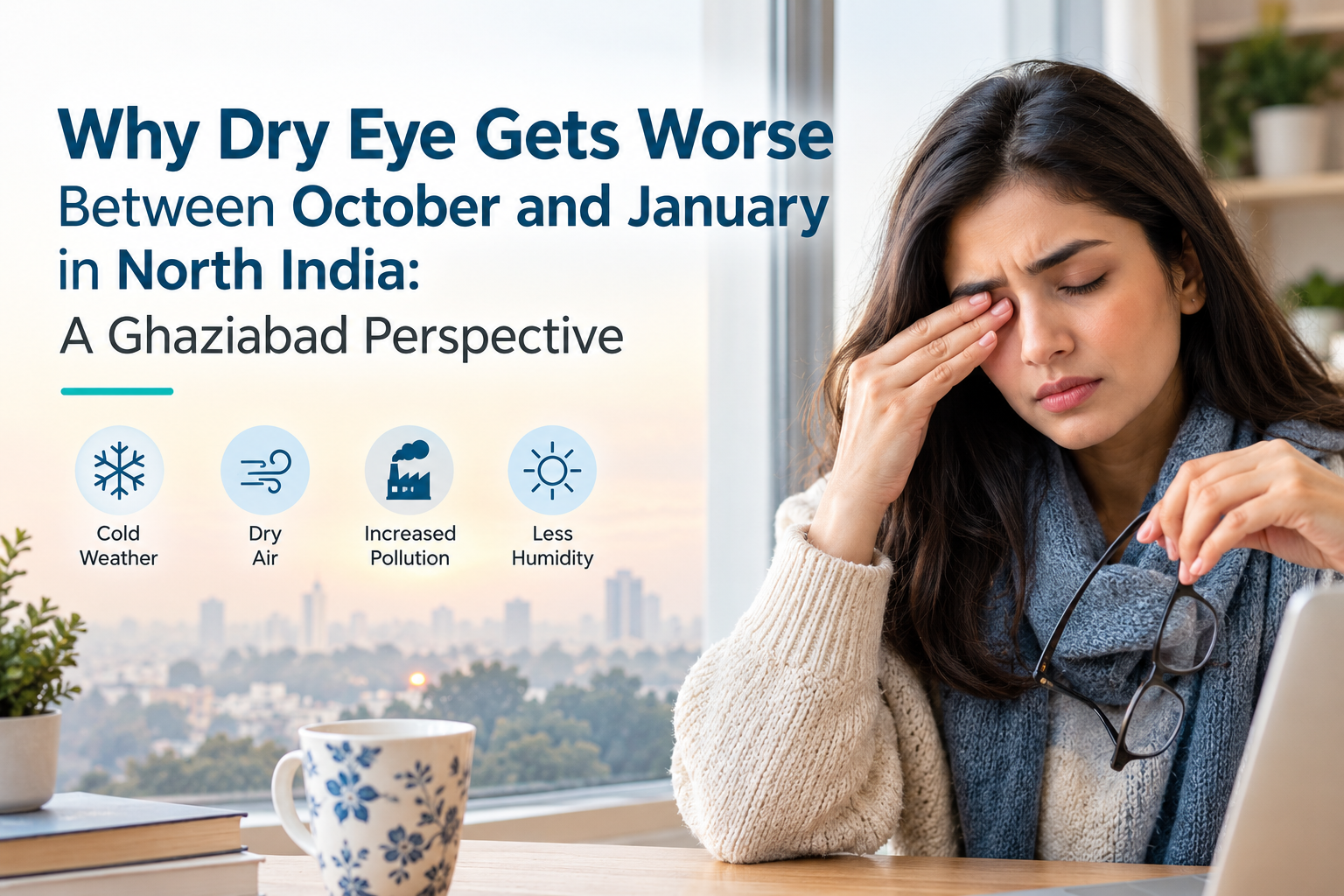
Why Dry Eye Gets Worse Between October and January in North India: A Ghaziabad Perspective
If your eyes feel fine in June but burn and water by November, you are not imagining it and you are not alone. Dry eye disease in North India follows a clear seasonal pattern, and the October to January window is its peak expression. The reasons are specific to this region, this season, and this combination of environmental factors, and understanding them explains why generic dry eye advice developed in other climates often falls short for patients in Ghaziabad, Vaishali, and across NCR.
A 45-year-old accountant from Vasundhara has been a patient at Samyak Eye Care Clinic for three years. She has mild meibomian gland dysfunction, a common underlying cause of dry eye. For eight months of the year, she manages well with lubricating drops twice daily and a warm compress routine every morning. From October, everything changes. She needs drops six to eight times daily. Her eyes are red by mid-morning. She has burning and grittiness that disrupts her concentration. By January, the symptoms are at their worst. By March, they are receding again. The clinical picture is textbook, and it is one I see in dozens of patients every winter at our clinic in Vaishali.
Understanding exactly why this happens in North India gives patients far more control over it than simply increasing lubricating drop use and hoping for spring.
The Three Converging Factors That Make October to January the Peak Dry Eye Season in NCR
Factor 1: The pollution surge
Delhi NCR's winter air quality crisis is well-documented, but its specific ocular consequences are less commonly discussed. Analysis published by the Centre for Science and Environment (CSE) found that PM2.5 levels in Delhi NCR spiked 71 per cent from October to December at monitoring stations including Anand Vihar. October 2025 was recorded as the worst October for air quality in three years, with AQI consistently in the Very Unhealthy to Hazardous range after mid-October.
What does particulate matter do to the eyes? PM2.5 particles are small enough to deposit directly on the ocular surface. They carry organic compounds, heavy metals, and chemical pollutants that are directly toxic to the corneal epithelium and conjunctival tissue. They adsorb to the tear film lipid layer, disrupting its stability and accelerating tear film evaporation. Research published in ophthalmology journals confirms a direct correlation between ambient PM2.5 levels and dry eye symptom severity and tear film instability.
For patients with pre-existing dry eye or meibomian gland dysfunction, the arrival of Delhi's winter pollution season is effectively the application of an external tear film-disrupting agent for three to four months. Their already-marginal tear film stability is further compromised by the daily particulate load their eyes are exposed to during commuting, outdoor activity, and even time near open windows.
Factor 2: Reduced ambient humidity
The post-monsoon transition into North India's winter brings a significant drop in ambient humidity. The humid, moisture-rich air of July and August that keeps the ocular surface comfortable gives way progressively to the dry, cold air of November and December. Lower ambient humidity increases the evaporation rate of the tear film. For a patient with marginal tear production or a compromised lipid layer (as in meibomian gland dysfunction), the additional evaporative load of dry winter air pushes the tear film below the threshold needed for comfort.
This humidity drop is also partly an indoor phenomenon. As temperatures fall through October and November, families and offices in Vaishali, Ghaziabad, and surrounding areas begin using electric heaters, room heaters, and blowers. These heating sources further reduce indoor humidity and create warm, dry air currents that directly increase tear film evaporation. Sitting near a room heater during winter in Ghaziabad is clinically equivalent to sitting in front of a hair dryer from the perspective of your tear film.
Factor 3: The cold air blink reflex reduction
Cold outdoor air causes an unconscious reduction in blink rate as part of a natural protective response. The eyes part-close in cold conditions to reduce ocular surface exposure. While this partially reduces evaporation from the ocular surface in cold outdoor conditions, it also reduces the blink-driven distribution of tear film across the cornea, and the incomplete blinking pattern that develops in cold conditions leaves the inferior cornea chronically under-lubricated. This is one reason why many patients experience their worst dry eye symptoms during cold morning commutes or walks in Ghaziabad in November and December.
Who Is Most Vulnerable to Winter Dry Eye in Ghaziabad
While the October to January environmental factors worsen dry eye for almost everyone with pre-existing tear film instability, some groups are at significantly higher risk:
Patients with diagnosed or subclinical meibomian gland dysfunction: The most common underlying cause of dry eye, meibomian gland dysfunction compromises the lipid layer of the tear film that slows evaporation. When the environmental evaporative load increases in winter, a compromised lipid layer is overwhelmed first.
Contact lens wearers: Contact lenses compete with the eye for tear film. In winter conditions that already reduce tear film volume and stability, contact lens wear compounds the problem significantly. Many contact lens wearers in Ghaziabad, Vaishali, and Indirapuram find their comfortable lens-wearing hours reducing markedly from October onwards.
Working professionals with high screen time: Reduced blink rate during screen work combined with winter environmental dry eye factors creates a compounding effect. The patient who manages screen-related dry eye adequately in summer may find the same working conditions intolerable from October.
People who commute outdoors in cold air: Two-wheeler commuters and those who walk are exposed to direct cold air across the ocular surface. Wraparound glasses or sports goggles during cold-weather outdoor commuting provide meaningful protection for vulnerable patients.
Managing Dry Eye Through the October to January Period in Ghaziabad
Upgrading lubricating drop frequency proactively
Patients who manage dry eye adequately at lower frequencies for most of the year should increase lubricating drop use proactively from October, not reactively after symptoms have escalated. For patients on dry eye management at Samyak Eye Care Clinic, I typically advise increasing lubricating drop frequency from October and adjusting back down from March, rather than waiting for symptoms to worsen before adding drops.
The type of lubricating drop matters in winter conditions. Drops with a lipid-based formulation (oil-in-water emulsions) are generally more effective in evaporative dry eye, which is the dominant mechanism in the winter NCR environment. For patients with significant symptoms, preservative-free unit dose vials are preferable to multi-dose bottles with preservatives, as preservatives themselves can compromise the ocular surface with frequent use.
Indoor humidity management
Adding a humidifier to the primary working space and bedroom can significantly reduce the indoor dryness that room heaters create. Maintaining indoor humidity between 40 and 60 per cent provides meaningful protection for the tear film. This is an underutilised, cost-effective intervention that many patients in Vaishali and Ghaziabad have not considered as part of their dry eye management.
Reducing direct heater exposure
Positioning work desks and seating away from direct heater or blower airflow makes a measurable difference to comfort. Warm, dry air currents directed at the face are one of the most potent acute triggers for tear film destabilisation in the winter months. If heating cannot be repositioned, using a humidifier in the same space partially counteracts the drying effect.
Managing outdoor pollution exposure
Wraparound glasses or close-fitting spectacle frames provide some protection against direct particulate matter deposition on the ocular surface during outdoor commuting in high-pollution conditions. During the worst AQI days of November and December, minimising unnecessary outdoor exposure during peak pollution hours (typically early morning and evening) is a practical recommendation for dry eye patients.
Warm compress and lid hygiene
For patients with meibomian gland dysfunction, a consistent warm compress routine applied for 10 minutes each morning followed by gentle lid massage is one of the most effective maintenance interventions available. It improves meibomian gland secretion quality, reducing the evaporative dry eye that is disproportionately worsened in winter conditions. This should be maintained year-round but is especially important in the October to January period.
When to Seek Assessment Rather Than Self-Manage
Not all worsening winter eye symptoms are straightforward dry eye. The following warrant formal assessment at a dry eye management clinic in Ghaziabad:
Symptoms that are significantly worse than the same period in previous years despite the same management approach
Redness that does not respond to lubricating drops within a few days
Discharge or mucous that was not present in previous winters
Vision that is blurred and does not clear with blinking
Pain rather than discomfort or grittiness
Contact lens wearers whose wearing time has reduced to less than 4 hours despite lubricating drops
These presentations may indicate a change in the underlying dry eye condition, a secondary infection or inflammation, or a worsening of meibomian gland dysfunction that requires professional treatment such as thermal pulsation or intense pulsed light therapy rather than lubricating drops alone.
Frequently Asked Questions
Q: Why do my eyes feel dry in winter in North India?
A: Three converging factors: the winter pollution surge (PM2.5 spikes 71 per cent from October to December in Delhi NCR), reduced ambient humidity as the post-monsoon air dries, and the drying effect of indoor heating. These factors combine to significantly increase tear film evaporation and destabilise the ocular surface, producing dry eye symptoms that are reliably worse from October onwards and peak in November and December.
Q: Does air pollution make dry eye worse?
A: Yes. Research confirms that PM2.5 particulates deposit directly on the ocular surface, disrupt the lipid layer of the tear film, and accelerate evaporation. The correlation between ambient PM2.5 levels and dry eye symptom severity is clinically established. Delhi NCR's winter pollution season creates a sustained ocular surface insult that worsens pre-existing dry eye and can trigger symptoms in people who have no significant dry eye complaints at other times of year.
Q: How often can I use lubricating eye drops in winter?
A: Preservative-free lubricating drops can be used as frequently as needed throughout the day without causing harm. Multi-dose drops with preservatives should generally not exceed 4 to 6 times daily, as the preservatives themselves can cause ocular surface irritation with frequent use. For patients requiring drops more frequently than this, switching to preservative-free unit dose vials is advisable. Your dry eye specialist in Ghaziabad will advise the appropriate frequency and formulation for your specific dry eye profile.
Q: When should dry eye be treated by a specialist?
A: When symptoms are significantly impacting daily function, when lubricating drops at reasonable frequency are not providing adequate relief, when redness or discharge accompanies dryness, when contact lens wear has become uncomfortable or impractical, or when symptoms are notably worse than in previous years despite the same management. A formal dry eye assessment at Samyak Eye Care Clinic provides meibomian gland imaging, tear film assessment, and treatment beyond lubricating drops where indicated.
October Begins: Start Managing Now
The accountant from Vasundhara starts her winter dry eye protocol on the first of October every year now. Lubricating drops increased from twice to four times daily. Humidifier running in the home office. Heater positioned away from her desk. Warm compress routine maintained consistently. Her November and December are meaningfully more comfortable than they were three years ago, not because her underlying condition has resolved but because she understands the seasonal mechanics and acts before the environment has had weeks to accumulate its effect on her tear film.
If October traditionally brings worsening eye dryness, burning, or redness for you, use this month to act rather than wait. For patients already under care at Samyak Eye Care Clinic, contact us to discuss adjusting your winter management plan. For patients who have not yet had a formal dry eye assessment, visit our clinic at Vaishali, Ghaziabad, before the worst of the pollution season arrives. We serve patients from across Vaishali, Vasundhara, Indirapuram, Kaushambi, Surya Nagar, and NCR.
Book Your Dry Eye Assessment Before Winter Peaks
Dr. Shalini Jain | Samyak Eye Care Clinic | Vaishali, Ghaziabad
Call: 98999 60700


