
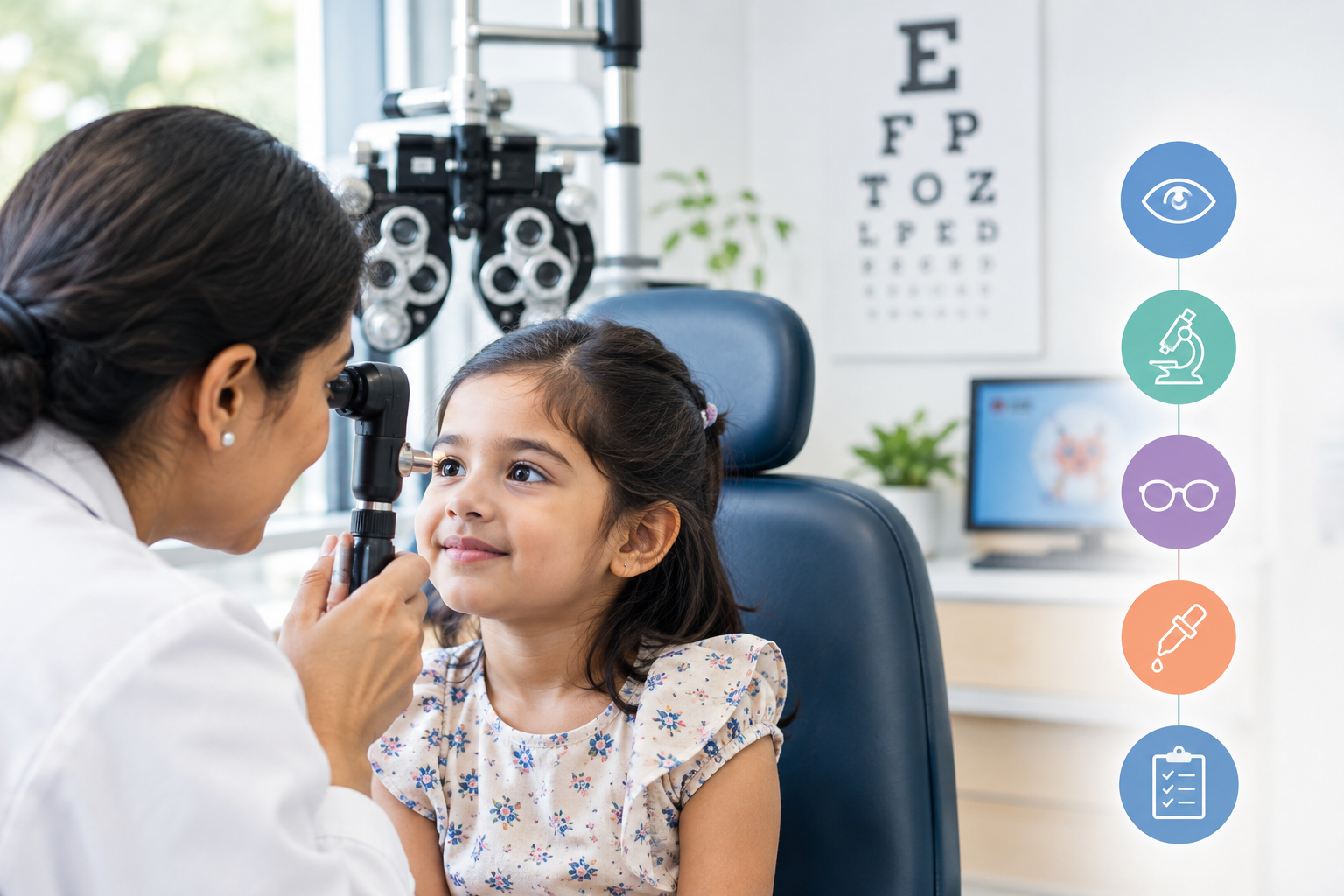
What Actually Happens Inside a Paediatric Eye Examination: A Step-by-Step Guide for Ghaziabad Parents
When parents at Samyak Eye Care Clinic ask me what a paediatric eye examination involves, the question underneath the question is almost always the same: will it be painful? Will my child cooperate? What are those drops for? And why does it take so much longer than a standard adult check?
These are entirely reasonable things to want to know before you bring a child into a clinical setting. The unfamiliarity of a medical environment is itself a barrier for many families, particularly when the child is young or anxious. Research confirms that at least 45 per cent of children under four years of age experience distress when eye drops are administered in a clinical setting, and the anticipatory anxiety of parents compounds this further.
What reduces this anxiety, consistently and reliably, is knowing what to expect. This guide walks through exactly what happens during a comprehensive paediatric eye examination at Samyak Eye Care Clinic in Ghaziabad, step by step. It is written for parents who are bringing a child for the first time, and for parents who have been coming for years but have never had each step properly explained.
Before the Examination Begins: The History Taking
Every thorough examination starts before any instrument is used. I spend time with the parent understanding the child's history: birth details including gestational age and birth weight, family history of eye conditions (myopia, amblyopia, strabismus, glaucoma), any symptoms the parent or teacher has noticed, academic performance patterns, and any previous eye examinations or treatments.
This history is not administrative routine. It is clinically essential. A child born at 30 weeks gestation has a different risk profile from a full-term child. A family history of retinoblastoma in a parent or sibling means newborn assessment is urgent. A child who has been struggling in class since Year 2 needs a different examination focus than one whose difficulty began recently. The history shapes every subsequent clinical decision.
For parents bringing a child for the first time, I always ask one question that surprises many of them: what made you decide to come today? The answer often reveals the most clinically relevant information of the entire appointment.
Step 1: Visual Acuity Assessment
The first objective measurement is visual acuity, how clearly the child can see at specific distances. The method depends entirely on the child's age and developmental stage.
Infants under 12 months: We use preferential looking techniques, observing whether the infant follows patterns and fixates on targets. No verbal response or cooperation is required.
Toddlers aged 1 to 3: Picture matching cards and Cardiff cards allow assessment without the child needing to name anything. The child simply points to or looks at what they can see.
Children aged 3 to 5: Kay Pictures or Lea symbols allow accurate acuity measurement without requiring letter recognition.
Children aged 5 and above: Standard Snellen letter chart or logMAR charts, read from a distance of 3 to 6 metres depending on the setup.
Both eyes are tested separately. This is important because a child with amblyopia in one eye often has normal vision in the other and will pass a binocular test without the problem being detected. Each eye is tested independently, with the other eye gently covered.
Step 2: Eye Alignment and Binocular Vision Assessment
This step assesses whether both eyes point in the same direction and work together as a team. It uses a cover test, one of the most important tools in paediatric eye care and one that requires no equipment at all, just an attentive examiner and a child who briefly follows a target.
The cover test detects strabismus (eye turning) even when it is subtle or intermittent. An eye that turns only when the child is tired, looking at a specific distance, or concentrating on near work can be completely invisible to a parent but clearly revealed by cover testing. I perform this at both near and distance fixation targets.
If the cover test raises a concern, further tests including the prism cover test and binocular vision assessment are performed to quantify the degree of deviation and assess how the visual system is managing it.
Step 3: Eye Movement Assessment
Smooth pursuit and saccadic eye movements are assessed by having the child follow a target in different directions of gaze. Deficiencies in tracking, the ability to follow a moving object smoothly across the visual field, are directly relevant to reading fluency and can underlie complaints of losing place when reading, skipping lines, or difficulty following a ball in sport.
For children undergoing vision therapy at our Eye Gym, baseline eye movement data is recorded at this stage and forms part of the monitoring protocol throughout treatment.
Step 4: Refraction, and Why the Drops Cannot Always Be Skipped
This is the step that generates the most parental questions, and the most anxiety. Let me address it directly.
Refraction is the process of measuring the eye's prescription. In adults, this is done by asking the patient to compare lenses: is it clearer with number one or number two? Children cannot reliably do this, particularly young children, because their ciliary muscle, the focusing muscle inside the eye, is extraordinarily powerful. A child can unconsciously use this focusing muscle to compensate for a significant refractive error during the test, giving a falsely normal reading.
Cycloplegic drops temporarily relax this ciliary muscle. They also dilate the pupil, allowing a clearer view of the inside of the eye. With the ciliary muscle relaxed, the true refractive error is revealed, not the compensated version the child's focusing system was masking.
The drops sting briefly on application. This is the part children find most uncomfortable. At Samyak Eye Care Clinic, I explain to parents before administration exactly what will happen, how long the stinging lasts (typically 30 to 60 seconds), and what the child will feel afterwards (slightly blurred near vision and sensitivity to bright light, lasting 4 to 6 hours for cyclopentolate, or up to 24 hours for atropine in some cases).
A topical anaesthetic drop given before the cycloplegic drop significantly reduces the stinging. I use this approach routinely for young children to make the process more comfortable.
Once the drops have taken effect (approximately 30 to 45 minutes), retinoscopy is performed. I use a handheld instrument called a retinoscope to measure the refraction objectively, without requiring any response from the child. A sleeping or inattentive infant can be refracted accurately with this technique. Autorefraction may also be used as a cross-check.
Step 5: Anterior Segment Examination
Using a slit lamp (a microscope with a bright light source), I examine the external eye and the structures at the front of the eye: the eyelids, cornea, iris, and lens. This checks for abnormalities including corneal irregularities relevant to conditions like keratoconus, lens opacities indicating cataract, and inflammatory signs.
For young children who cannot cooperate with a slit lamp, a handheld slit lamp or the direct ophthalmoscope is used. The examination is adapted entirely to what the child can manage, not to what is most convenient for the examiner.
Step 6: Dilated Fundus Examination
With the pupil now dilated from the cycloplegic drops, I examine the back of the eye: the retina, optic disc, macula, and peripheral retinal areas. This is done using an indirect ophthalmoscope or a fundus camera.
This step is essential for detecting early signs of retinal pathology in children with high myopia, optic nerve abnormalities in children with suspected glaucoma, structural abnormalities in children with unexplained poor vision, and in high-risk infants, conditions including retinopathy of prematurity and retinoblastoma.
Parents sometimes ask whether the fundus examination is necessary if the child seems well. The honest answer: the findings I am most relieved to make during this step are the ones that had no symptoms until I looked.
After the Examination: What Happens Next
At the end of the examination, I sit with the parent (and the child, if old enough) and explain the findings directly and clearly. If a prescription is indicated, I explain the reason for it and what it will achieve. If myopia control management is appropriate, I explain the options and evidence. If vision therapy is recommended, I explain what the condition is, why therapy addresses it, and what the programme involves.
Parents leave with a written summary of findings and, where relevant, a written prescription. Follow-up appointments are scheduled based on the clinical findings, not on a generic annual schedule. A child with rapidly progressing myopia needs a different follow-up interval than a child with a stable, mild prescription.
How Long Does the Examination Take?
A first comprehensive paediatric eye examination typically takes 60 to 90 minutes at Samyak Eye Care Clinic. This includes the history, all assessment steps, the waiting period after cycloplegic drops, and the post-examination discussion.
Parents who arrive expecting a 15-minute appointment are sometimes surprised. The length is not inefficiency. It is what a thorough examination of a young visual system actually requires. Shortcuts at this stage have clinical consequences that become apparent later.
I recommend bringing snacks, a small toy, or a familiar comfort object for young children. Waiting 30 minutes after drops is easier with a happy child than an anxious, bored one.
Frequently Asked Questions
Q: What happens during a child's eye examination?
A: A comprehensive paediatric eye examination includes history taking, visual acuity assessment, cover testing for eye alignment, eye movement evaluation, cycloplegic refraction with drops to reveal the true prescription, slit lamp examination of the front of the eye, and dilated fundus examination of the retina and optic nerve. The process takes 60 to 90 minutes.
Q: Why does my child need eye drops during the examination?
A: Cycloplegic drops temporarily relax the eye's powerful focusing muscle, which children use unconsciously to compensate for refractive errors. Without the drops, a significant prescription can be missed entirely. They also dilate the pupil to allow examination of the back of the eye. They are clinically non-negotiable for accurate refraction in children.
Q: Will the eye examination hurt my child?
A: The cycloplegic drops sting briefly on application, typically 30 to 60 seconds. A topical anaesthetic drop before them significantly reduces this. No other part of the examination is painful. The child may experience blurred near vision and light sensitivity for several hours after the examination due to the dilating drops.
Q: How long does a paediatric eye examination take?
A: A first comprehensive examination takes 60 to 90 minutes, including the history, all assessment steps, the 30-minute wait after cycloplegic drops, and the discussion of findings. Bring snacks and a small toy for young children to manage the waiting period comfortably.
Q: Where can I get a comprehensive paediatric eye examination in Ghaziabad?
A: Samyak Eye Care Clinic in Vaishali, Ghaziabad offers thorough paediatric eye examinations for children from infancy through adolescence. Visit our clinic to book an appointment.
Knowing What to Expect Changes Everything
The families who have the best examination experience are the ones who arrived knowing what was going to happen. The drops were expected. The wait was planned for. The child was prepared. The parent was not anxious.
If this guide has answered your questions and you are ready to book your child's examination, visit our clinic at Samyak Eye Care, Vaishali, Ghaziabad. We serve families from across Ghaziabad, Indirapuram, Kaushambi, Surya Nagar, and East Delhi. Bring the child, bring this guide if you want, and come prepared for an appointment that is thorough by design.
Book Your Child's Paediatric Eye Examination in Ghaziabad
Dr. Shalini Jain | Samyak Eye Care Clinic | Vaishali, Ghaziabad
Call: 98999 60700


