
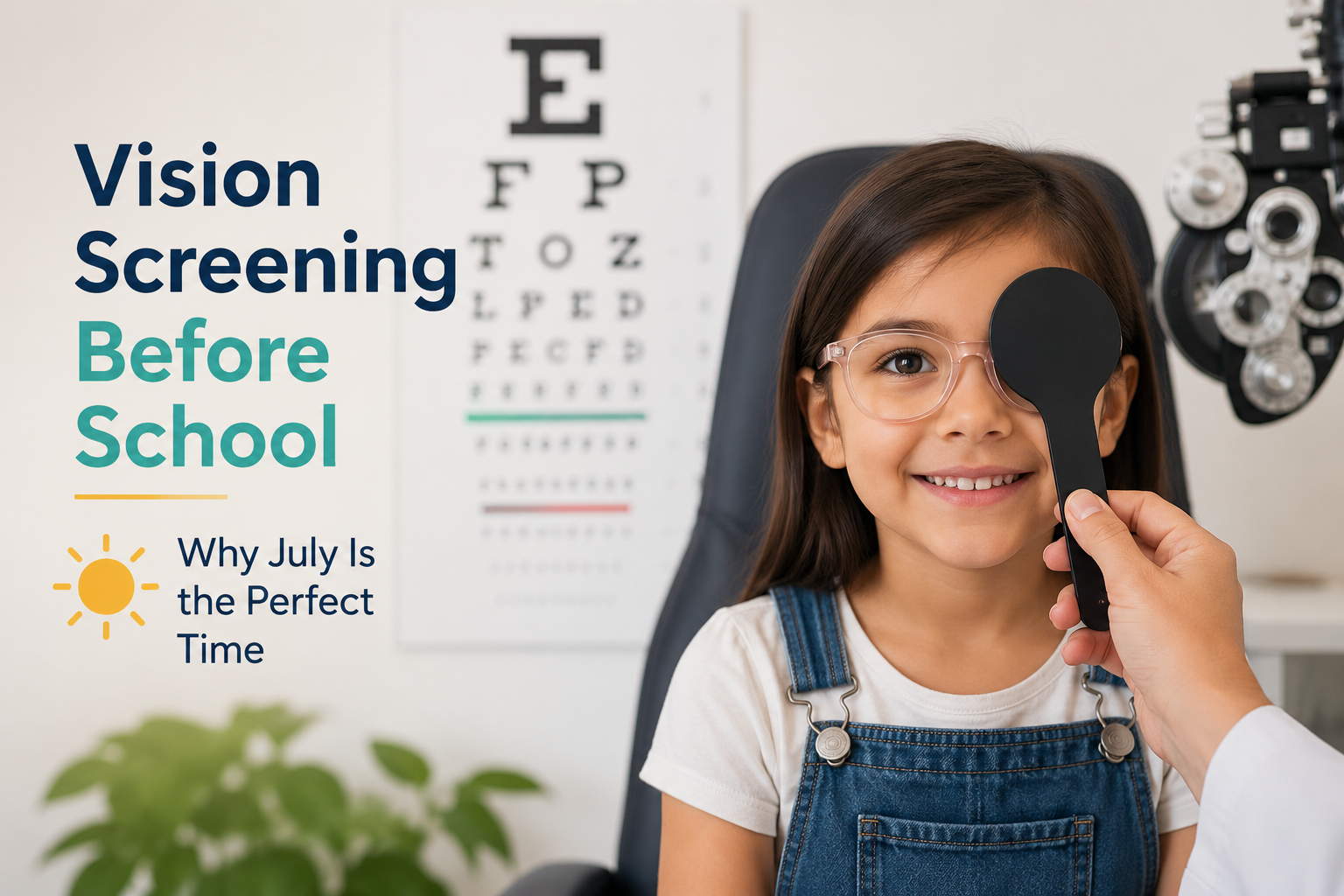
Vision Screening Before School: Why July Is the Perfect Time for Your Child's Eye Test
Every June and July, I see a predictable pattern in my Kaushambi-area practice. Parents bring children who have been "struggling in school" or "not interested in reading" — problems attributed to attention, motivation, or learning difficulties. By August, many of these same children are thriving academically. The difference? Glasses.
The connection between vision and learning is profound yet frequently overlooked. A child who cannot see the blackboard clearly, whose eyes tire quickly while reading, or who experiences headaches during homework will naturally avoid these activities. The behaviour looks like disinterest. The root cause is often a simple refractive error.
As the best child eye specialist near Kaushambi, I encourage every parent to schedule eye examinations before the new academic year begins. Here is why this timing matters and what a proper screening involves.
Why Vision Problems Often Go Undetected
Children do not know what normal vision looks like. A child who has always seen blurry text assumes everyone sees the same way. They develop coping mechanisms — sitting closer to screens, memorising rather than reading, avoiding detailed work. These adaptations mask the underlying problem.
Many vision problems affect only one eye, allowing the other eye to compensate. The child appears to see normally because one eye works well. Meanwhile, the weaker eye fails to develop properly, leading to amblyopia if uncorrected during critical developmental years.
School vision screenings, while valuable, have limitations. They typically test only distance vision and may miss problems with near vision, focusing ability, eye coordination, or eye health. The best eye doctor in Kaushambi sees children annually who passed school screenings yet have significant vision issues affecting their learning.
The Learning-Vision Connection
Consider what school demands visually. Reading requires tracking lines of text smoothly, shifting focus between page and board, sustaining near focus for extended periods, and processing visual information quickly. Writing requires hand-eye coordination and spatial awareness. Mathematics involves recognising symbols and aligning columns accurately.
A child struggling with any of these visual skills expends enormous effort simply to see — leaving less energy for comprehension and engagement. Fatigue sets in quickly. Attention wanders. Performance suffers. The child may be labelled inattentive, slow, or unmotivated when the real issue is uncorrected vision.
Research consistently shows that undetected vision problems correlate with lower academic achievement, reading difficulties, and behavioural issues in classrooms. The best child eye specialist in Kaushambi has seen academic transformations following simple vision correction.
What a Comprehensive Child Eye Examination Includes
A proper paediatric eye examination goes far beyond reading letters on a chart. We assess visual acuity at both distance and near — a child may see the board perfectly but struggle with books. We evaluate how well the eyes work together as a team — poor coordination causes double vision, eye strain, and reading difficulties.
Focusing ability matters enormously for schoolwork. Children should shift focus easily between the desk and the board. When this focusing system is weak, sustained reading becomes exhausting. We test this function specifically.
Eye health assessment checks for conditions that may affect vision development — problems with the cornea, lens, or retina that might not cause obvious symptoms but could worsen without treatment.
The best eye specialist in Kaushambi uses age-appropriate testing techniques. Young children cannot read letter charts, so we use pictures, shapes, and objective measurements that require no verbal response.
Signs That Suggest Your Child Needs an Eye Examination
Certain behaviours warrant prompt evaluation. Sitting very close to the television or holding books unusually close often indicates myopia. Frequent eye rubbing, especially during reading or homework, suggests eye strain. Squinting temporarily improves focus — a child who squints frequently likely needs correction.
Head tilting or turning consistently to one side may indicate one eye working harder than the other. Covering or closing one eye while reading suggests possible double vision. Complaints of headaches after school or during homework deserve investigation.
Academic signs include losing place while reading, skipping lines or words, using a finger to track text, poor reading comprehension despite adequate decoding, reluctance to read or complete written work, and messy handwriting with inconsistent spacing.
Any of these signs merit examination. Even without obvious signs, screening before each academic year catches developing problems early.
When to Start and How Often to Screen
I recommend comprehensive eye examinations at age three, before school entry, and annually thereafter. Children with a family history of eye problems, developmental delays, or known risk factors may need earlier or more frequent evaluation.
Annual examinations matter because children's eyes change rapidly during growth years. Myopia in particular tends to progress during school age. What was adequate correction last year may be insufficient this year. Our myopia control clinic helps manage progressive nearsightedness.
July timing makes sense practically. There is time to obtain glasses and allow adaptation before school begins. If vision therapy is needed, summer provides an opportunity for intensive treatment without competing academic demands.
Making Eye Examinations Positive Experiences
A frightened child cannot be examined effectively. At our clinic, we create welcoming environments specifically for children. We explain procedures in age-appropriate language. We use playful testing methods. We never rush.
Parents can help by framing the visit positively — not as something to fear but as something interesting. Avoid phrases like "it won't hurt", which paradoxically create anxiety. Simply explain that the doctor will check how their eyes work.
If glasses are prescribed, involve children in frame selection. Children who choose their own frames are far more likely to wear them consistently. Many attractive, durable options exist for children today.
Frequently Asked Questions
Q: My child passed the school vision screening. Do they still need an eye examination?
A: School screenings are limited — they typically test only distance vision. They may miss near vision problems, eye coordination issues, and focusing difficulties that significantly affect learning. A comprehensive examination provides much more information.
Q: At what age can children wear contact lenses?
A: There is no specific age requirement. Maturity and hygiene habits matter more than age. Some responsible eight-year-olds manage contacts well; some teenagers cannot. The best eye doctor in Kaushambi evaluates readiness individually.
Q: Will wearing glasses make my child's eyes weaker?
A: No. This is a persistent myth. Glasses correct vision; they do not weaken eyes. Children's prescriptions often change during growth regardless of whether they wear glasses. Not wearing needed glasses causes eye strain without any benefit.
Q: My child's teacher says they seem to see fine. Should I still get an examination?
A: Teachers observe many things, but they cannot assess vision comprehensively. A child may compensate effectively in class while struggling significantly. Only professional examination reveals the full picture.
Q: How long does a child's eye examination take?
A: Approximately 30-45 minutes for a comprehensive examination. If dilation is needed to examine the retina, add another 20-30 minutes for drops to take effect. Plan accordingly and bring activities to occupy your child while waiting.
Q: Where can I get a child's eye examination near Kaushambi?
A: Dr. Shalini Jain at Samyak Eye Care — the best child eye specialist near Kaushambi — provides comprehensive paediatric eye care. Our Vaishali clinic is easily accessible.
Set Your Child Up for Academic Success
The new academic year brings fresh opportunities. Make sure your child can seize them by ensuring their vision is optimised for learning. A simple eye examination could be the difference between struggling and thriving.
Schedule your child's pre-academic year vision screening today. Visit our clinic for expert evaluation and care.
Book Your Child's Vision Screening
Dr. Shalini Jain | Samyak Eye Care Clinic | Vaishali, Ghaziabad
Call: 98999 60700


