
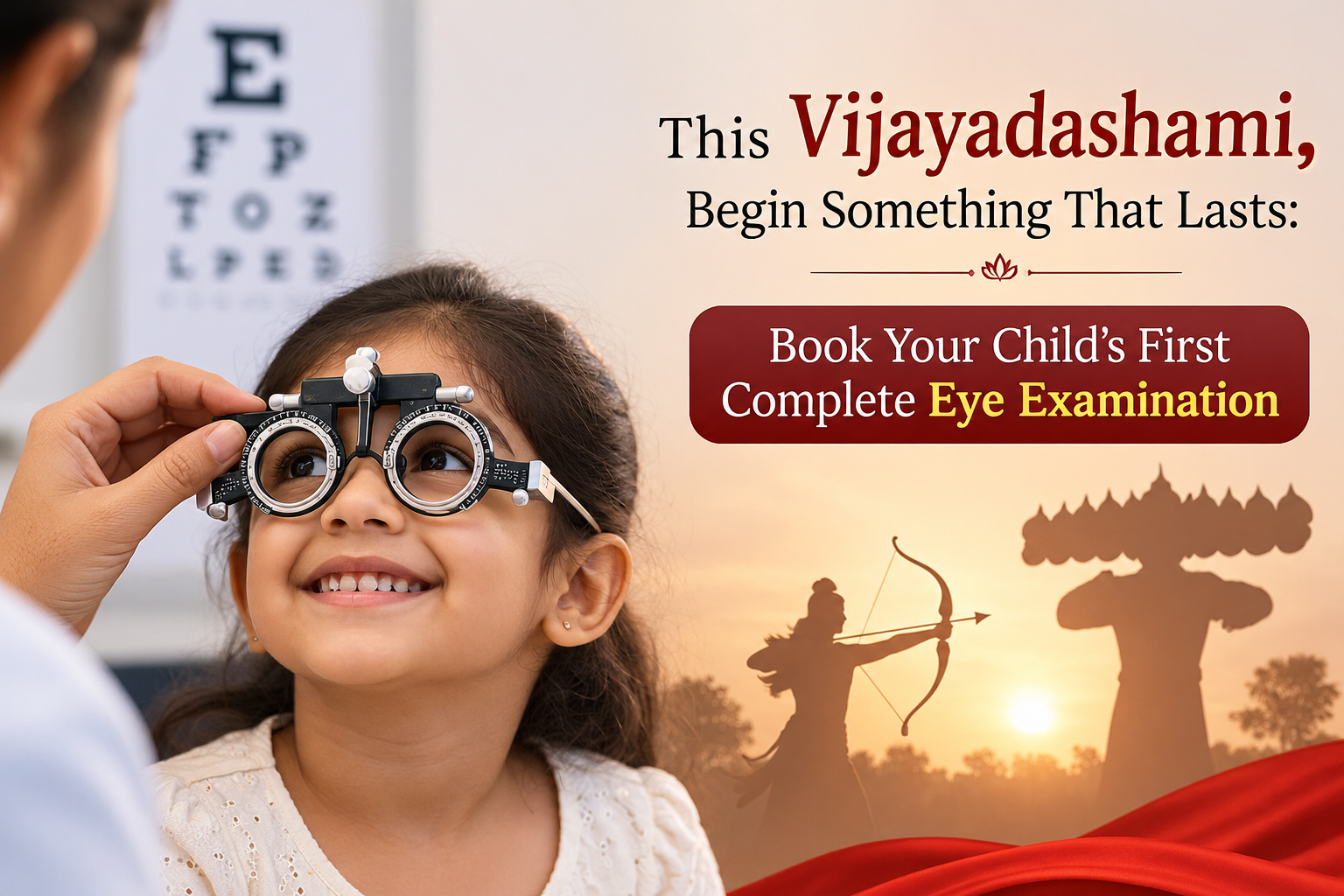
This Vijayadashami, Begin Something That Lasts: Book Your Child's First Complete Eye Examination
Vijayadashami is a festival of new beginnings. The tradition of Vidyarambham, starting new learning on this auspicious day, reflects something deeply understood in Indian culture: that the right beginning at the right time changes the quality of everything that follows. A new skill, a new habit, a new discipline. Begun on Vijayadashami, it carries the weight of intentionality.
I want to suggest one beginning that is easy to make this Dussehra, and that carries more practical consequence for your child's future than almost any other health decision you could make this season: a first complete, comprehensive paediatric eye examination.
Not a school screening. Not a quick chart reading at a general clinic. A thorough paediatric eye examination that assesses how your child's eyes see, how they work together, how they move, how they focus, and whether any condition is silently affecting their development or learning right now. This is the beginning I am recommending to every family in Vaishali, Indirapuram, Kaushambi, Vasundhara, and across Ghaziabad this Vijayadashami.
Why This Is the Right Moment in the Academic Calendar
October sits at a specific point in the Indian school year that makes it clinically meaningful for paediatric eye care. The first academic term is complete. Teachers have had three months to observe your child in a classroom setting. Mid-term examinations have just concluded. This convergence creates a valuable window:
If your child's teacher has mentioned any concern about attention, reading, copying from the board, or academic performance this term, you now have that information and can bring it to the examination.
If mid-term results were below your child's usual standard without an obvious explanation, an undetected vision problem is one of the most common and most consistently overlooked causes.
If your child has not had a comprehensive eye examination this year, three months of the academic year have already passed with whatever visual system your child has, corrected or uncorrected.
Beginning the process now means that if a prescription, a vision therapy programme, or a myopia control intervention is needed, it can be in place before the second and third academic terms begin. The remainder of the year your child will spend in the classroom will be spent with appropriate correction and care.
What School Eye Tests Do Not Check
Most schools in Ghaziabad, Vaishali, and across NCR conduct some form of vision screening, either through the school health programme or through a brief check-up by a visiting optician. These screenings have a defined and limited purpose: they check whether a child can read a Snellen chart from a fixed distance. They do not test:
Near vision and the ability to focus on reading and writing, which is what children do for the majority of their school day
Whether both eyes work together as a coordinated team, a function called binocular vision that is essential for reading comfort and depth perception
How the eyes move across a line of text, how accurately they track, and whether tracking deficiencies are causing the child to lose their place when reading
Whether the focusing system shifts smoothly between near and far, from notebook to blackboard
Early amblyopia, in which one eye has significantly reduced vision that the other eye compensates for, making the child appear to see normally in a binocular test
Significant hyperopia (farsightedness) that the child's own focusing muscles are actively compensating for during the test, masking the true prescription
A child who passes a school vision screening can still have any of these conditions. A child who fails it is correctly flagged for follow-up, but the follow-up they receive from a qualified paediatric eye specialist in Ghaziabad is a fundamentally different examination from the original screening.
The Vision Problems That Look Like Something Else in October
October is when I see a particular pattern at Samyak Eye Care Clinic. Parents arrive, typically after mid-term results, with concerns that have been attributed to other causes: the child is not concentrating, the child is not applying themselves, the child is easily distracted. They have tried extra tuition. They have consulted teachers. Nothing has changed.
The examination reveals an uncorrected refractive error, a convergence insufficiency, or an amblyopia that has been present since early childhood. The academic difficulty was a vision problem in disguise. The child was not inattentive. They were managing an invisible daily struggle that no amount of additional tuition addresses because the problem was in how the eyes were delivering information to the brain, not in how the brain was processing it.
The child who struggles to copy from the blackboard
Copying from the board requires the child to shift focus repeatedly from near to far and back, follow a line of text across the board accurately, and hold the content in working memory long enough to transfer it to the notebook. Uncorrected myopia makes the board unclear. Accommodative dysfunction makes the focus shift uncomfortable and slow. Tracking deficiencies make the horizontal eye movement imprecise. Any of these, individually or in combination, produces a child who is visibly slower at copying and who appears less engaged than classmates.
The child who reads slowly or avoids reading
Convergence insufficiency, a condition in which the eyes struggle to maintain coordinated inward focus for near tasks, makes reading physically tiring in a way that is genuinely difficult for the child to articulate. The words do not blur dramatically. They may move slightly, or occasional doubling may occur when the child is tired. The child experiences reading as effortful and unpleasant and naturally avoids it. Vision therapy addresses convergence insufficiency directly. Extra reading practice does not.
The child who gets afternoon headaches on school days
Headaches that appear consistently in the afternoon of school days and ease over weekends are a classic presentation of visual fatigue from sustained near work. An uncorrected hyperopic prescription means the child's focusing muscles are working continuously throughout the school day to compensate, producing a headache that builds progressively through the afternoon. Giving the child the correct prescription eliminates the headache. No other intervention comes close.
What a First Comprehensive Paediatric Eye Examination Involves
For families in Vaishali, Indirapuram, Kaushambi, and Vasundhara who have not yet brought their child for a comprehensive eye examination, here is a clear overview of what the process involves at Samyak Eye Care Clinic:
A detailed history of the child's development, any symptoms the parent or teacher has noticed, and family history of eye conditions
Visual acuity assessment using age-appropriate methods, including picture charts for young children who cannot yet read letters
Cover testing to assess eye alignment and detect any squint or tendency for the eyes to drift
Eye movement assessment to evaluate tracking, saccadic accuracy, and the ability to shift gaze accurately
Cycloplegic refraction, where drops are used to relax the focusing muscle and reveal the true refractive prescription without the child's compensation masking it
Assessment of binocular vision, including convergence and stereoacuity
Anterior and posterior segment examination of the eye health
The examination takes 60 to 90 minutes, including the waiting period after cycloplegic drops. It is entirely non-invasive and adapted to the child's age and developmental level. Bring a snack and a small distraction for young children.
The Vijayadashami Commitment Worth Making
The tradition of beginning something meaningful on Vijayadashami works because it creates a clear point of decision and action. Not someday. This week. This festival.
If your child has not had a comprehensive eye examination in the past year, or if your child has never had one at all, this Vijayadashami is the right moment to book it. The remainder of the academic year is ahead. The decisions made in October about your child's vision will shape how they experience the school year through to March.
Samyak Eye Care Clinic in Vaishali is easily accessible from across Indirapuram, Kaushambi, Vasundhara, Surya Nagar, and Ghaziabad. We have been providing comprehensive paediatric eye care in Ghaziabad for over 25 years. Visit our clinic and begin something that will serve your child for life.
Frequently Asked Questions
Q: At what age should a child have their first eye examination?
A: The clinical recommendation is the first comprehensive paediatric eye examination at 6 months of age, followed by examinations at 3 years and 5 to 6 years before school entry, then annually throughout the school years. If your child is school-age and has not had a comprehensive examination, this Vijayadashami is the right time to start.
Q: Why is Dussehra a good time to start new health routines?
A: Vijayadashami marks the beginning of a new phase in the Indian festive and academic calendar. The first academic term has just completed, mid-terms have concluded, and parents have current information about their child's academic experience to bring to the examination. Beginning a comprehensive eye care routine this Dussehra means the second and third terms of school will be spent with appropriate visual support in place.
Q: What is checked in a paediatric eye examination?
A: A comprehensive paediatric eye examination checks visual acuity at near and far distances, binocular vision and eye coordination, eye movement and tracking, the refractive prescription using cycloplegic refraction, assessment for amblyopia and strabismus, and a full health examination of the anterior and posterior segments of the eye.
Q: Can a child have a vision problem without complaining?
A: Yes, and this is the most important clinical point. Children have no reference for how vision should feel. A child with significant hyperopia that is causing eye strain, or amblyopia in one eye, or convergence insufficiency making reading uncomfortable, may never report a symptom because they assume their visual experience is the same as everyone else's. The only reliable way to detect these conditions is a comprehensive examination by a qualified specialist.
Begin This Vijayadashami
A new beginning that takes 90 minutes and may change the entire trajectory of your child's school year and visual future. That is the ratio of effort to outcome that makes this particular Vijayadashami commitment worth making.
Visit our clinic at Samyak Eye Care, Vaishali, Ghaziabad. Let this Dussehra be the day you gave your child's eyes the attention they deserve.
Book Your Child's Vijayadashami Eye Examination Today
Dr. Shalini Jain | Samyak Eye Care Clinic | Vaishali, Ghaziabad
Call: 98999 60700


