
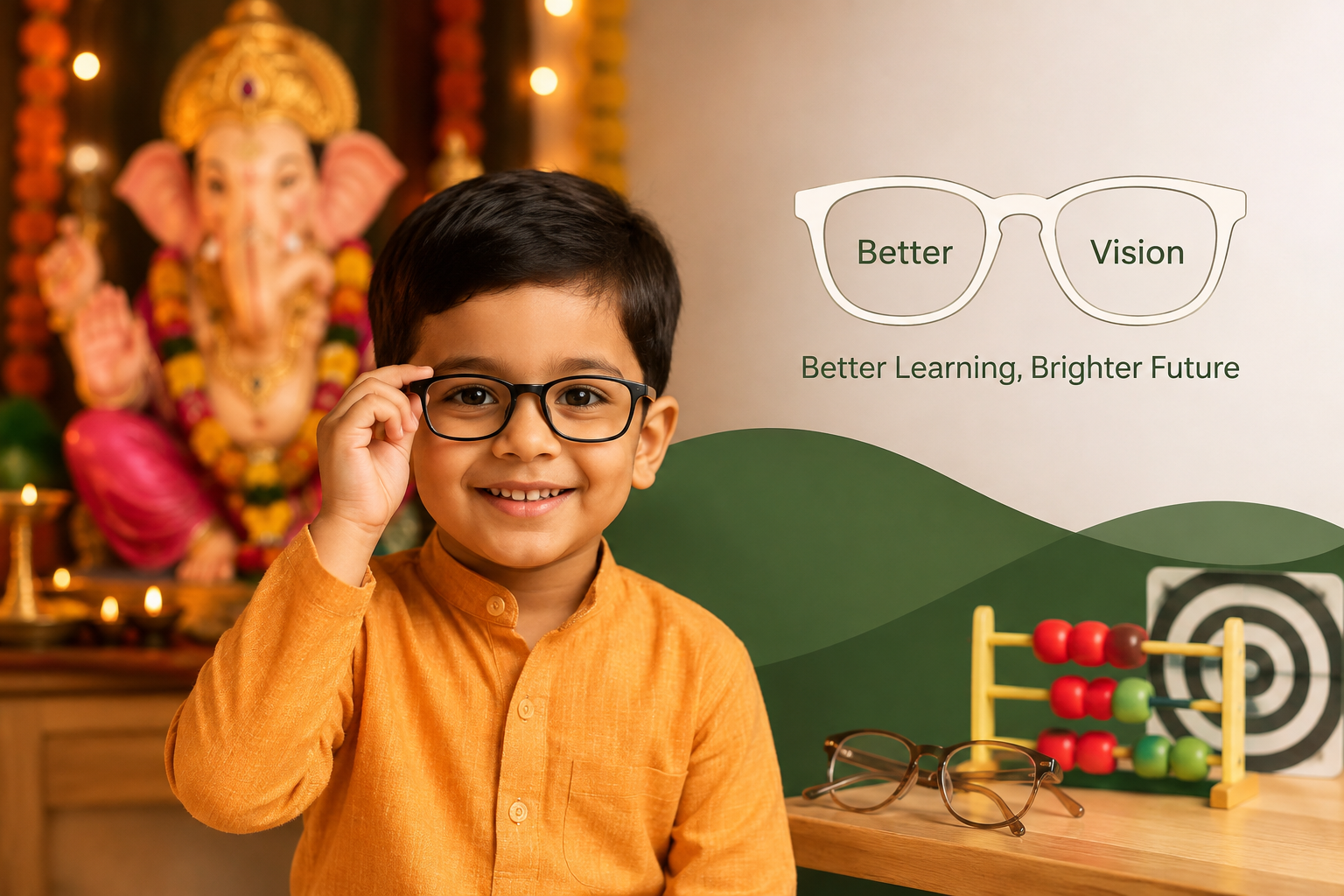
This Ganesh Chaturthi, Remove the "Vighna" from Your Child's Vision with Expert Therapy
Ganesh Chaturthi is the festival of new beginnings — a time to seek the removal of obstacles, or vighna, from every aspect of life. For millions of families across India, Lord Ganesha's blessings mark the start of important journeys. But what if the greatest obstacle your child faces every single day is one you cannot see — a vision problem that quietly disrupts their learning, their confidence, and their potential?
A father from Kaushambi visited Samyak Eye Care Clinic earlier this year with his 8-year-old son. The boy was struggling in school — his teachers described him as inattentive, slow to copy from the board, and prone to losing his place when reading. He had been assessed for learning difficulties and attention problems, but nothing conclusive had emerged. A comprehensive examination revealed something his parents had never suspected: convergence insufficiency, a condition in which the eyes do not work together effectively for near tasks. He had been straining his visual system every single day without anyone realising it. After a course of vision therapy at our Eye Gym, his reading improved significantly and so did his classroom performance.
As the best eye specialist in Vaishali, Ghaziabad, I see children like this regularly — children whose vision problems are mistaken for behavioural or learning difficulties. This Ganesh Chaturthi, let us remove this obstacle for your child.
What Is Vision Therapy and Why Do Children Need It?
Vision therapy is a structured, evidence-based treatment programme designed to improve the functional visual skills that glasses or contact lenses alone cannot address. While glasses correct how clearly the eyes see, vision therapy trains how effectively the eyes work together, track, focus, and process visual information.
Think of it as physiotherapy for the eyes and the visual system. Just as exercises rehabilitate a weak muscle, vision therapy exercises and activities strengthen the neural connections between the eyes and brain that govern visual performance. At Samyak Eye Care Clinic, our Eye Gym uses a combination of AI-based tools and structured home therapy kits to deliver this treatment with measurable, lasting results.
Conditions Vision Therapy Treats in Children
Convergence Insufficiency
This is one of the most common yet underdiagnosed visual conditions in school-age children. When the eyes struggle to turn inward together for near tasks like reading or writing, children experience double vision, headaches, eyestrain, and difficulty concentrating. It is frequently misidentified as ADHD or a reading disorder. Vision therapy is the gold standard treatment and produces excellent outcomes in children.
Amblyopia (Lazy Eye)
In amblyopia, one eye does not develop normal vision because the brain suppresses its input. Lazy eye management using vision therapy — particularly when combined with patching or atropine — is most effective during the early developmental years. Vision therapy helps the brain learn to use both eyes together effectively.
Strabismus (Squint)
Children with misaligned eyes often develop suppression — the brain ignores the input from one eye to avoid double vision. Vision therapy trains the brain to integrate input from both eyes, improving binocular function. In many cases, it reduces or eliminates the need for surgical intervention.
Eye Movement and Tracking Problems
Children who skip lines when reading, lose their place frequently, or have difficulty following moving objects may have tracking deficiencies. These affect reading fluency and classroom performance significantly. Targeted vision therapy exercises retrain eye movement skills efficiently and measurably.
Accommodative Dysfunction
When the eyes struggle to shift focus smoothly between near and distant objects — such as between a notebook and the classroom board — children experience eyestrain, blurred vision, and headaches. Accommodative therapy strengthens the focusing system and makes learning less physically demanding.
How Does Vision Therapy Work at Samyak Eye Care?
At our Vaishali clinic, vision therapy is delivered through a personalised programme developed after a thorough comprehensive eye examination. Every child's visual profile is unique, and the therapy programme reflects that.
Sessions are conducted in-clinic using advanced AI-based vision therapy software and specialised instruments. Between appointments, children follow a structured home therapy programme using the kit provided. Progress is monitored regularly, and the programme is adjusted based on each child's response.
Parents often ask how long therapy takes. Most children see meaningful improvements within 12–24 weeks of consistent therapy, though the exact timeline depends on the condition, its severity, and the child's compliance with the home programme. The best eye doctor in Vaishali, Ghaziabad will discuss a realistic timeline at your child's initial assessment.
Signs Your Child May Need Vision Therapy
Parents across Ghaziabad, Vaishali, Indirapuram, Kaushambi, and Surya Nagar often describe the same pattern: a child who is clearly intelligent but struggling academically for no obvious reason. Watch for these indicators:
Avoids reading or close work and complains of tired eyes after short periods
Loses place frequently when reading or uses a finger to track every line
Covers or closes one eye when reading or watching screens
Complains of words moving, jumping, or blurring on the page
Has difficulty copying from the board despite apparently adequate vision
Experiences headaches or eyestrain after school or homework
Has been assessed for ADHD or learning difficulties without a definitive diagnosis
These signs do not always indicate a vision problem, but they always warrant a comprehensive paediatric eye examination to rule it out. Many children who receive vision therapy show improvements in reading, concentration, and academic confidence that their parents describe as transformative.
Vision Therapy vs. Glasses: Understanding the Difference
A common question from parents is whether glasses are sufficient for their child's visual difficulties. The answer depends on the nature of the problem. Glasses correct how clearly the eyes see — the optical prescription. Vision therapy addresses how the eyes work together, move, focus, and process information — the functional skills that underlie reading, learning, and visual endurance.
Some children need both. A child with myopia and convergence insufficiency will need glasses for clear distance vision and vision therapy to resolve the near-task strain. Others may have perfect prescription clarity but significant functional deficits that only therapy can address. A thorough assessment at Samyak Eye Care Clinic determines precisely what your child needs.
Frequently Asked Questions
Q: What is vision therapy for children?
A: Vision therapy is a structured programme of exercises and activities that train the functional visual skills required for reading, learning, and comfortable daily vision. It addresses conditions such as convergence insufficiency, amblyopia, tracking problems, and accommodative dysfunction that glasses alone cannot correct.
Q: How do I know if my child needs vision therapy?
A: Signs include avoiding reading, losing place while reading, headaches after close work, covering one eye, and academic difficulties despite normal intelligence. A comprehensive paediatric eye examination at Samyak Eye Care Clinic will identify whether vision therapy is appropriate.
Q: What problems can vision therapy treat?
A: Vision therapy is effective for convergence insufficiency, amblyopia (lazy eye), strabismus, eye tracking and movement disorders, accommodative dysfunction, and visual processing difficulties that affect reading and learning.
Q: Can vision therapy improve reading difficulties?
A: Yes, when the reading difficulty has a visual basis — such as tracking problems, convergence insufficiency, or accommodative dysfunction — vision therapy can produce significant improvements in reading fluency, comprehension, and comfort.
Q: Is vision therapy effective for children?
A: Yes. Research strongly supports vision therapy for specific conditions, particularly convergence insufficiency, where it outperforms glasses and home exercises alone. Outcomes depend on accurate diagnosis, an appropriate therapy programme, and consistent participation by the child.
Q: Where can I find paediatric vision therapy in Ghaziabad?
A: Dr. Shalini Jain at Samyak Eye Care Clinic, Vaishali, Ghaziabad offers comprehensive vision therapy through our Eye Gym. Visit our clinic to schedule your child's assessment.
This Ganesh Chaturthi, Start Your Child's Journey to Clearer Vision
That 8-year-old from Kaushambi no longer struggles in school. His teachers have noticed the change. His parents describe it as a transformation. The obstacle was always there — it simply needed to be identified and addressed.
If your child is struggling and you cannot explain why, let this Ganesh Chaturthi be the moment you seek answers. Schedule a comprehensive eye examination at Samyak Eye Care Clinic and discover whether vision therapy is the solution your child has been waiting for. Visit our clinic — we are here to help.
Unlock Your Child's Visual Potential
Dr. Shalini Jain | Samyak Eye Care Clinic | Vaishali, Ghaziabad
Call: 98999 60700


