
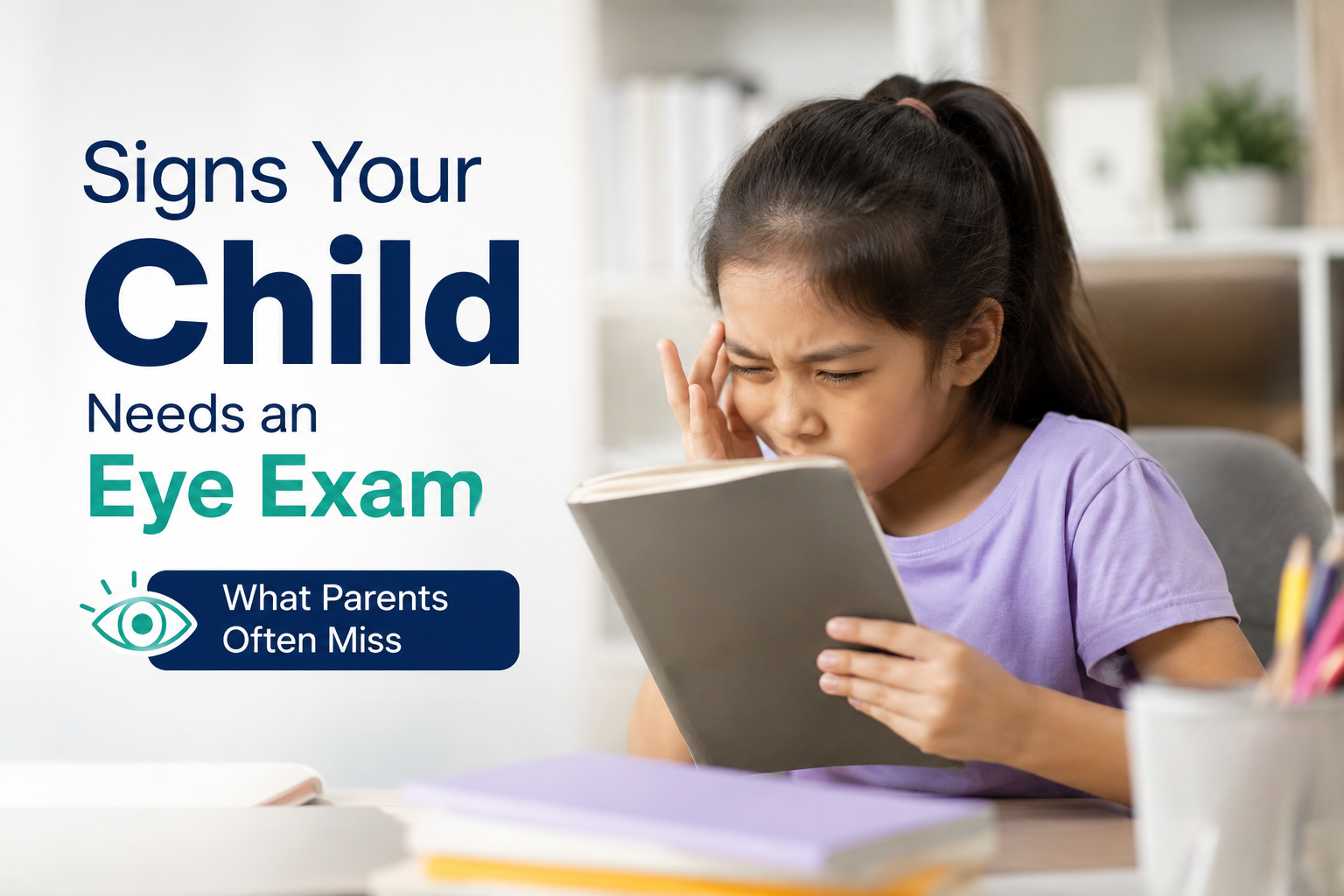
Signs Your Child Needs an Eye Exam: What Parents Often Miss
gling to see clearly. Squinting indicates a refractive error that glasses could correct.
Head Tilting or Turning
A child who consistently tilts or turns their head while looking at objects may have an eye muscle imbalance or a significant difference in vision between their eyes. The unusual head position helps align images or favour the stronger eye. This subtle sign often goes unnoticed until pointed out.
Covering One Eye
If a child covers one eye while reading or watching, they may be suppressing a weaker eye that provides blurry or misaligned images. This behaviour suggests amblyopia (lazy eye) or a significant prescription difference between eyes — conditions that benefit enormously from early treatment.
Frequent Eye Rubbing
While occasional eye rubbing is normal, frequent rubbing — particularly during visual tasks like reading or homework — suggests eye strain. The visual system is working harder than it should, causing fatigue that the child tries to relieve through rubbing.
Academic and Learning Signs
Avoiding Reading
A child who previously enjoyed books but now avoids reading, or who has never shown interest in reading despite normal intelligence, may find the visual effort of reading exhausting or uncomfortable. Vision problems make reading difficult in ways the child cannot articulate.
Losing Place While Reading
Children with tracking problems — difficulty moving eyes smoothly along lines of text — frequently lose their place, skip words or lines, or use a finger to guide their reading. These eye movement difficulties affect reading fluency and comprehension.
Short Attention Span for Visual Tasks
A child who cannot sustain attention during reading, writing, or other visual activities but concentrates well on auditory or physical tasks may be experiencing visual discomfort. What appears to be an attention problem may actually be a vision problem.
Poor Handwriting
Messy handwriting with uneven spacing, letters of inconsistent size, or difficulty staying on lines can indicate visual-motor integration problems. The eyes and hands must coordinate precisely for neat writing — vision problems disrupt this coordination.
Declining Academic Performance
When a capable child's grades slip without obvious cause, vision should be considered. Difficulty seeing the board, eyestrain during reading, or visual processing problems can all undermine academic performance despite adequate intelligence and effort.
Physical Symptoms That Parents Notice
Frequent Headaches
Headaches, particularly after school or during homework, often indicate eye strain. The effort to see clearly through uncorrected refractive errors causes muscle tension and fatigue that manifests as headaches. These typically concentrate around the forehead and temples.
Watery or Red Eyes
Eyes that frequently water or appear red, especially after visual work, suggest strain or irritation. While allergies can cause similar symptoms, persistent redness without other allergic signs deserves visual evaluation.
Sensitivity to Light
Unusual sensitivity to bright light or glare may indicate various eye conditions. A child who consistently avoids bright environments or squints more than peers in sunlight should be evaluated.
Complaints of Tired Eyes
When a child says their eyes feel tired, heavy, or uncomfortable, believe them. Children do not typically complain about their eyes without reason. This symptom suggests the visual system is working harder than it should.
Age-Specific Considerations
Infants and Toddlers (0-3 years)
Watch for eyes that do not align properly, a white pupil in photographs (which should appear red), failure to make eye contact or follow objects, and excessive tearing. Professional examination at age 6 months and 2-3 years catches problems during critical development windows.
Preschoolers (3-5 years)
At this age, amblyopia treatment is most effective. Signs include covering one eye, obvious eye turn (crossing or drifting), sitting very close to screens, and lack of interest in age-appropriate visual activities like colouring or puzzles.
School-Age Children (6-12 years)
Academic demands reveal many vision problems during these years. Myopia commonly develops and progresses. Watch for all the behavioural and academic signs discussed above. Annual comprehensive eye examinations should become routine.
Teenagers (13-18 years)
Myopia often accelerates during growth spurts. Increased screen use adds strain. Teenagers may hide vision problems to avoid wearing glasses. Note if they borrow others' glasses, hold phones very close, or seem to struggle with distance vision.
When to Seek Professional Evaluation
The best eye doctor in Raj Nagar Extension recommends comprehensive eye examinations at age 3, before school entry (age 5-6), and annually during school years — regardless of apparent problems. Many conditions are detected only through professional examination, not through observation of symptoms.
Beyond routine examinations, seek prompt evaluation if you notice any of the signs discussed above, if your child complains about their eyes or vision, if there is a family history of eye conditions, if teachers express concern about your child's vision, or if your child fails a school vision screening.
At our clinic, we use child-friendly testing techniques that accurately assess vision even in children too young to read letter charts. We evaluate not just whether children can see clearly, but whether their visual system functions efficiently for learning.
What Happens If Problems Are Found?
Many childhood vision problems respond well to treatment when caught early. Simple refractive errors require only glasses. Amblyopia (lazy eye) responds to patching therapy, particularly when initiated before age 7-8. Eye coordination and tracking problems often improve dramatically with vision therapy.
For progressive myopia — increasingly common in school-age children — our myopia control clinic offers interventions that slow progression, protecting long-term eye health.
Early detection makes treatment more effective. Delaying evaluation allows problems to progress and, in some cases, become permanent. The investment of time in regular eye examinations pays dividends in your child's visual development and academic success.
Frequently Asked Questions
Q: My child passed the school vision screening. Do they still need an eye exam?
A: School screenings catch only obvious problems. They typically test only distance vision and miss near vision problems, focusing difficulties, eye coordination issues, and conditions like amblyopia. A comprehensive examination provides much more information.
Q: At what age should my child have their first eye exam?
A: The first comprehensive examination should occur around age 3, or earlier if you notice any concerning signs or there is a family history of eye problems. Our paediatric eye care includes examinations for children of all ages.
Q: Will wearing glasses make my child's eyes weaker?
A: No. This persistent myth has no medical basis. Glasses correct vision; they do not weaken eyes. Not wearing needed glasses causes unnecessary strain without any benefit to eye strength or development.
Q: My child does not want to wear glasses. What can I do?
A: Involve your child in frame selection — children who choose their own glasses are more likely to wear them. For children who truly resist glasses, Ortho-K lenses provide clear daytime vision without any eyewear during school hours.
Q: Can vision problems cause behavioural issues?
A: Yes. Children who cannot see comfortably often avoid visual tasks, appearing inattentive or unmotivated. Some behaviours attributed to attention disorders actually stem from visual difficulties. A comprehensive examination can identify or rule out visual contributions to behaviour.
Q: Where can I get my child's eyes examined near Raj Nagar Extension?
A: Dr. Shalini Jain at Samyak Eye Care — the best eye specialist near Raj Nagar Extension — provides comprehensive paediatric eye examinations. Our Vaishali clinic is easily accessible from Raj Nagar Extension.
Do Not Wait for Complaints That May Never Come
That girl from Raj Nagar Extension? With proper glasses, she discovered a visual world she had never known. She could see the board clearly for the first time. She noticed details in nature that had always been blurry. She told her father that she had not realised how much she was missing.
Your child may be adapting to vision problems without complaint, unaware that things could be different. Do not wait for symptoms that children cannot recognise or articulate. Schedule regular eye examinations and pay attention to the subtle signs discussed here. Visit our clinic for a comprehensive evaluation that protects your child's vision and supports their full potential.
Schedule Your Child's Eye Examination
Dr. Shalini Jain | Samyak Eye Care Clinic | Vaishali, Ghaziabad
Call: 98999 60700


