
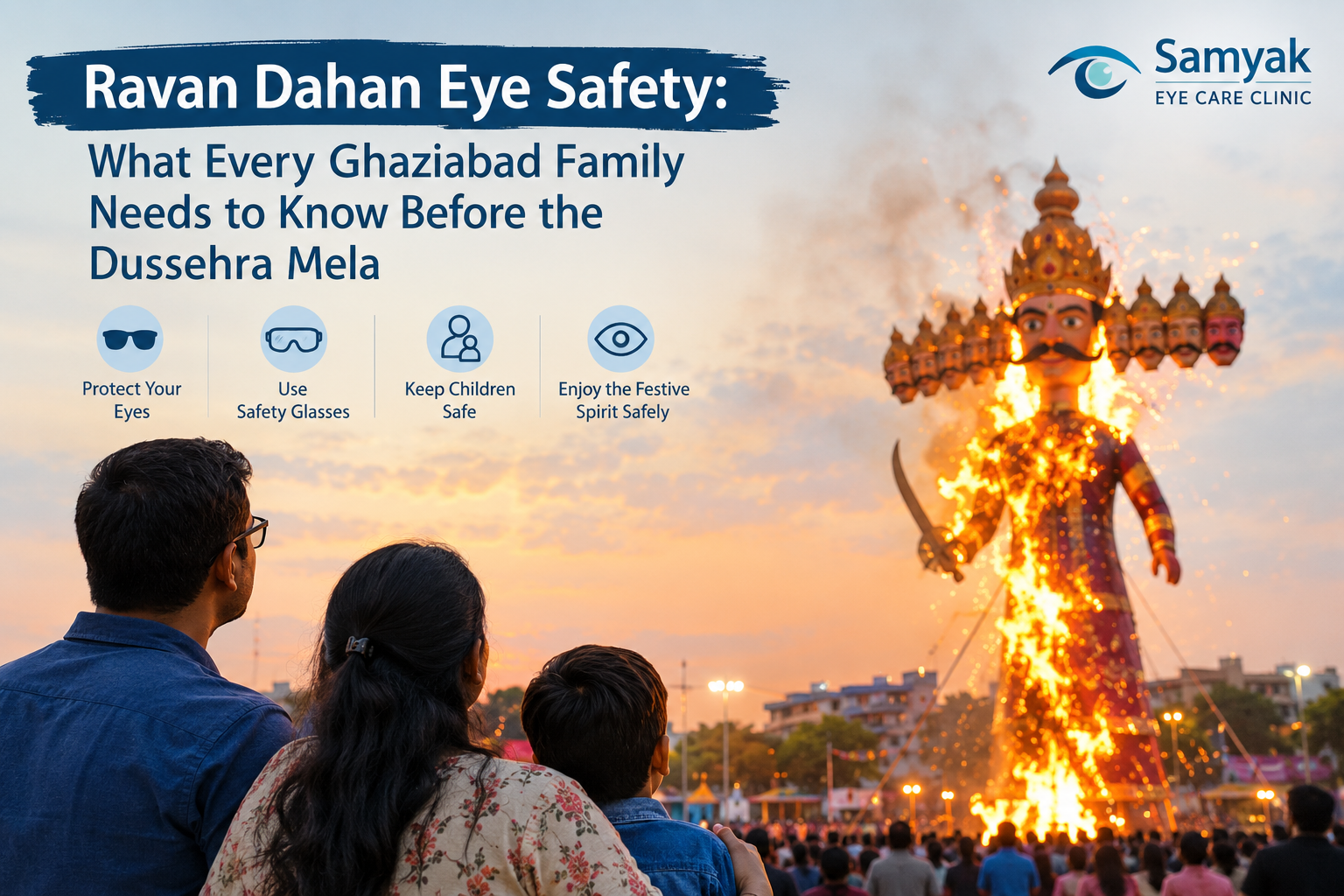
Ravan Dahan Eye Safety: What Every Ghaziabad Family Needs to Know Before the Dussehra Mela
Ravan Dahan is one of the most spectacular public celebrations of the year. The towering effigies, the crowds, the moment the firecrackers ignite, and the structure lights up against the night sky. Across Ghaziabad, Vaishali, Indirapuram, and the wider NCR region, families gather at mela grounds every Dussehra to witness it together.
It is also, clinically speaking, one of the highest-risk eye injury environments of the festive season. Not because Ravan Dahan is inherently more dangerous than other fireworks events, but because of a specific combination of factors: large outdoor crowds, fireworks launched at close range, unpredictable wind that carries sparks and burning debris, and thousands of people with no eye protection standing and watching upward with their eyes fully open.
A 12-year-old girl was brought to Samyak Eye Care Clinic the morning after a Dussehra mela two years ago. She had been standing with her family watching the Ravan effigy burn when a wind gust carried burning debris into the crowd. A spark had entered her left eye. By the time she came to us the next morning, the corneal burn had deepened overnight. It required treatment over several weeks and left a faint but permanent corneal scar. Her family had been standing at what they believed was a completely safe distance. Nobody in the crowd had been handling any fireworks.
As the best eye specialist in Vaishali, Ghaziabad, I want to use this October to give families a specific and practical guide to Ravan Dahan eye safety, one that goes beyond generic reminders and addresses the actual clinical risk profile of this type of event.
Why Ravan Dahan Events Create a Specific Eye Risk Profile
Wind and burning debris travel unpredictably
Unlike a controlled fireworks display where rockets are directed upward and away from the crowd, Ravan Dahan involves large structures burning at ground level with firecrackers embedded throughout. Wind that changes direction during the burn can carry sparks, hot ash, and burning fragments horizontally into a crowd. The person standing 20 metres away, watching the spectacle with eyes wide open and face tilted upward, is not protected by distance alone.
The crowd is looking directly at the fire
Most eye injuries from flying debris occur when the person is not looking in the direction of the debris at the moment of impact, because the natural blink reflex is triggered by objects entering the peripheral visual field. At a Ravan Dahan event, the entire crowd is looking directly at the burning structure. There is no peripheral detection. A spark that travels horizontally from the fire reaches a face and open eyes simultaneously, with no warning.
Children are at greater height risk from ground-level sparks
This is a counterintuitive but clinically significant point. Children standing in an adult crowd are at a height where their eyes are directly in the path of ground-level sparks that travel horizontally from the burning structure. Sparks that pass over adult faces at shoulder height intersect with a child's face at eye level. In the Indian fireworks injury data, children under 18 consistently represent the majority of bystander victims in crowd settings.
No one wears eye protection at a Ravan Dahan mela
Indian clinical studies on Diwali and festival eye injuries consistently report one finding: zero per cent of patients with serious eye injuries were wearing any form of protective eyewear at the time of injury. At Ravan Dahan events, where people are watching rather than participating, the idea of wearing protective glasses does not occur to most families. This is precisely where protective eyewear has the most untapped value.
Practical Eye Safety for Ravan Dahan Events in Ghaziabad
Know the wind direction before you choose where to stand
Before settling into a position at the mela ground, observe the wind direction for a few minutes. Position your family upwind of the effigy, not downwind. Wind carries burning material from the fire toward downwind positions in the crowd. This single decision, choosing upwind position, significantly reduces exposure to airborne sparks and debris.
Maintain genuine distance, not just apparent distance
The Ravan effigies at major Ghaziabad mela grounds can be 20 to 40 feet tall. When they collapse or when large firecracker loads ignite simultaneously, burning material can scatter significantly further than the casual viewer expects. For families with young children, a viewing distance of at least 50 to 100 metres from the effigy is a clinically defensible recommendation. This may mean a less spectacular view. It also means significantly reduced exposure to debris.
Protective eyewear for children in the front rows
If your child wants to be close enough to truly experience the event, invest in a pair of wraparound safety glasses or protective goggles before Dussehra. Polycarbonate lenses provide excellent impact and heat resistance. They are widely available at hardware and sports stores in Vaishali, Indirapuram, and Ghaziabad for under 100 rupees. Worn during the burn, they provide meaningful protection against the specific risk of horizontal spark travel.
Avoid crowding near the perimeter barrier
At organised Ravan Dahan events, local authorities typically establish a perimeter barrier. The space immediately behind this barrier is typically where the densest crowd gathers, with the best view. It is also the position closest to the effigy and most directly exposed to debris from the initial firecracker ignition phase, when sparks travel furthest and most unpredictably. Standing one or two rows back from the barrier perimeter significantly reduces exposure without meaningfully reducing the experience of the event.
First Aid for a Spark or Debris in the Eye at a Mela
If your child or a family member gets a spark or debris in their eye during Ravan Dahan celebrations, the correct immediate response matters significantly. Do not wait until you get home. Every minute without appropriate first aid allows a corneal burn to deepen.
Do not rub the eye under any circumstances. Rubbing drives particles deeper and spreads chemical injury.
Irrigate immediately with any clean water available. A water bottle, a hand-washing station, or any clean water source. Irrigate continuously for a minimum of 10 to 15 minutes.
If the eye is visibly injured, swollen, or the person cannot open it, cover it gently with a clean cloth and proceed directly to an emergency eye facility. Do not wait until the next morning.
If vision seems affected in any way, even mildly, treat it as an emergency. Firework injuries that initially seem minor frequently worsen within hours.
Samyak Eye Care Clinic in Vaishali is accessible from across Ghaziabad, Indirapuram, Kaushambi, and Surya Nagar. If you need emergency assessment after a Ravan Dahan or Diwali eye injury, contact us immediately on 98999 60700 or visit our clinic directly.
The Day After: Symptoms That Need Immediate Assessment
Some firework-related eye injuries do not produce immediately obvious symptoms. The following morning after Dussehra celebrations, check carefully for:
Any redness that was not present the previous day
Sensitivity to light that was not present before the event
A gritty or scratchy sensation, as if something is still inside the eye
Any change in vision, including mild blurring or haziness
A small dark spot or floater that was not present before
Any of these symptoms appearing the day after a Ravan Dahan or Diwali event should be assessed at a qualified eye clinic in Ghaziabad without waiting. Corneal injuries, intraocular foreign bodies, and early retinal changes can all present with mild initial symptoms that worsen significantly if untreated.
Ravan Dahan for Children: A Specific Note for Parents
Children are genuinely more vulnerable at Ravan Dahan events than adults, for several reasons beyond just their smaller size. Their blink reflex is less trained than an adult's. Their attention during exciting events is directed entirely at the spectacle, making them less likely to notice and respond to early warning signs of debris. And as noted above, the height at which horizontal sparks travel from a ground-level fire corresponds directly with a child's eye level in an adult crowd.
If you are bringing young children to a Ravan Dahan mela this Dussehra, the three most protective decisions you can make are: choose an upwind position, maintain genuine distance, and consider protective eyewear for children under 10. None of these prevents the enjoyment of the celebration. All of them meaningfully reduce the clinical risk.
Frequently Asked Questions
Q: How do firecrackers cause eye injuries during Dussehra?
A: Firecrackers in Ravan Dahan effigies launch sparks, hot fragments, chemical compounds, and burning debris in unpredictable directions, particularly when wind changes during the burn. Most victims are bystanders who were watching rather than handling fireworks. Injuries range from corneal burns and abrasions to intraocular foreign bodies and, in severe cases, open globe injuries requiring surgery.
Q: What should I do immediately if a spark enters my eye?
A: Irrigate immediately with clean water for a minimum of 10 to 15 minutes. Do not rub the eye. Cover gently with a clean cloth and proceed to an emergency eye clinic without delay. If vision is affected or the eye cannot be opened, treat it as an emergency requiring immediate care at a specialist eye clinic in Ghaziabad.
Q: How far should you stand from a Ravan effigy burning?
A: Clinical studies on firework bystander injuries do not establish a universally safe distance, because wind and debris scatter unpredictably. For families with young children, a minimum of 50 to 100 metres from the effigy is a reasonable precaution. Upwind positioning is as important as distance. The crowd barrier perimeter is typically the closest safe civilian position, and even one or two rows back from it reduces exposure significantly.
Q: Are protective glasses necessary at a Dussehra mela?
A: For children who will be in the front rows or at close viewing distance, wraparound safety glasses or polycarbonate goggles provide meaningful protection against the specific risk of horizontal spark travel in a crowd setting. In the Indian festival eye injury data, no victim was wearing any form of eye protection. Making protective eyewear normal for children at such events is a sensible precaution.
Dussehra Is a Celebration Worth Protecting
That 12-year-old from Ghaziabad healed well, with no loss of functional vision. Her scar is minor. But she also arrived the morning after, not immediately, and the delay deepened the injury that the immediate first aid could not fully reverse. Her parents now bring the whole family for annual comprehensive eye examinations, and they now carry a water bottle specifically for eye irrigation to every festival event. Two changes. Both simple. Both sensible.
Celebrate Dussehra fully. Watch Ravan burn. But take the upwind position, keep real distance if you have young children, and carry the means to irrigate an eye if the need arises. And if any eye injury does occur, visit our clinic at Samyak Eye Care, Vaishali, Ghaziabad, without waiting for the next day.
Eye Injury During Dussehra Celebrations? Contact Us Immediately
Dr. Shalini Jain | Samyak Eye Care Clinic | Vaishali, Ghaziabad
Call: 98999 60700


