
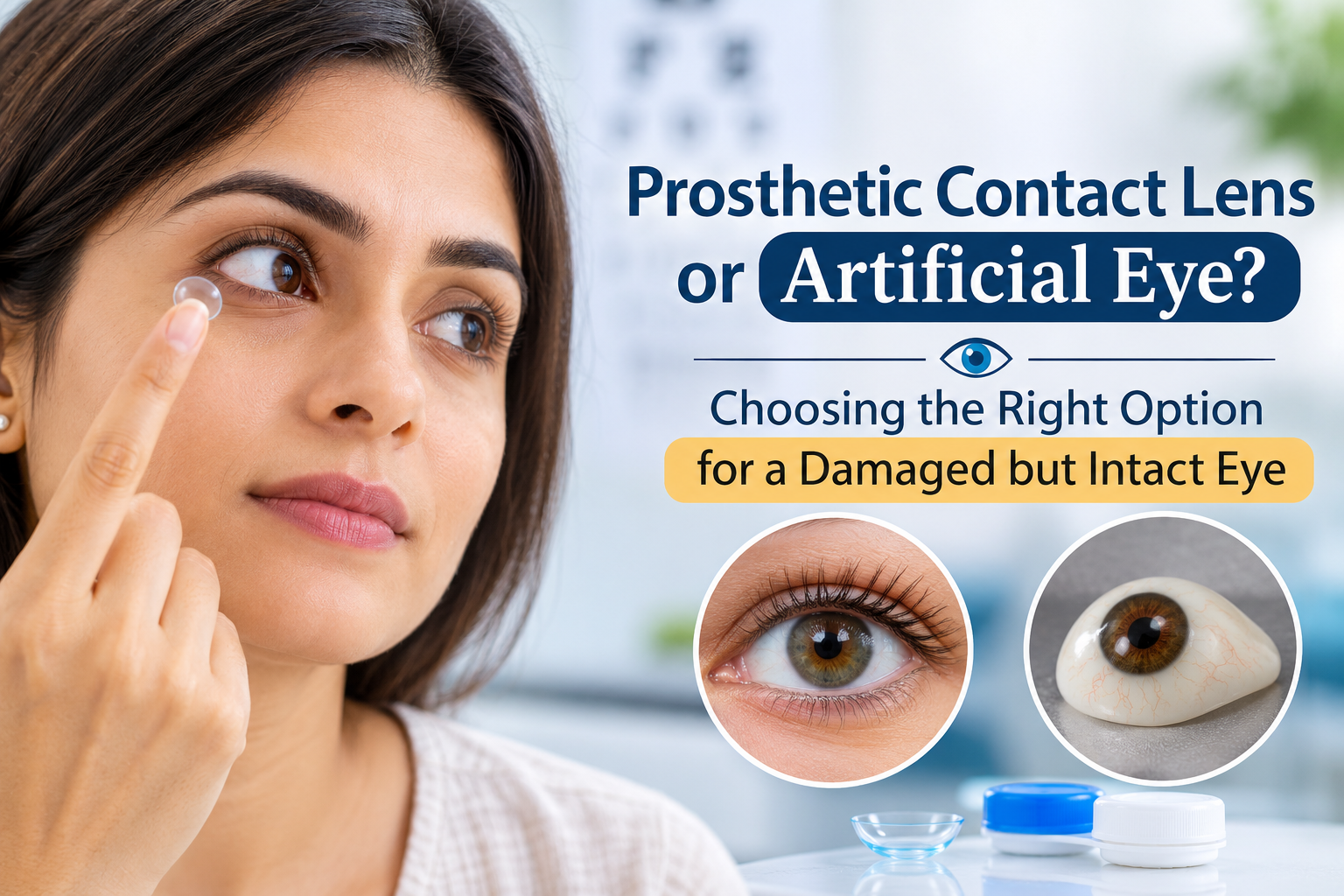
Prosthetic Contact Lens or Artificial Eye? Choosing the Right Option for a Damaged but Intact Eye
When a patient comes to Samyak Eye Care Clinic with an eye that has been damaged by trauma, infection, or disease, there is an assumption that often arrives with them: that a disfigured eye means an artificial eye. This assumption is understandable but frequently incorrect. For a significant proportion of patients with a disfigured, scarred, or cosmetically abnormal eye, the eye itself is still physically present, the globe is intact, and what is needed is not an artificial eye at all. It is a prosthetic contact lens.
A 32-year-old woman from Vaishali came to our clinic two years after a severe acid-related eye injury. Her right eye had been treated successfully; vision had been preserved to a functional level. But the cornea had extensive white scarring that was highly visible and had significantly altered the appearance of her eye. She had been told at one facility that she needed an artificial eye. She was devastated at the prospect of losing the eye that still gave her some functional vision.
The correct recommendation was a custom prosthetic contact lens. Her eye remained in place. The lens, hand-painted to match her left eye, sat over the scarred corneal surface and restored a cosmetically matched appearance without any surgical intervention. She wore it daily. Her functional vision was unaffected. At normal conversational distance, the scar was invisible.
As the prosthetic contact lens specialist at Samyak Eye Care Clinic, Vaishali, I want to explain clearly what prosthetic contact lenses are, when they are the appropriate choice over an artificial eye, and when an artificial eye is genuinely necessary.
The Fundamental Distinction: Intact Globe vs. Absent Eye
The single most important clinical factor in determining whether a prosthetic contact lens or an artificial eye is appropriate is whether the eye itself is still physically present.
An artificial eye (ocular prosthesis) is used when the eye has been surgically removed through enucleation (removal of the entire eyeball) or evisceration (removal of the eye contents, with the scleral shell retained). In these cases, there is no eye to place a contact lens over. The artificial eye occupies the empty socket and provides cosmetic restoration without any vision.
A prosthetic contact lens is used when the eye is still physically present but is disfigured, scarred, discoloured, or cosmetically abnormal in a way that the patient wishes to address. The lens sits over the natural eye surface, concealing the underlying abnormality and matching the appearance of the fellow eye. In many cases, where the eye retains some functional vision, the prosthetic lens can be fitted with an optical correction that simultaneously improves vision and addresses the cosmetic concern.
The clinical rule is straightforward: if the globe is intact, a prosthetic contact lens is the first option to evaluate. Surgical removal of an eye that could be managed with a prosthetic lens is a more invasive and irreversible intervention that should only be taken when there are specific clinical indications, such as a painful blind eye that is causing significant suffering, or an eye that poses an ongoing threat to the fellow eye.
Conditions That Prosthetic Contact Lenses Address
Corneal scarring from trauma or infection
Corneal scars from acid or alkali injuries, severe infections, healed corneal ulcers, or penetrating trauma are among the most common indications for prosthetic contact lenses. The scar tissue is white, opaque, and visually prominent. A custom-painted prosthetic lens replicates the appearance of the normal iris and sclera over the scar, making it virtually invisible at conversational distance. In cases where the scar does not affect the central optical zone of the cornea, some functional vision is preserved through the lens.
Aniridia: absence of the iris
Aniridia is the congenital absence or severe underdevelopment of the iris, the coloured ring that surrounds the pupil. Without the iris, there is no colour, no regulation of light entry, and significant photophobia (sensitivity to light). Prosthetic contact lenses with an opaque iris painted on a translucent or tinted lens restore the appearance of a normal iris while providing an aperture that reduces light sensitivity. This is one of the most cosmetically and functionally significant applications of prosthetic contact lenses.
Severely disfigured or phthisical eye
A phthisical eye is one that has atrophied, becoming small, soft, and cosmetically very different from the fellow eye. If the globe is still technically present but severely shrunken, a soft prosthetic contact lens may not maintain adequate on-eye stability. In these cases, a scleral shell (a rigid prosthetic device that sits over the shrunken globe without requiring surgical removal) may be the more appropriate option. At Samyak Eye Care Clinic, the assessment determines which approach is clinically suitable for each individual's eye anatomy.
Diplopia from strabismus or deviation
Some patients with a deviated or misaligned eye that is causing double vision and that cannot be fully corrected by surgery or prisms may benefit from a prosthetic contact lens with an opaque pupil that blocks input from the deviated eye. This eliminates the diplopia without requiring the patient to close one eye or wear an eye patch, and it preserves the cosmetic appearance of having both eyes open.
Photophobia from traumatic mydriasis or iris damage
Traumatic damage to the iris sphincter can result in a fixed, dilated pupil that causes severe sensitivity to light and glare. A prosthetic contact lens with a small, painted pupil over an opaque base significantly reduces the light entering the eye, providing meaningful relief from photophobia without any surgical intervention.
The Fitting Process for Prosthetic Contact Lenses
Fitting a prosthetic contact lens is more complex than fitting a standard contact lens. The primary challenge is matching the lens colour, iris pattern, pupil size, and scleral detail to the fellow eye so precisely that the result is indistinguishable at normal conversational distance.
Assessment of the eye
The affected eye is assessed for globe integrity, corneal surface regularity, and contact lens tolerance. Any active infection, inflammation, or corneal epithelial compromise must be resolved before lens fitting. The base curve and diameter of the lens are determined based on the corneal curvature measurement.
Colour matching and lens design
High-quality photographs of the fellow eye under standardised lighting are taken. These serve as the reference for the iris colour, limbal ring, scleral vascular pattern, and pupil size that must be replicated in the prosthetic lens. Standard lenses are available in a range of iris colours for mild scarring where the underlying iris is not significantly altered. Custom hand-painted lenses are ordered for cases requiring precise iris replication.
Trial fitting and refinement
A trial lens is fitted and evaluated for comfort, stability, and cosmetic match under different lighting conditions. The match that appears perfect in the consulting room may look different under fluorescent office lighting or outdoor sunlight. Multiple trial sessions may be needed to achieve an optimal result across conditions.
At Samyak Eye Care Clinic, the prosthetic contact lens fitting process is conducted with the understanding that each patient's case is unique. The fellow eye is the reference; the goal is a match that allows the patient to move through daily life without the disfigurement being the first thing anyone notices.
Practical Considerations: Daily Life with a Prosthetic Contact Lens
Wearing time
Prosthetic contact lenses are typically worn during waking hours and removed at night. Most patients achieve comfortable wearing times of 10 to 14 hours. The specific wearing schedule is guided by the eye's tolerance for contact lens wear, which varies based on the underlying condition and the health of the ocular surface.
Care and hygiene
Prosthetic contact lenses require the same care discipline as standard contact lenses: thorough hand washing before handling, appropriate cleaning solution use, lens case replacement, and regular professional review. Patients with compromised corneal surfaces may need more frequent lens assessment, as surface changes can affect lens fit over time.
Replacement schedule
Custom prosthetic contact lenses are typically replaced every 12 to 24 months, depending on the lens material, the patient's care habits, and how well the colour match is maintained over time. The iris painting does not degrade quickly in high-quality lenses, but the lens surface accumulates deposits over time that eventually require replacement.
When the eye changes
If the underlying eye condition changes, a new fitting may be required. Corneal scars can change in density and extent over years. The fellow eye's colour may change subtly with age. Regular follow-up appointments allow these changes to be monitored and the lens to be updated as needed.
Frequently Asked Questions
Q: What are prosthetic contact lenses used for?
A: Prosthetic contact lenses are custom-fitted contact lenses used to mask disfigurements of the natural eye that is still physically present. Common uses include corneal scarring from trauma or infection, aniridia (absence of the iris), photophobia from iris damage, and diplopia management. They restore cosmetic appearance and in some cases improve vision and light tolerance.
Q: Can a scarred eye be made to look normal without surgery?
A: In many cases, yes. A custom prosthetic contact lens hand-painted to match the fellow eye can make a corneal scar, iris damage, or other disfigurement virtually invisible at normal conversational distance. No surgical intervention is required. The assessment at our clinic determines whether a prosthetic lens is an appropriate option based on the individual eye's anatomy and the nature of the disfigurement.
Q: How long does a prosthetic contact lens last?
A: Custom prosthetic contact lenses typically last 12 to 24 months before replacement is needed, depending on lens material, care quality, and whether the fellow eye's appearance has changed. The colour matching is reproduced precisely at each replacement, ensuring consistent cosmetic results.
Q: Is a prosthetic contact lens comfortable to wear daily?
A: Most patients achieve comfortable daily wearing times of 10 to 14 hours. Comfort depends on the health of the underlying eye surface and the accuracy of the lens fit. Patients with dry eye or surface compromise may require lubricating drops during wear. Any persistent discomfort warrants review at our prosthetic lens clinic in Vaishali.
You May Not Need the Option You Fear Most
The woman from Vaishali has worn her prosthetic contact lens for two years. She teaches at a local school. She said at her last review that she no longer thinks about her eye when she walks into a classroom. The injury had taken something visible away. The prosthetic lens gave it back.
If you or a family member has a disfigured eye that is still physically present, the first evaluation should be for a prosthetic contact lens, not for eye removal. Visit our clinic at Samyak Eye Care, Vaishali, Ghaziabad, for a proper assessment of what is appropriate for your specific situation.
Book Your Prosthetic Contact Lens Assessment Today
Dr. Shalini Jain | Samyak Eye Care Clinic | Vaishali, Ghaziabad
Call: 98999 60700


