
Paediatric Eye Care: A Parent's Complete Guide to Protecting Your Child's Vision
A six-year-old girl was brought to my Vaishali clinic because her teacher noticed she squinted at the blackboard. Her parents were shocked when I diagnosed amblyopia — lazy eye — that had likely been present since infancy. "But she never complained," her mother said. "She seemed to see everything just fine."
This is the challenge of children's eye problems. Kids adapt. They do not know what normal vision looks like. They compensate unconsciously. By the time problems become obvious, precious treatment windows may have closed.
After two decades as a child eye specialist in Vaishali, Ghaziabad, I have learned that proactive detection beats reactive treatment every time. Here is what parents need to know at every stage of their child's visual development.
Why Children's Eyes Need Special Attention
Children are not small adults — their visual systems work differently. Vision develops actively throughout childhood, with critical periods when the brain learns to interpret signals from the eyes. Disruptions during these periods can cause permanent problems that no glasses or surgery can fix later.
The first seven years are especially crucial. During this period, neural pathways connecting the eyes to the brain strengthen and refine. If one eye sends blurry images — due to uncorrected refractive error, misalignment, or obstruction — the brain may suppress signals from that eye permanently. This is amblyopia, the leading cause of preventable childhood vision loss.
Early detection changes outcomes dramatically. A three-year-old diagnosed with amblyopia has excellent chances of full recovery with treatment. The same child diagnosed at ten may face permanent visual impairment in the affected eye. The best child eye specialist in Vaishali, Ghaziabad, emphasises this point with every parent: timing matters enormously.
Age-by-Age Vision Development: What to Expect
Newborns see blurry shapes and high-contrast patterns. By two months, babies should track moving objects and make eye contact. By six months, depth perception develops, and eyes should work together smoothly. Any persistent crossing, wandering, or inability to track indicates the need for evaluation.
Between ages one and three, visual acuity sharpens rapidly. Children learn to judge distances, recognise faces, and coordinate hand-eye movements. Problems during this period often manifest as clumsiness, difficulty with puzzles, or reluctance to colour or draw.
Pre-school years — ages three to five — offer an excellent window for vision screening. Children can now cooperate with basic eye tests. Problems detected here remain highly treatable. The best eye specialist in Vaishali, Ghaziabad, recommends a comprehensive examination before school entry.
School-age children face new visual demands: reading, writing, board work, computer use. Vision problems that did not matter much before suddenly become significant barriers to learning. Academic struggles sometimes have visual causes that simple glasses can fix.
Warning Signs Every Parent Should Know
Children rarely complain about poor vision directly — they do not know anything is wrong. Instead, watch for behavioural clues. Frequent eye rubbing, especially during visual tasks, suggests fatigue or discomfort. Tilting or turning the head consistently to one side may indicate one eye working harder than the other.
Sitting very close to the television or holding books unusually close indicates possible myopia. Squinting temporarily improves focus by changing light entry — a child who squints frequently may need vision correction.
Covering or closing one eye habitually deserves attention — this may suggest double vision or a significant difference between the eyes. Complaints of headaches, especially after reading or screen time, often have visual origins.
Academic changes warrant investigation, too. A previously good reader who avoids books, a child who loses their place constantly while reading, or deteriorating handwriting may all reflect vision problems rather than learning difficulties or behavioural issues.
Common Childhood Vision Problems We Treat
Refractive errors — myopia (nearsightedness), hyperopia (farsightedness), and astigmatism — are most common. These are usually correctable with glasses. The concern with childhood myopia is progression; it often worsens throughout school years. Our myopia control clinic offers interventions that can slow this progression significantly.
Amblyopia (lazy eye) affects approximately 3% of children. One eye does not develop proper vision despite appearing normal. Treatment involves forcing the brain to use the weaker eye — typically through patching the stronger eye. Success depends critically on age at diagnosis.
Strabismus (squint) involves misaligned eyes — one turning in, out, up, or down. Beyond cosmetic concerns, strabismus can cause amblyopia and loss of depth perception. Treatment may include glasses, vision therapy, or surgery depending on the type and severity.
Convergence insufficiency makes sustained near work difficult — a common cause of reading avoidance and homework headaches. Vision therapy can address this effectively.
What Happens During a Paediatric Eye Examination
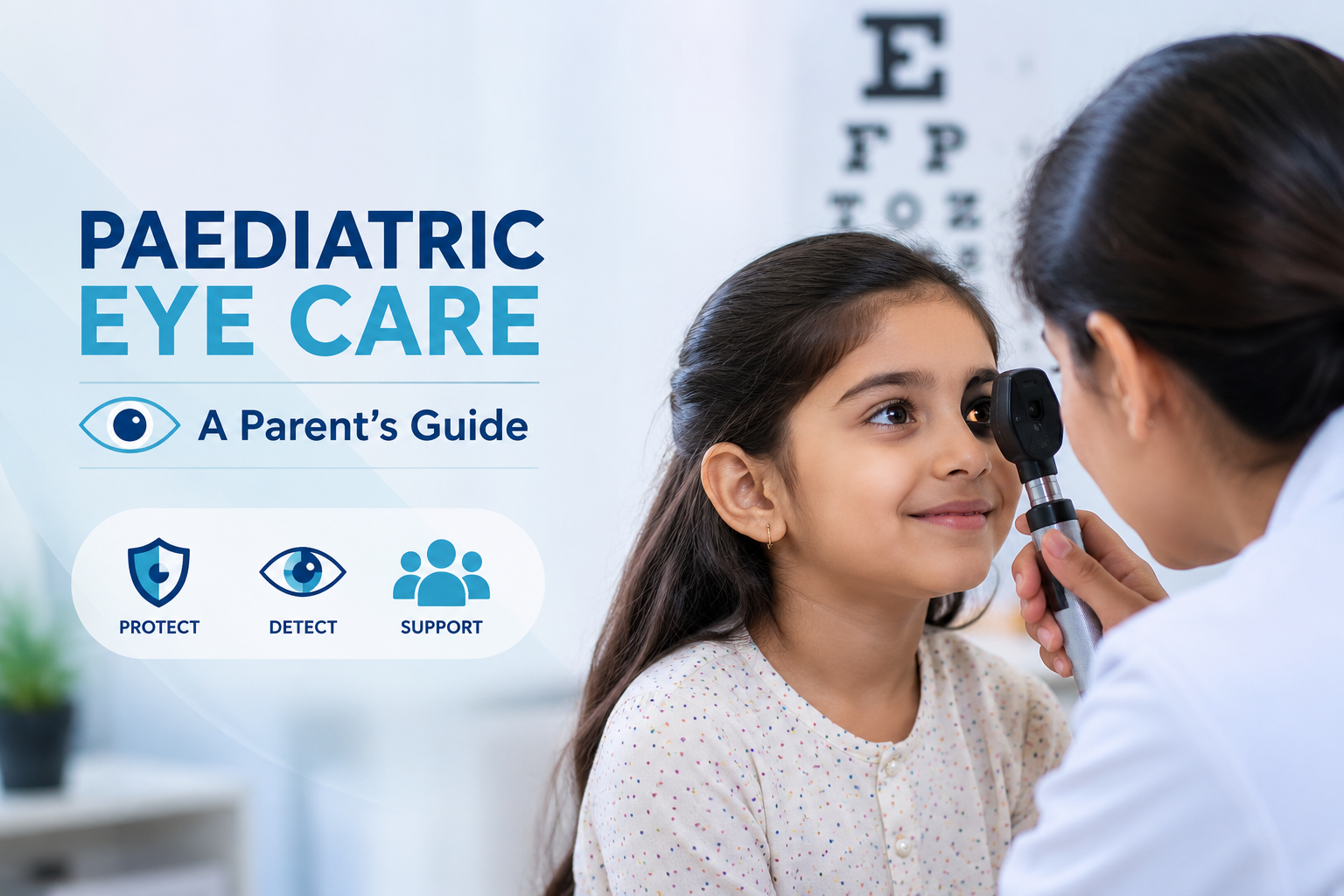
Parents often worry that their young child cannot cooperate with an eye test. In reality, we have specialised techniques for every age group. Infants undergo objective testing — we measure how light focuses in their eyes without requiring any response. Toddlers can match pictures or play simple games that reveal visual function.
A comprehensive paediatric eye examination includes more than just reading letters on a chart. We assess eye alignment, movement, focusing ability, and eye teaming. We check the health of eye structures — sometimes finding conditions parents never suspected. We evaluate how both eyes work together — essential for comfortable reading and sports.
The best child eye specialist in Vaishali, Ghaziabad, makes examinations comfortable and even enjoyable for children. A frightened, crying child cannot be examined properly. Patient, playful approaches yield better results and happier families.
Screen Time and Modern Visual Challenges
Today's children face visual demands unknown to previous generations. Hours of near-work on tablets, smartphones, and computers strain developing visual systems. Research increasingly links heavy screen use with myopia development and progression.
The evidence for outdoor time is compelling. Children who spend more time outside — at least two hours daily — show lower rates of myopia development. Natural light and distance viewing appear protective. Encouraging outdoor play is now a formal recommendation for eye health, not just general wellbeing.
Practical screen guidelines help: the 20-20-20 rule (every 20 minutes, look at something 20 feet away for 20 seconds), maintaining proper viewing distances, ensuring adequate lighting, and limiting total screen time where possible. These habits established early protect eyes throughout life.
Frequently Asked Questions
Q: At what age should my child have their first eye examination?
A: I recommend a comprehensive examination by age three, earlier if you notice any concerns or there is a family history of eye problems. Newborns should be checked before hospital discharge, and infants at their regular paediatric visits.
Q: My child passed the school vision screening. Is that sufficient?
A: School screenings are valuable but limited. They typically test distance vision in each eye — important, but not comprehensive. They may miss problems with near vision, eye teaming, focusing, or eye health. A full examination detects more.
Q: How can I tell if my child is genuinely struggling to see or just seeking attention?
A: Children rarely fake vision problems convincingly. If your child exhibits behaviours suggesting difficulty — squinting, sitting close, avoiding reading — take it seriously. An examination will clarify whether correction is needed.
Q: My child hates wearing glasses. What can I do?
A: Involve children in frame selection — they wear what they like. Ensure proper fit; uncomfortable glasses get removed. Explain clearly why they help. For some children, contact lenses or orthokeratology may be appropriate alternatives.
Q: Is my child's increasing myopia normal?
A: Some progression during growth years is common, but rapid increases warrant attention. Myopia control options can slow progression significantly. Discuss interventions with the best child eye specialist in Vaishali, Ghaziabad, if prescriptions change frequently.
Q: Where can I find a paediatric eye specialist in Vaishali?
A: Dr. Shalini Jain at Samyak Eye Care provides comprehensive paediatric eye care in Vaishali, Ghaziabad. Our clinic offers child-friendly examinations and specialised treatments. Visit our clinic for expert care.
Give Your Child the Gift of Clear Vision
That six-year-old girl with amblyopia? With intensive patching therapy started immediately, her vision improved significantly over the following year. She caught up academically once she could see the blackboard clearly. Her parents now bring their younger child for regular examinations — prevention being far easier than treatment.
Your child's vision shapes how they learn, play, and experience the world. A comprehensive eye examination is a small investment with potentially enormous returns. Book an appointment today.
Schedule Your Child's Eye Examination
Dr. Shalini Jain | Samyak Eye Care Clinic | Vaishali, Ghaziabad
Call: 98999 60700


