
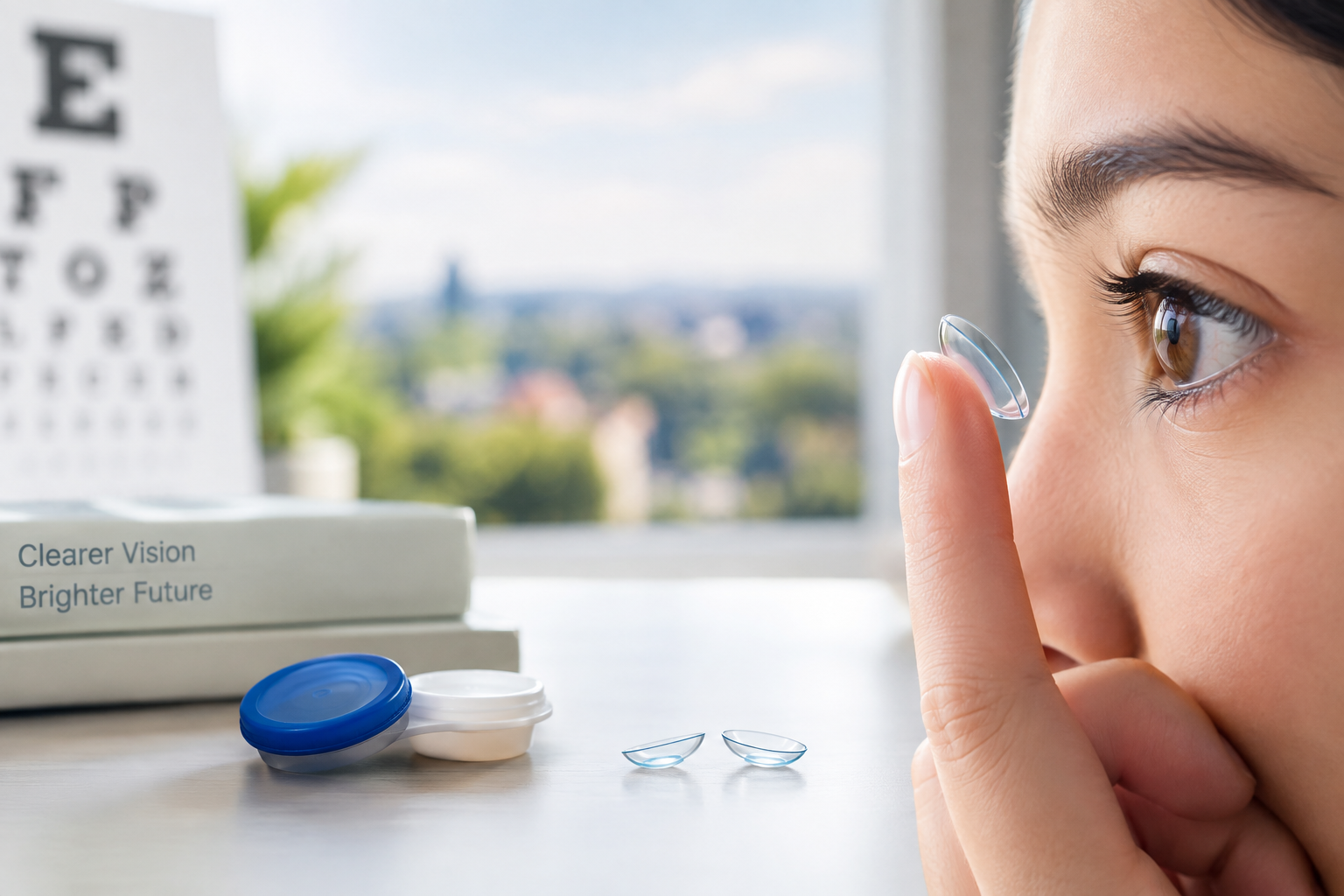
Ortho-K Lenses for High Myopia: When Glasses Are No Longer Enough
There is a conversation I have regularly with parents who arrive at Samyak Eye Care Clinic with a child whose prescription has crossed -4 or -5 dioptres. They have usually been managing with glasses for several years. The lenses are thick. The vision correction works, just about. But the prescription keeps climbing, the lenses keep getting thicker, and the parents are beginning to realise that glasses alone are not a solution. They are simply a way of staying one step behind a worsening condition.
The clinical reality of high myopia is something most Indian parents have not been told clearly. Beyond a certain level of myopia, the risks are no longer just about needing thick glasses. High myopia, defined clinically as a prescription of -6 dioptres or above, is associated with significantly elevated lifetime risks of retinal detachment, myopic maculopathy, glaucoma, and early-onset cataract. These are not rare complications. They are well-documented, progressive risks that scale with the degree of myopia. And critically, the myopia that accumulates during childhood is the myopia that cannot be undone.
This is not a blog about whether Ortho-K lenses are a nice alternative to glasses. This is a blog about what the clinical evidence says regarding Ortho-K lenses for high myopia, where the limits are, what combination approaches exist for children who are not responding to single treatments, and why the children who need this information most are the ones least likely to receive it at a standard optician's appointment.
What Qualifies as High Myopia and Why It Is a Different Clinical Problem
Clinically, myopia is categorised as:
Low myopia: 0 to -3 dioptres
Moderate myopia: -3 to -6 dioptres
High myopia: -6 dioptres and above
Pathological myopia: typically -8 dioptres and above, associated with structural changes to the eye
The concern with high myopia is not primarily the thickness of the lenses. It is the axial elongation of the eyeball that underlies the high prescription. As the eye lengthens beyond its normal dimensions, the retina stretches and thins. The mechanical stress on the retinal tissue, the choroid, and the optic nerve increases progressively. Research published in peer-reviewed ophthalmology literature consistently shows that each additional dioptre of myopia beyond -5D meaningfully increases the risk of sight-threatening complications in adulthood.
For children currently at moderate myopia who are progressing at -0.75D or more per year, high myopia is not a theoretical future risk. It is a predictable destination unless the progression is actively managed.
What the Evidence Says About Ortho-K for High Myopia
A 2024 review published in Ophthalmic and Physiological Optics examined the effectiveness of orthokeratology, atropine, and spectacle lenses specifically in children with high myopia (defined as -6D or above). The findings were important and nuanced, and most parents never encounter them.
Ortho-K was found to effectively slow axial elongation in high myopia over a one-year period, comparable to its performance in moderate myopia. However, the review also noted that Ortho-K for prescriptions of -6D or stronger increased the risk of corneal staining, and that the visual outcome and fitting process are generally more complex and time-intensive than for low to moderate myopia.
The practical implication: Ortho-K lenses can be fitted for higher prescriptions, but the clinical process requires significantly more expertise, more frequent follow-up, and in some cases a partial correction approach combined with daytime spectacles for residual refractive error. This is not something a general optician can manage. It requires a specialist with experience in high myopia Ortho-K fitting, corneal topography-guided customisation, and a structured monitoring protocol.
The Combination Therapy Approach for Children Not Responding to Ortho-K Alone
This is the part of the conversation that most parents in India have not had access to, and it represents a significant gap in widely available information.
For children with high myopia, or for those whose axial elongation continues despite Ortho-K monotherapy, combination treatment with low-dose atropine drops is emerging as the evidence-based next step. Research from 2023 and 2024, including a study published in Scientific Reports examining 101 children over a four-year period, confirmed that adding 0.01 per cent atropine to Ortho-K reduced annual axial elongation by an additional 28 per cent compared to Ortho-K alone. Escalating to 0.025 per cent and 0.05 per cent concentrations produced further reductions of 31 and 39 per cent respectively in children who were not responding adequately to lower doses.
A 2025 review in Contact Lens Spectrum identified the children most likely to benefit from combination therapy:
Children with high myopia at -6D or above
Younger myopes, particularly those under 10 years at onset
Children with a strong family history of high myopia in both parents
Children showing rapid progression of 1D or more per year despite Ortho-K monotherapy
At our myopia control clinic in Ghaziabad, axial length is measured at every follow-up using our IOL Master equipment. If a child's axial elongation rate exceeds the clinical threshold despite Ortho-K, combination therapy is discussed with the family at that point. The decision to escalate is based on objective measurement, not on whether the prescription looks worse on the Snellen chart.
When Ortho-K Is Not the Right Starting Point for High Myopia
Honesty here matters. For children with very high prescriptions, particularly above -6D with significant corneal irregularity or steep corneal curvature, Ortho-K may not achieve full correction. In these cases, daytime soft multifocal contact lenses, DIMS spectacle lenses, or a partial Ortho-K correction with supplementary daytime glasses may be more appropriate as the primary approach.
For children with keratoconus co-existing with myopia, scleral contact lenses may be the better option for clear, stable vision alongside myopia management. Our scleral contact lens service addresses this specific group, who are often poorly served by standard contact lens fitting approaches.
This is precisely why a thorough assessment at a qualified myopia control specialist in Ghaziabad is essential before any treatment is selected. The choice of intervention for a child with high myopia is not a simple menu decision. It requires corneal topography, axial length measurement, assessment of progression rate, and an honest conversation about what each modality can and cannot achieve for that specific prescription.
The Lifetime Risk Calculation Parents Should Understand
This is the clinical framing that changes how parents think about myopia management, and it is rarely presented this plainly.
Every dioptre of myopia a child accumulates during their growing years translates into a measurable increase in adult disease risk. A person with -6D myopia has approximately 22 times the risk of retinal detachment compared to someone with no myopia. The risk of myopic maculopathy, the leading cause of irreversible vision loss in high myopes, increases steeply beyond -6D.
The goal of myopia control treatment is not simply to avoid thick glasses. It is to limit the final adult prescription, and in doing so, reduce the accumulated lifetime risk of conditions that no glasses, contact lenses, or surgery can fully reverse. A child managed effectively from age 8 may reach adulthood at -4D instead of -8D. That is not just a cosmetic or convenience difference. That is a fundamentally different risk profile for the rest of their life.
Frequently Asked Questions
Q: Can Ortho-K lenses correct high myopia above -6 dioptres?
A: Yes, with important caveats. Ortho-K can be fitted for prescriptions above -6D, but full correction may not always be achievable. A partial correction approach combined with low-power daytime spectacles is sometimes used. The fitting process is more complex, requires corneal topography guidance, and demands closer follow-up. Consult a specialist myopia clinic in Ghaziabad for an accurate assessment of suitability.
Q: What is combination therapy for high myopia in children?
A: Combination therapy involves using Ortho-K lenses alongside low-dose atropine eye drops for children whose axial elongation is not adequately controlled with Ortho-K alone. Research published between 2023 and 2025 shows that adding atropine to Ortho-K produces significantly greater slowing of axial elongation than either treatment alone, with the greatest benefit seen in high myopes and rapid progressors.
Q: Why are the risks of high myopia more serious than low myopia?
A: High myopia causes progressive axial elongation of the eyeball, which mechanically stresses the retina, choroid, and optic nerve. This is associated with sharply elevated lifetime risks of retinal detachment, myopic maculopathy, glaucoma, and early cataract. These risks are cumulative and permanent. Every dioptre of progression that is prevented during childhood reduces the adult disease risk.
Q: What is the best myopia control treatment for a child with -5D or above?
A: The appropriate treatment depends on the child's specific corneal profile, rate of progression, age, and axial length measurements. Ortho-K, combination Ortho-K and atropine, multifocal soft lenses, or DIMS spectacle lenses may all be appropriate in different clinical contexts. A personalised assessment at our myopia control clinic is the correct starting point.
Q: Where can I get Ortho-K lenses for high myopia fitted in India?
A: Samyak Eye Care Clinic in Vaishali, Ghaziabad specialises in Ortho-K lens fitting, including for higher prescriptions, with corneal topography-guided customisation and structured follow-up. We serve patients from across Delhi NCR. Visit our clinic for a comprehensive assessment.
The Conversation Worth Having Now
If your child's myopia has crossed -3D and is progressing, the question is not whether to act. It is which intervention is appropriate, and whether that intervention is working. Axial length monitoring, not just chart reading, is the clinically correct way to know.
At Samyak Eye Care Clinic in Vaishali, Ghaziabad, we have been managing myopia in children across the NCR region for over 25 years. We were the first clinic in North India to establish a dedicated myopia control programme, and we have the equipment and the clinical experience to manage high myopia with the seriousness it deserves. Visit our clinic or call us to arrange a comprehensive assessment for your child.
Take Control of Your Child's Myopia Before It Controls Their Future
Dr. Shalini Jain | Samyak Eye Care Clinic | Vaishali, Ghaziabad
Call: 98999 60700


