
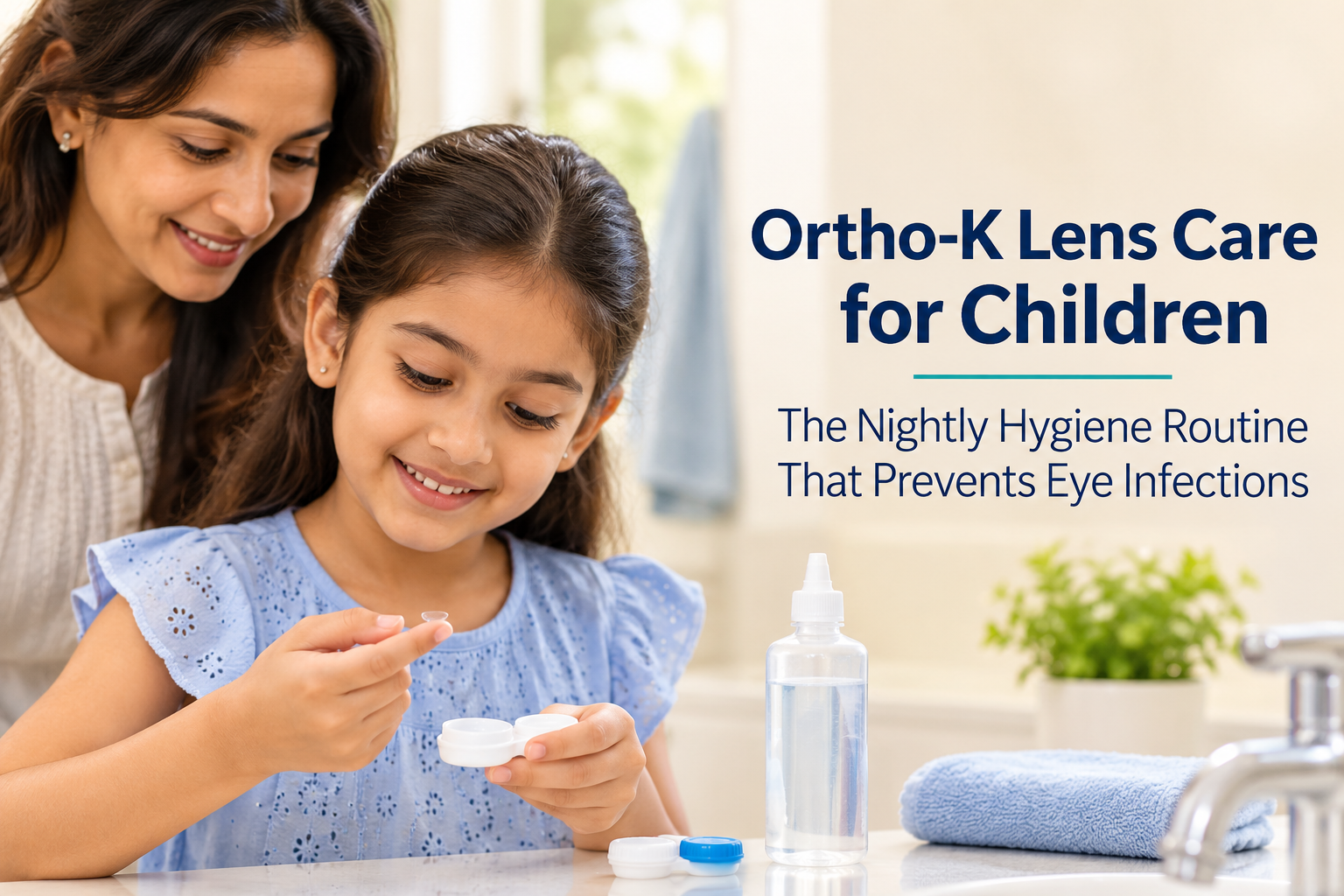
Ortho-K Lens Care for Children: The Nightly Hygiene Routine That Prevents Eye Infections
When a child starts wearing Ortho-K lenses at Samyak Eye Care Clinic, the clinical conversation does not end at the fitting appointment. The most important conversation for long-term safety happens at the training sessions that follow: the detailed, step-by-step explanation of the hygiene routine that makes the difference between a child who wears Ortho-K safely for years and one who develops a preventable complication.
A 2025 to 2026 case-control study published in a peer-reviewed ophthalmology journal identified the key modifiable risk factors for Acanthamoeba keratitis (AK) in Ortho-K lens wearers. AK is a rare but serious corneal infection caused by a microscopic organism found in water sources. The study, which examined Ortho-K wearers between 2021 and 2025, found that the most significant preventable risk behaviours were: not rubbing the lens during cleaning, using tap water on lenses or lens cases, topping off lens solution instead of replacing it completely, not replacing the lens case regularly, and not seeking prompt professional assessment when ocular discomfort occurred.
Every single one of these risk factors is within a family's control. The infection risk with proper hygiene is approximately 1 case per 1,000 to 2,000 wearers per year, comparable to the risk from standard reusable daytime contact lenses. Strict adherence to hygiene protocols reduces this risk by over 90 per cent. As the Ortho-K specialist at Samyak Eye Care Clinic, Vaishali, Ghaziabad, I want every family in Kaushambi, Indirapuram, Vaishali, and across NCR whose child wears Ortho-K lenses to have this information clearly and completely.
Why Ortho-K Hygiene Requires More Attention Than Standard Contact Lenses
Ortho-K lenses are worn during sleep, which means they are in contact with the eye surface throughout the night. Unlike daytime contact lenses, where any developing discomfort wakes the wearer and prompts lens removal, Ortho-K complications can develop during sleep without the child being aware of them until morning.
Ortho-K lenses are also rigid gas-permeable (RGP) lenses, not soft lenses. RGP lenses are highly oxygen-permeable, which is one reason they are safe for overnight wear. However, their rigid surface can accumulate deposits differently from soft lenses, and the cleaning technique, specifically physical rubbing of the lens, is essential for effective deposit removal in a way that rinse-only methods are not.
The combination of overnight wear, rigid lens material, and the involvement of children (whose hygiene supervision requires parental engagement) makes Ortho-K hygiene a genuinely important clinical topic that deserves more attention than it typically receives at non-specialist clinics.
The Five Non-Negotiable Hygiene Rules for Ortho-K Wearers
Rule 1: Always wash and thoroughly dry hands before touching lenses
Hand contamination is the primary route by which micro-organisms reach the lens surface and subsequently the eye. The hands must be washed with soap and rinsed completely, then dried with a lint-free towel before handling lenses. Damp hands are particularly problematic because residual water introduces the tap water contamination risk described below. In households in Kaushambi and Ghaziabad where family members share towels, a dedicated lint-free towel for the lens-handling parent or child is a worthwhile investment.
This rule applies without exception. Not when the child is tired at bedtime. Not when the morning is rushed. Not when the parent supervising is in a hurry. It applies every time, without compromise.
Rule 2: Never allow tap water contact with lenses, case, or hands during lens handling
This is the single most important safety rule in Ortho-K care. Tap water in India, as in most countries, contains Acanthamoeba organisms that are harmless when ingested but can cause devastating corneal infection when they contact a contact lens-wearing eye. They adhere to the lens surface during water contact and are not removed by standard lens cleaning solutions.
Tap water must never come into contact with the lens itself, the lens case, or the hands at the moment of lens handling. This means:
Rinsing lenses under the tap is prohibited. Only the prescribed contact lens solution may be used to rinse lenses.
Showering or swimming with lenses in place is prohibited.
Washing hands and then handling lenses while hands are still damp is a risk if any residual tap water remains.
Rinsing the lens case under tap water is prohibited. Cases should be cleaned with fresh lens solution only.
The historical clusters of Ortho-K-related infections that occurred in East Asia in the early 2000s were traced almost entirely to the use of tap water as a cleaning solution. When regulatory bodies stepped in to prohibit this and enforce proper solution use, infection rates dropped dramatically. The lesson from that period is clear and permanent: tap water and Ortho-K lenses must never come into contact.
Rule 3: Physically rub the lens during cleaning — rinsing alone is not sufficient
Research presented at the International Myopia Conference 2024 evaluated the cleaning efficacy of various Ortho-K lens care solutions with and without physical rubbing. The findings confirmed that all solutions significantly reduced lens deposits and bacterial adhesion, but the chlorine-based solution used with rubbing produced lenses that appeared equivalent to unworn lenses. Rinsing alone, even with effective solutions, does not achieve the same deposit removal.
The correct cleaning technique:
Place the lens in the palm of the hand.
Apply several drops of the prescribed cleaning solution.
Rub the lens gently with the fingertip in a circular motion for 20 to 30 seconds on each surface.
Rinse thoroughly with fresh solution.
Place in the storage case with fresh solution.
Parents supervising a child's Ortho-K routine should watch specifically for this rubbing step. Many children and some parents skip it because rinsing seems equivalent. The evidence clearly shows it is not.
Rule 4: Always use fresh solution — never top off
Topping off means adding fresh solution to solution that is already in the lens case rather than discarding the used solution and refilling with fresh. This practice significantly increases infection risk because micro-organisms can accumulate in the stored solution and are not eliminated by adding fresh solution to a contaminated reservoir.
The correct routine every morning after the lens is removed:
Discard all remaining solution from the lens case.
Rinse the case with fresh, prescribed solution (not water).
Leave the case open to air dry during the day.
Refill with fresh solution each evening before storing the cleaned lens.
Rule 5: Replace the lens case every one to three months
Lens cases develop biofilm on their interior surfaces over time regardless of how carefully they are cleaned. Biofilm is a structured community of micro-organisms embedded in a protective matrix that is resistant to standard lens solutions. Regular case replacement prevents biofilm accumulation from becoming a source of lens contamination.
Most Ortho-K lens solution kits include a new case. Every new bottle of solution should be accompanied by a new case. If the case becomes scratched, cracked, or stained, replace it immediately regardless of when it was last changed.
The Morning Routine: Removal and Storage
The evening insertion routine is typically what families focus on, but the morning removal and storage routine is equally important for lens safety.
Wash and dry hands before touching the lens.
Apply one or two drops of rewetting drops to the eye before removal to ensure the lens is mobile and not adhered to the cornea overnight. Attempting to remove a lens that has dried onto the cornea can cause corneal abrasion.
Remove the lens using the prescribed technique (plunger or finger method as taught at the training session).
Clean the lens immediately using the rubbing method described above.
Rinse and store in fresh solution.
Clean and air-dry the case.
Warning Signs That Require Immediate Action
Parents of children wearing Ortho-K lenses in Kaushambi, Ghaziabad, and surrounding areas should be familiar with the warning signs that require same-day professional assessment, not a wait-and-see approach:
Redness, pain, or significant discomfort on waking or after lens removal
Sensitivity to light that was not present before
Blurred vision that does not improve within 30 to 60 minutes of lens removal
Excessive watering or discharge
Any visible change in the appearance of the eye or the lens
The 2025 to 2026 case-control study specifically identified delayed professional consultation for ocular discomfort as a significant risk factor for worse outcomes in Ortho-K-related infections. The instruction is simple: if the eye is uncomfortable after lens removal, do not wait. Contact us on 98999 60700 or visit our clinic the same day.
When a Child Is Old Enough for Independent Lens Care
Parental supervision of the entire hygiene routine is essential for young children. The question of when a child can take over independent lens care is one that should be answered individually based on the child's demonstrated reliability, not on age alone.
At Samyak Eye Care Clinic, I recommend that parents supervise the complete routine until the child can perform it reliably, correctly, and without prompting for a minimum of four consecutive weeks. The transition to independence should be gradual: the parent watches the entire routine for several weeks, then supervises the critical steps only (hand washing, rubbing technique, solution change), then checks in spot-randomly without full supervision.
Full independence is appropriate only when the child consistently demonstrates all five non-negotiable rules without reminders. A child who rushes the rubbing step, or who occasionally rinses with tap water when not supervised, is not ready for independent lens care.
Frequently Asked Questions
Q: How do you clean Ortho-K lenses correctly?
A: Wash and thoroughly dry hands first. Place the lens in the palm, apply several drops of the prescribed cleaning solution, and rub gently with a fingertip in a circular motion for 20 to 30 seconds on each surface. Rinse thoroughly with fresh solution and store in the case with fresh solution. Rinsing without rubbing is not sufficient. Tap water must never be used at any stage.
Q: Can Ortho-K lenses cause an eye infection?
A: Yes, as with all contact lenses, there is a small risk of eye infection. With proper hygiene, the risk is approximately 1 case per 1,000 to 2,000 wearers per year, comparable to daytime reusable soft lenses. Strict hygiene adherence reduces this risk by over 90 per cent. The primary preventable risk factors are tap water contact, skipping the rubbing step during cleaning, topping off solution, and not replacing the lens case regularly.
Q: How often should Ortho-K lenses be replaced?
A: The replacement schedule depends on the specific lens material and the individual patient's lens care quality, as prescribed by the fitting clinician. Most Ortho-K lenses are replaced every 12 to 24 months. The lens case should be replaced every one to three months regardless of the lens replacement schedule. Follow the schedule specified at your fitting at Samyak Eye Care Clinic; do not extend the wearing period to reduce cost, as degraded lens surfaces increase infection risk.
Q: What solution should be used with Ortho-K lenses?
A: Only the specific solution prescribed at your fitting appointment. Different Ortho-K lenses may require different care solutions, and using an incorrect solution can damage the lens coating, reduce cleaning efficacy, or cause ocular irritation. Never substitute a standard soft contact lens solution for the prescribed Ortho-K solution. Contact our Ortho-K clinic in Ghaziabad if you are running low and need guidance on the correct replacement.
The Routine That Protects Everything Else
Ortho-K lenses provide your child with clear daytime vision without glasses and actively slow myopia progression. The hygiene routine is the non-negotiable foundation that makes both of those benefits safe and sustainable. A child who wears their lenses reliably and maintains the hygiene routine correctly gets the full clinical benefit of Ortho-K myopia control with a very small and well-managed infection risk.
If you have questions about your child's Ortho-K hygiene routine, if you have been unsure about any step, or if you would like a refresher training session, visit our clinic at Samyak Eye Care, Vaishali, Ghaziabad. We serve families from Kaushambi, Indirapuram, Vaishali, Surya Nagar, and across NCR. The routine takes about five minutes. It is worth every second.
Book a Lens Care Review or Training Session Today
Dr. Shalini Jain | Samyak Eye Care Clinic | Vaishali, Ghaziabad
Call: 98999 60700


