
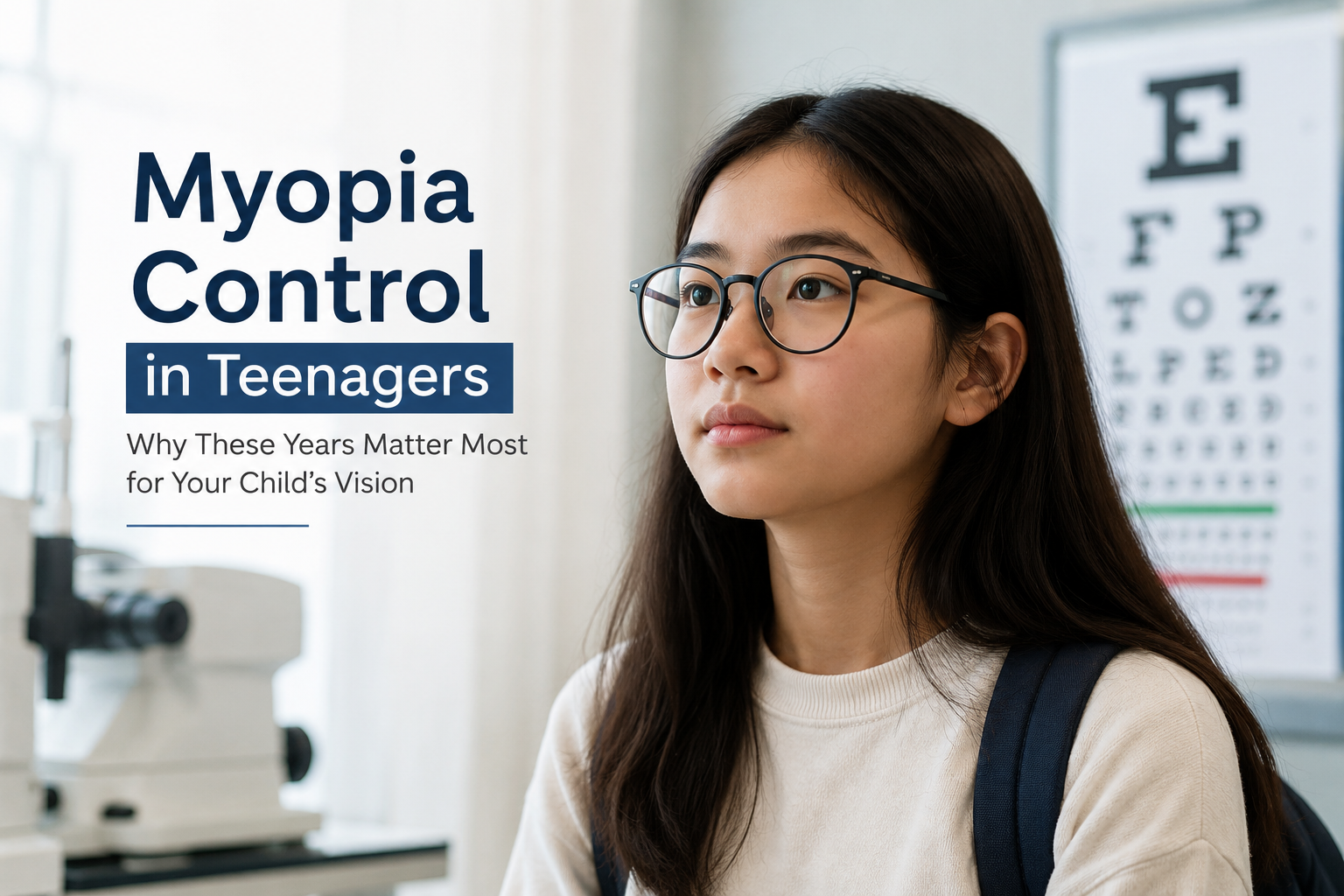
Myopia Control in Teenagers: Why These Years Matter Most for Your Child's Vision
When Aditya from Surya Nagar came for his annual eye check at age 13, his prescription had jumped from -3.00 to -4.50 in just one year. His parents were alarmed. "He already wears thick glasses," his mother said. "At this rate, what will his vision be by college?"
Her concern was justified. Myopia does not simply stabilise because a child becomes a teenager. In fact, adolescence often brings the fastest progression, driven by growth spurts, increasing academic demands, and heavy screen use. Without intervention, a teenager with moderate myopia can easily develop high myopia by adulthood — with all the associated lifetime risks.
As the best eye specialist near Surya Nagar, I work extensively with teenagers and their families on myopia control. Here is what parents of teens need to understand — and what options exist to slow progression during these critical years.
Why Myopia Progresses Fastest During Teenage Years
Myopia progression is fundamentally linked to eye growth. The nearsighted eye is too long from front to back, causing light to focus in front of the retina rather than on it. During childhood and adolescence, the eyeball continues growing — and in myopic individuals, it often grows too much.
Teenage growth spurts accelerate this process. The same hormones driving height increases also influence eye growth. Board examination years add intense near-work demands exactly when eyes are most susceptible. Smartphone and laptop use soars, keeping eyes focused at close range for hours daily.
The result: many teenagers see their prescriptions increase by -0.50 to -1.00 dioptres annually. What was -2.00 at age twelve becomes -5.00 or -6.00 by eighteen. The best eye doctor in Surya Nagar sees this pattern repeatedly without intervention.
High Myopia: Why the Numbers Matter Beyond Glasses Thickness
High myopia — generally defined as -6.00 dioptres or greater — is not simply an inconvenience requiring thick glasses. It is a medical condition with real risks. The elongated eyeball stretches the retina thin, increasing vulnerability to serious complications.
Retinal detachment risk increases significantly with high myopia. The stretched retina can tear or separate from underlying tissue, requiring emergency surgery. Myopic macular degeneration can develop in middle age, affecting central vision. Glaucoma risk rises. Cataracts tend to develop earlier.
The difference between finishing at -4.00 versus -8.00 matters enormously for lifetime eye health. This is why myopia control during teenage years is not just about convenience — it is about protecting long-term vision. Our myopia control clinic focuses specifically on slowing progression.
Myopia Control Options for Teenagers
Standard glasses correct vision but do nothing to slow progression. Myopia control treatments actively work to reduce the rate at which myopia worsens. Several proven options exist, each with different mechanisms and practical considerations.
Orthokeratology (Ortho-K) involves wearing specially designed rigid lenses during sleep. These lenses temporarily reshape the cornea overnight, providing clear vision during the day without glasses or contacts. Studies consistently show a 40-60% reduction in myopia progression compared to standard glasses.
Low-dose atropine eye drops are another proven approach. Applied once daily at bedtime, these drops slow eye growth through mechanisms still being researched. Different concentrations (0.01% to 0.05%) balance effectiveness against side effects. Most teenagers tolerate low-dose atropine well.
Speciality soft contact lenses designed for myopia control incorporate specific optical designs that influence peripheral focus. Worn during the day like standard contacts, these lenses correct vision while signalling the eye to slow growth.
The best eye specialist in Surya Nagar evaluates each teenager individually, considering prescription, progression rate, lifestyle, and family preferences when recommending approaches.
Choosing the Right Approach for Your Teenager
Ortho-K appeals to active teenagers who dislike wearing glasses or daytime contacts. Athletes, swimmers, and those self-conscious about glasses often embrace the freedom Ortho-K provides. However, it requires nightly lens wear and meticulous hygiene — not all teenagers are ready for this responsibility.
Atropine drops are simple — one drop before bed — but require consistent daily use. Some teenagers experience mild light sensitivity or difficulty with near focus, though these effects are minimal with lower concentrations. Atropine can be combined with glasses or regular contact lenses.
Myopia control soft lenses suit teenagers already comfortable with contact lens wear. They function like regular contacts during the day, making the transition seamless. However, daily disposables cost more than standard options.
Sometimes combination approaches work best — atropine drops alongside Ortho-K for aggressive progressors, for example. Treatment plans should be individualised based on how rapidly myopia is advancing.
Lifestyle Factors That Support Myopia Control
Medical interventions work best when supported by healthy visual habits. Outdoor time is one of the most powerful protective factors — research suggests that at least two hours daily of outdoor activity reduces myopia development and progression. Natural light exposure, not just distance viewing, appears important.
Convincing board-examination-focused teenagers to spend more time outdoors is challenging but worthwhile. Even study breaks outside help. Walking to coaching classes rather than driving, outdoor sports, and weekend outdoor activities all contribute.
Screen habits matter too. Taking regular breaks from intensive near work using the 20-20-20 rule helps reduce eye strain. Maintaining proper viewing distances — arm's length for computers, farther for television — reduces accommodative stress. Good lighting prevents squinting.
The best eye doctor in Surya Nagar discusses these lifestyle modifications with every teenage myopia patient. Treatment works better when combined with healthy habits.
Monitoring and Adjusting Treatment
Myopia control is not set-and-forget. Regular monitoring — typically every six months — tracks prescription changes, measures eye length with specialised instruments, and assesses treatment effectiveness. If progression continues too rapidly, treatment can be intensified or modified.
Treatment typically continues through the teenage years and sometimes into the early twenties, until eye growth stabilises. Stopping treatment prematurely may allow accelerated progression to resume. The decision to discontinue is made collaboratively based on age, stability, and individual factors.
Frequently Asked Questions
Q: My teenager's myopia has not changed this year. Do they still need myopia control?
A: One stable year does not guarantee future stability. If there is a history of progression or if the teenager is still growing, continued monitoring and possibly treatment is wise. Stopping too soon risks allowing progression to resume.
Q: Are myopia control treatments safe for teenagers?
A: All proven myopia control methods have strong safety records when used appropriately. Ortho-K requires careful hygiene to prevent infection. Atropine at low doses has minimal side effects. The best eye specialist in Surya Nagar monitors all treatments carefully.
Q: Will myopia control eliminate the need for glasses entirely?
A: No. Myopia control slows progression but does not reverse existing myopia. The goal is to end with lower myopia than would otherwise occur — for example, finishing at -4.00 instead of -7.00. This significantly reduces lifetime health risks.
Q: Can laser surgery later correct whatever myopia develops?
A: Laser surgery corrects focusing power but does not reverse the structural changes of high myopia. A highly myopic eye remains at elevated risk for complications even after laser correction. Preventing high myopia is far better than correcting it surgically.
Q: My teenager resists wearing glasses. Will they comply with treatment?
A: Teenagers who dislike glasses often embrace Ortho-K precisely because it eliminates daytime eyewear. The motivation to be glasses-free can improve compliance significantly. We discuss options openly with teenagers to find approaches they will actually follow.
Q: Where can I get myopia control treatment near Surya Nagar?
A: Dr. Shalini Jain at Samyak Eye Care — the best eye specialist near Surya Nagar — provides comprehensive myopia management for teenagers.
Take Action Now — These Years Will Not Return
Aditya from Surya Nagar started Ortho-K shortly after that alarming examination. Eighteen months later, his prescription has increased only -0.25 dioptres — a dramatic improvement from his previous progression rate. He wears no glasses during the day, plays cricket without visual limitations, and feels confident his eyesight is being protected.
Your teenager's vision trajectory is not fixed. Intervention during these high-progression years can meaningfully reduce lifetime myopia and associated risks. If your child's prescription keeps increasing, schedule an evaluation to discuss myopia control options. Visit our clinic for expert guidance.
Slow Your Teen's Myopia Progression
Dr. Shalini Jain | Samyak Eye Care Clinic | Vaishali, Ghaziabad
Call: 98999 60700


