
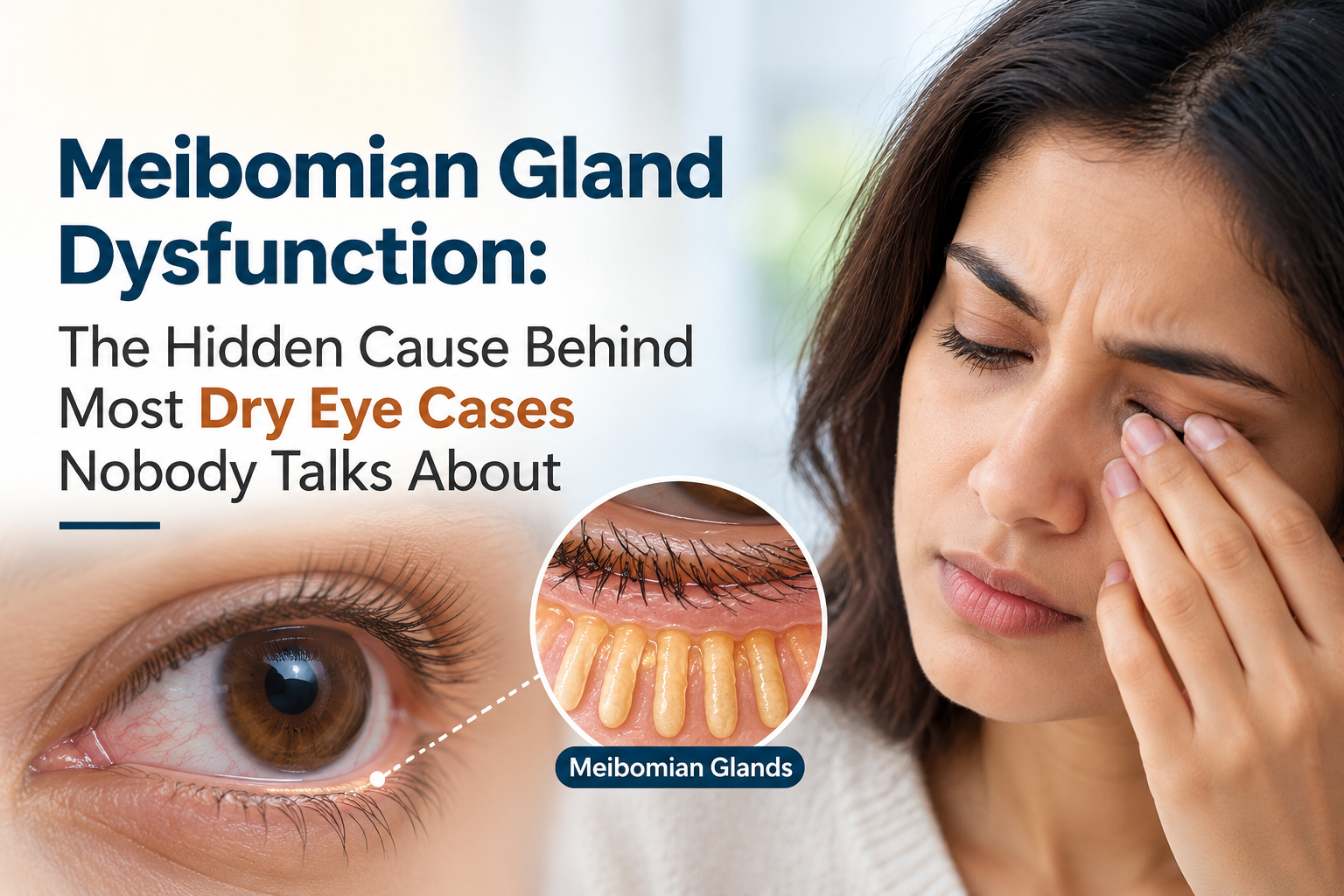
Meibomian Gland Dysfunction: The Hidden Cause Behind Most Dry Eye Cases Nobody Talks About
Most patients who come to Samyak Eye Care Clinic with dry eyes have already tried lubricating drops. They have been using them for months, sometimes years. The drops provide temporary relief, but the symptoms return. The eyes feel gritty, burn, or water persistently. Some patients have been told this is just how their eyes are, something they will have to manage indefinitely with artificial tears.
What most of these patients have not been told is that lubricating drops, while helpful, address the symptom of dry eye rather than its most common underlying cause. Research published in the Indian Journal of Ophthalmology confirms that meibomian gland dysfunction (MGD) affects approximately 55 per cent of the Indian population. This is higher than reported prevalence in Caucasian populations (21 to 29.5 per cent) and makes MGD a genuinely India-specific clinical priority. Yet it is one of the most under-diagnosed conditions in eye care, because diagnosing it correctly requires specific assessment that goes beyond a standard dry eye evaluation.
As the dry eye management specialist at Samyak Eye Care Clinic, Vaishali, Ghaziabad, I want to explain what MGD actually is, why it is the cause of most evaporative dry eye, what correct diagnosis requires, and why warm compresses alone are not the whole answer for most patients.
What Meibomian Glands Are and What They Do
The eyelids contain rows of specialised glands called meibomian glands, approximately 25 to 40 in the upper eyelid and 20 to 30 in the lower eyelid. These glands secrete a specialised lipid (oil) called meibum with every blink. The meibum forms the outermost layer of the tear film, the lipid layer, which sits on top of the watery aqueous layer and prevents it from evaporating.
When the meibomian glands function normally, the lipid layer is continuously renewed, and the tear film remains stable between blinks. When the glands are blocked, thickened, or atrophic, the lipid layer is compromised. Without adequate lipid coverage, the aqueous layer of the tear film evaporates much faster than it should. This evaporative loss is the mechanism behind the vast majority of dry eye disease, including in patients whose tear production (aqueous production) is entirely normal.
This is a clinically important distinction: many patients with significant dry eye symptoms have normal tear production on standard tests. They are told their tears are fine. But their meibomian glands are not producing adequate lipid, and the tears they produce are evaporating before they can do their job. Standard dry eye tests that measure aqueous production will not detect this.
Why MGD Is So Prevalent in India
The 55 per cent prevalence of MGD in the Indian population, compared to 21 to 29.5 per cent in Caucasian populations, reflects several factors that are specific to the Indian context:
Dietary patterns: The International Workshop on MGD recommends omega-3 fatty acid supplementation as part of MGD management, as omega-3 deficiency is associated with altered meibum composition and increased ductal blockage. Indian dietary patterns, while variable, may contribute to the elevated prevalence through nutritional factors.
Environmental exposure: The high particulate load of North Indian winter air, particularly in Delhi NCR where PM2.5 levels reach hazardous levels between October and January, has been shown to damage meibomian gland tissue directly. Chronic environmental exposure to pollutants is an increasingly recognised risk factor for MGD.
Contact lens wear patterns: Contact lens wear is associated with meibomian gland changes and accelerated gland atrophy. As contact lens wear increases among younger urban Indians, so does the prevalence of MGD in this demographic.
Screen time and reduced blink rate: Incomplete blinking during screen use reduces the mechanical expression of meibum from the glands with each blink cycle. Over years of high screen time, this contributes to gland stagnation and blockage.
How Meibomian Gland Dysfunction Is Correctly Diagnosed
This is where the gap between how MGD is currently managed and how it should be managed is most significant. Many patients in Ghaziabad and across NCR are given a diagnosis of dry eye and lubricating drops without any assessment of the meibomian glands themselves.
Correct MGD diagnosis requires:
Slit lamp examination of the eyelid margin: The clinician directly observes the meibomian gland orifices, which are visible at the eyelid margin. In MGD, these orifices show characteristic changes including plugging (a waxy obstruction covering the gland opening), vascular changes in the adjacent lid margin, and irregularity of the orifice architecture.
Meibomian gland expression: The glands are gently expressed by applying pressure to the eyelid. Normal glands express a clear, fluid oil. MGD glands produce thickened, cloudy, or toothpaste-like secretion, or no secretion at all. The quality and expressibility of the meibum directly indicates the severity of gland dysfunction.
Meibography where indicated: Meibography is infrared imaging of the eyelid that allows direct visualisation of the meibomian gland structures. It reveals gland dropout (areas where glands have atrophied and can no longer produce meibum), gland truncation, and gland distortion. This is the gold standard for assessing structural gland loss and guiding treatment decisions.
Tear film break-up time (TBUT): The stability of the tear film is assessed by measuring how quickly the tear film breaks up after a blink. A short TBUT (under 10 seconds) is characteristic of evaporative dry eye from MGD.
The Warm Compress Conversation: What It Does and What It Does Not
Warm compress therapy is the most commonly recommended first-line intervention for MGD, and the evidence base is genuine. A comprehensive review of 20 clinical studies published between 2004 and 2023 confirmed that warm compress therapy effectively improves tear quality and meibomian gland health in MGD patients. The target eyelid temperature of 40 degrees Celsius, achievable with hot towels, microwavable eye masks, or self-heating eye masks, is sufficient to soften the thickened meibum that is blocking the gland orifices.
The clinical recommendation: warm compress applied for a minimum of 10 minutes, followed by gentle lid massage to express the softened meibum from the glands. Done consistently once or twice daily, this produces measurable improvement in meibum quality and tear film stability over 4 to 8 weeks.
However, warm compress therapy has important limitations that patients need to understand:
It is palliative, not curative. It manages the gland dysfunction by improving secretion flow but does not reverse structural gland damage (atrophy or dropout) that has already occurred.
Compliance is the critical variable. Warm compresses done inconsistently or for insufficient duration produce limited benefit. The patients who see the most improvement are those who make it a daily habit rather than an occasional intervention.
It is insufficient for moderate to severe MGD. Patients with significant gland dropout or refractory MGD who do not respond adequately to warm compress therapy may need thermal pulsation (a device-based in-clinic treatment that applies controlled heat and pressure to the eyelids) or intense pulsed light (IPL) therapy.
The Correct Treatment Sequence for MGD
At Samyak Eye Care Clinic, MGD management follows an evidence-based sequence:
Stage 1: Lid hygiene and warm compress
Daily warm compress for 10 minutes followed by gentle lid massage. Lid hygiene using appropriate lid wipes or diluted baby shampoo to remove debris and reduce the bacterial load on the lid margin. This stage is initiated immediately and maintained throughout treatment.
Stage 2: Lubricating drops with lipid component
Standard aqueous lubricating drops address tear volume but not the lipid layer deficiency of evaporative dry eye. Lipid-containing eye drops (oil-in-water emulsions) supplement the deficient lipid layer directly and are more effective for MGD-related dry eye than standard aqueous drops. Omega-3 fatty acid supplementation is also recommended as part of the dietary management component.
Stage 3: In-clinic treatments for moderate to severe MGD
For patients who do not respond adequately to stages 1 and 2, in-clinic thermal pulsation treatment applies controlled heat and pressure to the eyelids for a single 12-minute treatment session that can produce sustained improvement for up to 12 months. IPL therapy, originally developed for dermatological conditions, has also shown significant efficacy for MGD by reducing the inflammatory component and improving meibomian gland function.
Stage 4: Monitoring with meibography
Regular meibography allows tracking of gland health over time. The goal is to prevent further gland atrophy; glands that have already dropped out cannot be regenerated with current treatments. This makes early diagnosis and early treatment the most important factors in long-term outcomes.
Frequently Asked Questions
Q: What is meibomian gland dysfunction?
A: Meibomian gland dysfunction (MGD) is a condition in which the oil-secreting glands in the eyelids become blocked, thickened, or atrophied, reducing or altering the lipid layer of the tear film. This causes the aqueous tears to evaporate faster than normal, producing evaporative dry eye. It is the most common underlying cause of dry eye disease, affecting approximately 55 per cent of the Indian population according to data published in the Indian Journal of Ophthalmology.
Q: How do warm compresses help dry eyes?
A: Warm compresses applied at 40 degrees Celsius for 10 minutes soften the thickened meibum blocking the meibomian gland orifices. Following the compress with gentle lid massage expresses this softened secretion from the glands, improving meibum quality and tear film lipid layer stability. A review of 20 clinical studies confirms warm compress therapy is effective for improving tear quality in MGD when applied consistently.
Q: Can blocked oil glands in the eyelids be reversed?
A: Gland blockage and dysfunction can be improved with appropriate treatment, including warm compresses, lid hygiene, and in-clinic thermal pulsation or IPL therapy. However, structural gland atrophy (gland dropout) that has already occurred cannot be reversed with current treatments. This makes early diagnosis and early intervention the most important factors in preserving meibomian gland function long-term.
Q: What is the correct way to clean eyelids at home for MGD?
A: After warm compress and lid massage, eyelid cleaning should be performed with commercial lid wipes specifically formulated for lid hygiene, or with a clean cotton bud moistened with diluted baby shampoo (approximately one drop in 20ml of warm water). The lid margin is cleaned gently in a horizontal motion. This removes debris, dead cells, and bacterial colonisation that contribute to the MGD cycle. Ask your dry eye specialist in Ghaziabad for the specific technique appropriate for your eyelid anatomy.
Q: Where can I get my meibomian glands assessed in Ghaziabad?
A: Samyak Eye Care Clinic in Vaishali, Ghaziabad offers comprehensive dry eye and MGD management including meibomian gland expression assessment, tear film analysis, and meibography where indicated. We serve patients from across Ghaziabad, Vaishali, Indirapuram, Kaushambi, Surya Nagar, and NCR. Visit our clinic for an assessment.
The Drops Are Not Enough
A 48-year-old teacher from Ghaziabad had been using lubricating drops four to six times daily for two years when she first came to Samyak Eye Care Clinic. Her previous care had focused entirely on tear volume and had never assessed her meibomian glands. Meibum expression revealed thick, paste-like secretion from most of her glands. Meibography showed moderate gland atrophy. She began a consistent warm compress and lid hygiene routine, switched to lipid-containing drops, and added omega-3 supplementation. Within six weeks, her drop requirement had reduced to twice daily, and her symptom scores had improved significantly.
The drops were not wrong. They were just incomplete. If you have been managing dry eye with lubricating drops for more than a few months without adequate relief, the meibomian glands are the most likely place your assessment has a gap. Visit our clinic at Samyak Eye Care, Vaishali, Ghaziabad, for a complete dry eye evaluation that actually looks at where the problem is coming from.
Book Your MGD and Dry Eye Assessment Today
Dr. Shalini Jain | Samyak Eye Care Clinic | Vaishali, Ghaziabad
Call: 98999 60700


