
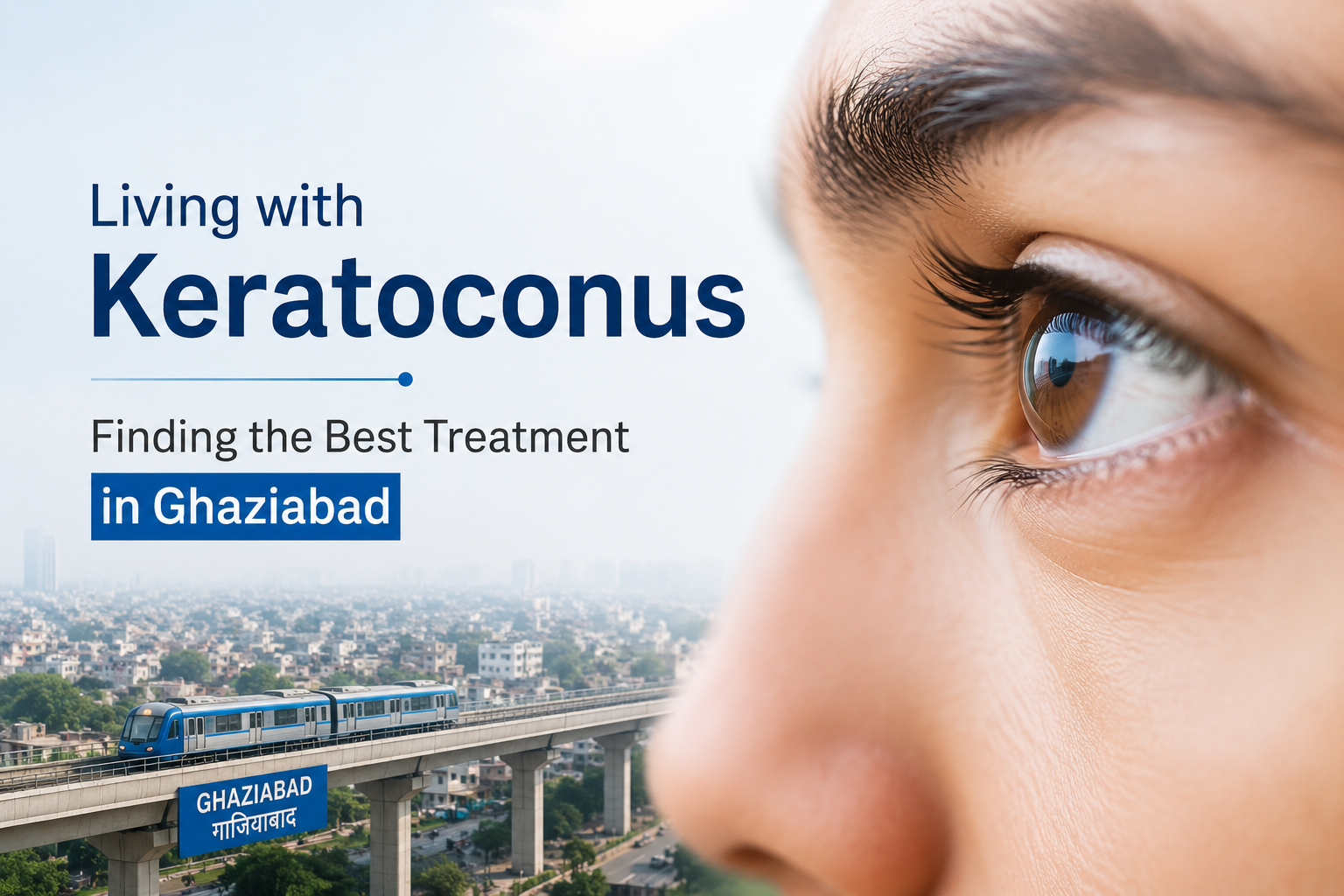
Living with Keratoconus: Finding the Best Treatment in Ghaziabad
Imagine watching the world slowly twist and blur, headlights stretching into starbursts, straight lines bending like reflections in a funhouse mirror. For the estimated 1 in 2,000 people living with keratoconus, this isn't imagination — it's daily reality.
Keratoconus is a progressive eye condition where the cornea — normally dome-shaped — thins and bulges outward into a cone. This distortion scatters light unpredictably, causing blurred vision, ghost images, and extreme sensitivity to glare. The condition typically begins in the teenage years, progressing through the twenties before stabilising. But without proper treatment, those crucial decades can be marked by frustration, anxiety, and declining vision.
The good news? Keratoconus treatment in Ghaziabad has advanced remarkably. What once led inevitably toward corneal transplant now offers multiple paths to clear, stable vision. At Samyak Eye Care, patients discover that a keratoconus diagnosis doesn't mean surrendering to poor vision.
Understanding the Keratoconus Journey
The earliest signs often appear innocuously. A teenager complains that their glasses prescription keeps changing. An engineering student finds themselves squinting at lecture slides. A young professional notices halos around streetlights at night. Many patients initially receive misdiagnoses of simple astigmatism, cycling through stronger and stronger prescriptions that never quite work.
"The biggest challenge isn't the condition itself," explains Dr. Shalini Jain, who has managed hundreds of keratoconus cases over 25 years. "It's the delay in diagnosis. Patients spend years thinking they simply have difficult eyes, when earlier intervention could have preserved more vision."
Modern diagnostic technology has transformed early detection. Corneal topography maps the cornea's surface with micron-level precision, revealing the characteristic steepening pattern long before symptoms become severe. Pachymetry measures corneal thickness at multiple points, tracking the thinning that defines disease progression. For those seeking keratoconus treatment in Ghaziabad, these advanced diagnostics are now locally accessible — no need to travel to Delhi for proper evaluation.
Treatment Options: From Glasses to Speciality Lenses
Keratoconus treatment in Ghaziabad follows a staged approach, matching intervention intensity to disease severity. In early stages, spectacles or soft contact lenses may provide adequate correction. But as the cornea becomes more irregular, standard optics simply cannot focus light properly onto the retina.
This is where speciality contact lenses enter the picture. Rigid gas permeable (RGP) lenses create a smooth optical surface over the irregular cornea, dramatically improving vision. For many patients, this represents a turning point — the first time in years they experience genuinely clear sight. The best eye specialist in Vaishali, Ghaziabad, will determine which lens type suits your specific corneal shape and lifestyle needs.
However, RGP lenses sit directly on the cornea, which can cause discomfort and complications in advanced keratoconus. This limitation led to the development of Scleral lenses — larger diameter lenses that vault entirely over the cornea, resting instead on the white of the eye (sclera). The space between the lens and cornea fills with saline, creating a fluid reservoir that bathes the cornea continuously while providing exceptional optical correction.
"Scleral lenses transformed keratoconus management," notes Dr. Jain. "Patients who couldn't tolerate smaller lenses suddenly find all-day comfort. The visual quality rivals or exceeds what they experienced before keratoconus progressed." Scleral lenses in Vaishali, Ghaziabad, are fitted using advanced mapping technology that ensures precise customisation for each patient's unique corneal profile.
Corneal Cross-Linking: Stopping Progression
While contact lenses address the visual symptoms of keratoconus, they don't halt the underlying disease. For progressive cases — particularly in younger patients — corneal collagen cross-linking (CXL) offers a way to stabilise the cornea and prevent further deterioration. This procedure has become an essential component of comprehensive keratoconus treatment in Ghaziabad.
The procedure involves applying riboflavin (vitamin B2) drops to the cornea, then exposing it to controlled ultraviolet light. This combination triggers chemical bonds between collagen fibres, strengthening the corneal structure. Think of it as adding cross-braces to a weakening building frame. A thorough evaluation by the best eye specialist in Vaishali, Ghaziabad, determines whether cross-linking is appropriate based on your age, progression rate, and corneal thickness.
Cross-linking doesn't improve vision directly — its purpose is preservation rather than correction. Most patients still require speciality contact lenses afterwards, often Scleral lenses for optimal visual outcomes. But by stopping progression, CXL often eliminates the need for corneal transplant surgery down the line, making it a crucial early intervention.
Concerned about keratoconus? Expert evaluation and treatment are available locally. Contact Samyak Eye Care at 98999 60700 for a comprehensive consultation.
Living Well with Keratoconus
A keratoconus diagnosis can feel overwhelming, but most patients lead completely normal lives with proper management. Students complete demanding academic programmes. Professionals thrive in visually intensive careers. Athletes compete at high levels. The key lies in finding the right specialist and maintaining consistent follow-up care.
Certain lifestyle adjustments help preserve eye health: avoiding eye rubbing (which can accelerate corneal thinning), protecting eyes from UV exposure with quality sunglasses, managing allergies that cause itching, and maintaining regular sleep patterns. These simple measures complement medical treatment in keeping keratoconus stable.
For those seeking keratoconus treatment in Ghaziabad, local expertise matters tremendously. Speciality lens fitting requires skill developed over hundreds of cases. Cross-linking demands precise technique and appropriate patient selection. Having an experienced specialist nearby means easier follow-up appointments and faster response when adjustments are needed. Patients no longer need to travel to metro cities for advanced care — Scleral lenses in Vaishali, Ghaziabad, offer the same technology and expertise available anywhere in India.
Common Questions About Keratoconus
Is keratoconus hereditary?
Genetics play a role, with roughly 10% of patients having affected family members. However, most cases occur without a family history. If keratoconus runs in your family, early screening is advisable — a thorough evaluation can detect subtle changes before symptoms appear.
Can keratoconus lead to blindness?
With proper treatment, keratoconus very rarely causes complete vision loss. Even severe cases can typically be managed with Scleral lenses or, if necessary, corneal transplantation. The real risk lies in delayed treatment, allowing unnecessary progression. Early consultation with the best eye specialist in Vaishali, Ghaziabad, prevents this outcome.
How long do Scleral lenses last?
With proper care, Scleral lenses typically last 1-3 years. Regular professional cleaning and careful handling extend their lifespan. Your specialist will monitor both lens condition and your corneal health at follow-up appointments to ensure optimal performance.
Is LASIK possible with keratoconus?
No. LASIK and similar laser procedures are contraindicated in keratoconus because they further thin the cornea, potentially worsening the condition. This is precisely why accurate diagnosis matters — some patients have undergone LASIK elsewhere without proper screening, only to develop corneal ectasia afterwards. Always consult a keratoconus specialist before considering any refractive surgery.
What makes Scleral lenses different from regular contacts?
Scleral lenses are larger (14-24mm diameter versus 9-10mm for standard soft lenses) and vault over the entire cornea without touching it. This design provides superior comfort, stability, and optical correction for irregular corneas. Proper fitting by an experienced specialist ensures optimal results — Scleral lenses in Vaishali, Ghaziabad, are customised using advanced corneal mapping for each patient.
Where can I find keratoconus treatment near Indirapuram?
Samyak Eye Care offers comprehensive keratoconus treatment in Ghaziabad, serving patients from Indirapuram, Kaushambi, Surya Nagar, and throughout the region. The clinic is conveniently located near the Vaishali metro station. Visit our clinic for advanced diagnostics and treatment.
How much does keratoconus treatment cost?
Treatment costs vary depending on the approach required. Initial consultation and diagnostic testing are reasonably priced. Scleral lenses represent an investment but typically last 1-3 years with proper care. Cross-linking is a one-time procedure that can prevent far more expensive interventions later. The best eye specialist in Vaishali, Ghaziabad, will discuss all options and associated costs during your consultation, ensuring you can make an informed decision.
Taking the First Step
Keratoconus needn't define your vision or your life. With 25+ years of experience, 37,500+ patients treated, and recognition through 4+ government awards, Dr. Shalini Jain provides keratoconus treatment in Ghaziabad that combines clinical excellence with genuine patient care. Whether you're newly diagnosed or seeking better management for longstanding keratoconus, expert guidance is available close to home.
SCHEDULE YOUR KERATOCONUS CONSULTATION
Call: 98999 60700
Website: www.samyakeyecare.com
Location: Gaur Heights, Sector 4, Vaishali, Ghaziabad
Serving patients from Vaishali | Indirapuram | Kaushambi | Surya Nagar | Ghaziabad


