
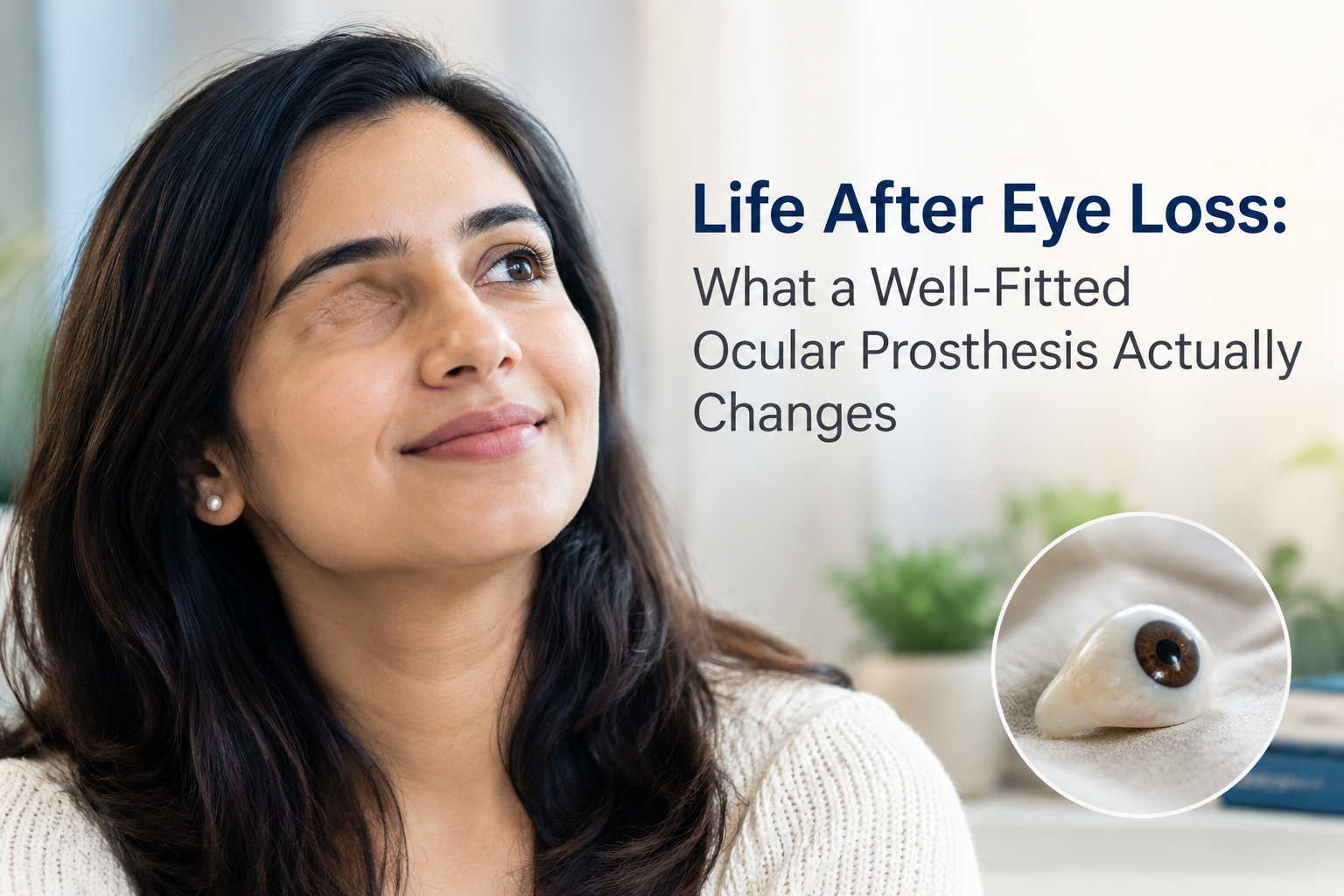
Life After Eye Loss: What a Well-Fitted Ocular Prosthesis Actually Changes
Nobody prepares you for how other people react. That is what most patients who have lost an eye tell me, not in the clinical sense of symptoms or recovery, but in the human sense of how life changes when you return to work, to family gatherings, to ordinary social situations. Some patients withdraw. They cancel plans, decline invitations, avoid situations where strangers will look at them. Some develop a habit of turning their head to avoid being seen from the affected side. Some simply stop going out in the way they used to.
This withdrawal is not inevitable. It is not a natural consequence of eye loss that must simply be endured. In almost every case I have seen at Samyak Eye Care Clinic over 25 years, it is a consequence of inadequate prosthetic rehabilitation, either no prosthesis, a poorly fitted stock prosthesis, or a custom prosthesis that was not followed up and maintained to the standard needed to maintain a convincing natural appearance.
A 39-year-old teacher from Kaushambi lost her right eye to severe trauma two years ago. She had been fitted with a stock prosthesis at the hospital where her surgery was performed. By the time she reached our clinic, she had taken six months of medical leave from her school. She felt, in her words, that her students would not be able to look at her without discomfort. After a comprehensive custom ocular prosthesis fitting and three months of follow-up care, she returned to her classroom. She told me at her six-month review that none of her students had commented on her eye. Not one.
This blog is about what life with an ocular prosthesis actually looks like. What is possible, what requires adjustment, and what a good prosthesis can genuinely restore.
What an Ocular Prosthesis Can Restore
Facial symmetry and natural appearance
The most immediate and psychologically significant restoration a well-fitted custom prosthesis provides is facial symmetry. The absence of an eye is not just visually apparent; it changes the entire dynamics of the face. Eyelids droop without the structural support of the eye. The socket appears hollow. Facial expressions become asymmetric because the muscles around the absent eye have nothing to respond to.
A well-fitted custom ocular prosthesis restores the structural volume of the socket, supports the eyelids, and provides a natural-appearing eye that moves in partial response to the orbital muscles. Research published in peer-reviewed prosthetics journals consistently documents significant improvements in patient-reported confidence and social reintegration following high-quality custom prosthesis fitting. The prosthesis does not restore vision. But it restores the face that vision loss took with it.
The ability to move through public life without self-consciousness
This is harder to quantify than facial symmetry but more important to patients. The ability to attend a meeting, have a conversation, travel on the metro, or eat in a restaurant without feeling that the other person is looking at their eye rather than at them. A well-matched custom prosthesis, in good condition and properly maintained, achieves this in the vast majority of cases. At normal conversational distance, an observer who does not already know about the eye loss typically cannot identify which eye is the prosthesis.
This outcome is not guaranteed by any prosthesis. It is achieved specifically by a custom prosthesis that has been carefully fitted, carefully colour-matched, and regularly maintained to preserve the surface quality that makes the natural appearance possible.
Return to work and normal occupational function
The vast majority of people who lose one eye can return to their previous occupation. This is one of the most practically important questions patients and families ask, and the honest clinical answer for most situations is yes. Monocular vision, vision in one eye only, carries specific adaptations, particularly in depth perception and peripheral vision on the affected side. These adaptations can be learned with time and practice.
Driving is a question that arises frequently. In India, a person with monocular vision (good vision in one eye) can hold a driving licence for private vehicles, though the specific regulations should be confirmed with the relevant licensing authority at the time of application or renewal. Many patients return to driving within months of prosthesis fitting once they have adjusted to monocular depth perception.
Jobs that require precise binocular depth perception, such as certain surgical specialities or precision engineering roles, may require adjustment or redeployment. For the majority of professions, including teaching, office work, business, and most technical roles, monocular vision with a good prosthesis does not prevent full professional function.
What Requires Genuine Adjustment
Depth perception for close tasks
Binocular vision provides depth perception through the slight difference in viewpoint between the two eyes. With one eye, this specific mechanism is lost. Tasks that rely on fine depth judgment at close range, such as threading a needle, pouring to a precise level, or certain detailed craft work, require more care and practice. Most patients develop compensatory strategies within weeks to months of adapting to monocular vision.
Peripheral vision on the affected side
The visual field on the side of the absent eye is reduced. This is significant for road safety and for awareness in busy environments. Patients need to consciously compensate by turning their head more when in traffic, navigating crowds, or in situations where objects may approach from the affected side. This becomes habitual with time but requires deliberate attention initially.
Sports requiring fast-moving targets
Catching or hitting a fast-moving ball relies on binocular depth perception for accurate spatial judgment. Many patients adapt successfully to racquet sports, cricket, and similar activities with monocular vision, but it typically requires a period of re-learning and practice. Swimming, cycling, running, and most fitness activities are entirely unaffected by monocular vision.
Practical Questions About Daily Life with an Ocular Prosthesis
Can you sleep with an artificial eye?
Custom ocular prostheses can typically be worn continuously, including during sleep, unlike stock prostheses, which should be removed nightly. Your ocular prosthesis specialist will advise on the specific recommendations for your prosthesis based on its type, fit, and your socket health.
Does an artificial eye move with the other eye?
A custom prosthesis, fitted over an orbital implant, moves in partial coordination with the fellow eye because the prosthesis is in contact with the conjunctival lining, which is connected to the residual orbital muscles. The degree of movement varies between patients and depends on the surgical technique used for eye removal, the type and position of the orbital implant, and the fit of the prosthesis. Most patients with a good implant and well-fitted custom prosthesis achieve movement that is natural enough to be unnoticeable in casual interaction.
Can people tell you have a prosthetic eye?
At normal conversational distance, with a well-fitted, well-maintained custom prosthesis, most people cannot identify which eye is the prosthesis without prior knowledge. In bright light or at close range, very subtle differences in pupil response (the prosthesis pupil does not constrict in bright light) may be noticeable to an attentive observer. These differences become less apparent as the prosthesis ages and the polish is maintained at a high standard.
The Timeline of Adjustment: What to Expect
Patients and families consistently report that the adjustment to life with an ocular prosthesis is faster and more complete than they initially feared. A realistic timeline:
Weeks 1 to 4: Physical adjustment to the prosthesis, learning insertion and removal, managing any initial socket sensitivity. The prosthesis may feel unfamiliar. This phase improves rapidly.
Months 1 to 3: Increasing confidence in social situations. Monocular vision adaptation begins. Most patients return to social activities they had withdrawn from during this period.
Months 3 to 6: Most patients have largely re-established their normal daily and professional routines. Depth perception adaptation is progressing. Return to work typically occurs in this window for patients who had taken extended leave.
Months 6 to 12: Most monocular vision adaptations are well-established. The prosthesis is part of daily routine. Social self-consciousness has typically reduced to a level that does not interfere with normal life.
The timeline is influenced significantly by the quality of the prosthetic fitting, the follow-up care received, and whether the patient has access to honest, supportive guidance about what to expect and how to adapt. At Samyak Eye Care Clinic, we provide that guidance as part of the prosthesis fitting process, not as a separate referral.
Frequently Asked Questions
Q: Can people tell if you have a prosthetic eye?
A: With a well-fitted, well-maintained custom prosthesis matched carefully to the fellow eye, most people at normal conversational distance cannot identify the prosthesis without prior knowledge. The pupillary light response will differ in bright light, which may be noticeable in very close or very bright settings. Quality of the colour match, surface maintenance, and prosthesis movement all affect how natural the appearance is.
Q: Does an artificial eye move with the other eye?
A: Yes, partially. A custom prosthesis fitted over a good orbital implant moves in response to the residual orbital muscles, which are connected to the conjunctival lining in contact with the prosthesis. The degree of movement varies between patients. Most patients with appropriate surgical and prosthetic management achieve movement that is natural enough for normal social interaction.
Q: How long does it take to adjust to an artificial eye?
A: Most patients are functionally adjusted within 3 to 6 months. Physical comfort with the prosthesis typically improves within the first few weeks. Social confidence returns over months as the patient re-engages with daily and professional life. The timeline is influenced significantly by prosthesis quality and the quality of follow-up support received.
Q: Can you drive and work normally with one eye?
A: For most occupations, yes. Driving with monocular vision is possible and legal in India for private vehicles, with appropriate licensing. Depth perception at close range requires adaptation, but most patients develop effective compensatory strategies within months. Occupations requiring precise binocular depth perception may require role adjustments, but the majority of professions are fully accessible with monocular vision.
The Teacher Returned to Her Classroom
She came back for her annual review last month. Her prosthesis is in excellent condition. She has been teaching full-time for eighteen months. She runs a reading circle with her class on Friday afternoons. She told me, with the directness that good outcomes sometimes allow, that she cannot believe she considered resigning.
Eye loss is a significant event. What follows it is not determined by the loss itself. It is determined by the quality of the rehabilitation that comes after. If you or a family member has experienced eye loss and is navigating what comes next, visit our clinic at Samyak Eye Care, Vaishali, Ghaziabad. We offer comprehensive ocular prosthesis fitting and rehabilitation, serving patients from across Ghaziabad, Vaishali, Indirapuram, Kaushambi, and NCR.
Book Your Ocular Prosthesis Rehabilitation Consultation
Dr. Shalini Jain | Samyak Eye Care Clinic | Vaishali, Ghaziabad
Call: 98999 60700


