
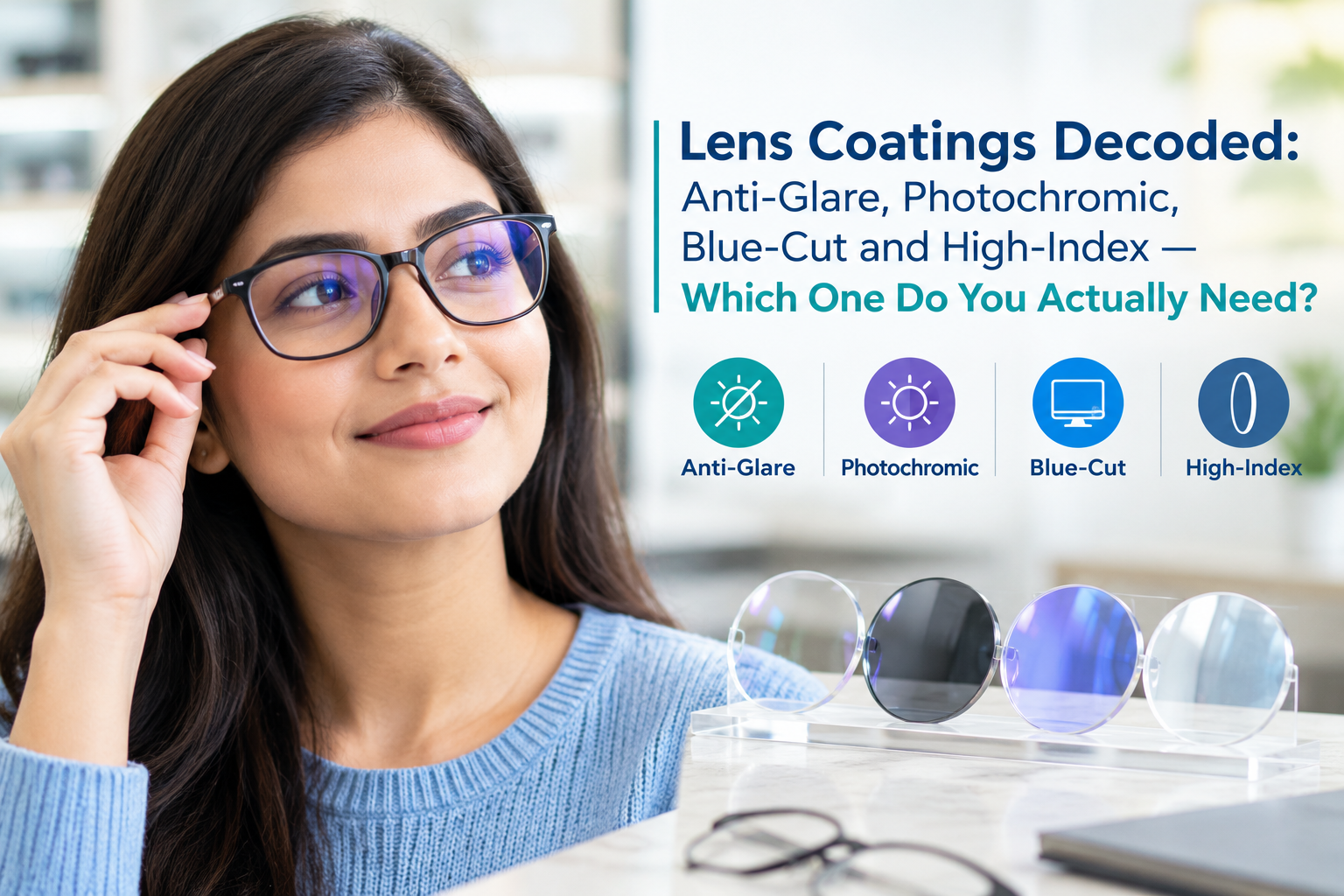
Lens Coatings Decoded: Anti-Glare, Photochromic, Blue-Cut and High-Index — Which One Do You Actually Need?
Every time a patient collects a new pair of glasses in Indirapuram, Ghaziabad, or anywhere in NCR, a version of the same conversation happens at the optical counter. The optician mentions anti-glare coating. They may also mention blue-cut lenses. Photochromic is an option. High-index is available for an additional cost. The patient nods, selects something, and pays without being entirely sure what they have chosen or whether it is what their eyes actually need.
The confusion is understandable. These terms sound technical; they overlap in their marketing, and optical retail in India often presents all of them as broadly beneficial without distinguishing what each one specifically does, who it genuinely helps, and who is paying for a feature they will not notice the benefit of.
As the optical services specialist at Samyak Eye Care Clinic, Vaishali, serving families from Indirapuram, Kaushambi, Vaishali, and across Ghaziabad, I want to break this down clearly. Four coatings or lens types. Four different problems. Four different patients who benefit. If you know which problem you have, you know which lens you need.
Anti-Glare (Anti-Reflective) Coating: What It Actually Does
Anti-glare coating, also called anti-reflective or AR coating, is a thin film applied to both surfaces of the lens that reduces light reflecting off the lens surface. When light strikes an uncoated lens, some of it bounces off the back surface and enters the eye as a secondary reflection, contributing to glare and visual noise. AR coating suppresses this reflection by creating destructive interference in the reflected light waves.
What this means practically: the image you see through an AR-coated lens is cleaner and higher-contrast, because less light is being scattered by lens surface reflections. This is particularly noticeable in two situations: night driving, where headlights and street lights create strong reflections off uncoated lenses that can be genuinely distracting, and video calls or photographs, where the lens reflection that obscures the eyes in an uncoated pair is eliminated.
Anti-glare coating also allows more light to pass through the lens to the eye, slightly improving optical clarity, particularly in dim conditions.
Who genuinely benefits from anti-glare coating
Anyone who drives at night, works under fluorescent lighting, uses screens extensively, or is frequently in situations where the appearance of their eyes through the lenses matters (video calls, presentations, photography). In practical terms, anti-glare coating is beneficial for the majority of spectacle wearers and is the coating with the strongest general-purpose case. It is not optional in the way marketing sometimes suggests. For anyone who wears glasses regularly, anti-glare is the baseline coating worth having.
Blue-Cut Lenses: What They Do and What the Evidence Says
Blue-cut lenses, also called blue-light blocking lenses, contain a filter that absorbs a portion of the high-energy visible blue light emitted by LED screens, fluorescent lights, and digital devices. The filtering capacity varies significantly by product, from around 10 per cent of blue light blocked at the lower end to over 90 per cent in more heavily tinted versions.
Here is the honest clinical picture. The evidence that blue-cut lenses prevent or reduce digital eye strain is limited. Major ophthalmology bodies, including the American Academy of Ophthalmology, have reviewed the research and found that blue light from screens is not a significant cause of digital eye strain. The primary causes of eye fatigue from screen use are reduced blinking rate, sustained near focal demand, screen brightness, and poor ergonomics, none of which are addressed by blue-cut lenses.
Where blue-cut lenses do have a clearer evidence base is in sleep quality. Blue light suppresses melatonin production, and using screens in the hour before sleep can delay sleep onset. Blue-cut lenses worn in the evening may help reduce this effect for people who cannot avoid screen use before bed.
Who genuinely benefits from blue-cut lenses
People who use screens extensively in the evening and have difficulty falling asleep, and who cannot or do not want to use Night Mode on their devices. People who find the slight yellow tint of blue-cut lenses acceptable and notice subjective improvement in comfort during extended screen use. People who report screen fatigue may also benefit, though it is important to note that the fatigue is more likely caused by accommodation and blinking factors than blue light specifically, and blue-cut lenses are not the primary solution for those causes.
Blue-cut lenses are a reasonable choice for screen-heavy users who want an additional layer of protection and find them comfortable. They are not a substitute for proper ergonomics, regular breaks, adequate screen brightness management, or, where appropriate, binocular vision assessment to address accommodation-based fatigue.
Photochromic Lenses: The Right Choice for the Right Lifestyle
Photochromic lenses are clear indoors and automatically darken in response to UV light exposure when outdoors, functioning as sunglasses when the light conditions call for it and reverting to clear lenses indoors. The darkening typically takes under a minute. The clearing process, from dark to clear when moving indoors, takes somewhat longer, typically 3 to 5 minutes for modern photochromic lenses, though this varies by product and temperature (photochromic reactions are faster in cooler conditions).
The clinical advantage of photochromic lenses is convenience. A person who moves between indoor and outdoor environments frequently throughout the day carries one pair of glasses that functions in both settings. For people who find switching between prescription glasses and prescription sunglasses cumbersome, or who cannot always carry two pairs, photochromic lenses eliminate the problem entirely.
Who genuinely benefits from photochromic lenses
People who spend significant time in varying light conditions: those who commute on foot or by two-wheeler, who have outdoor lunch breaks, who work in settings where indoor-outdoor transitions are frequent. Also ideal for older children and teenagers in Indirapuram and Ghaziabad who are active outdoors and whose parents want UV protection without the management of separate sunglasses. Not ideal for people who primarily drive, as standard photochromic lenses do not darken sufficiently inside a car windscreen (which blocks much of the UV that triggers the photochromic reaction).
Some modern photochromic lenses now incorporate both blue-light filtering and photochromic technology in a single lens, providing screen protection indoors and sun protection outdoors. For eligible patients, this combination is available through our optical services at Samyak Eye Care Clinic.
High-Index Lenses: Not a Coating but a Material Upgrade That Matters
High-index lenses are not a coating; they are a different lens material with a higher refractive index than standard plastic. What this means practically: for the same prescription, a high-index lens is significantly thinner and lighter than a standard lens. The higher the refractive index, the thinner the lens for any given prescription.
This matters specifically for patients with moderate to high prescriptions. A -5D myopia prescription in standard plastic produces a lens that is visibly thick at the edges. The same prescription in a 1.67 or 1.74 high-index material produces a lens that is dramatically thinner, lighter, and more cosmetically acceptable in any frame. Thinner lenses also sit closer to the eye in a frame, reducing the distortion of the eye's appearance that thick lenses can cause.
Who genuinely benefits from high-index lenses
Anyone with a prescription above approximately +/-3D who prioritises lens thinness, frame versatility, and weight comfort. For higher prescriptions (+/-5D and above), high-index is not a luxury; it is a practical necessity for comfortable, cosmetically acceptable spectacle wear. For lower prescriptions, the benefit is present but less dramatic, and standard materials may be entirely adequate.
High-index lenses require anti-glare coating as a practical matter, because the higher refractive index of the material actually increases surface reflections compared to standard plastic. High-index lenses without anti-glare coating have noticeably more reflection than standard lenses with coating. If you are prescribed high-index lenses, anti-glare coating is not optional.
A Simple Decision Guide
Before selecting any lens coating at our optical services centre in Ghaziabad, ask these questions:
Do you drive at night or work under fluorescent lights? Anti-glare coating. This is the coating with the broadest benefit for most people.
Do you use screens in the evening and have sleep difficulty? Blue-cut lenses, used primarily in the evening.
Do you move between indoor and outdoor environments frequently? Photochromic lenses.
Is your prescription above +/-3D? High-index lenses, combined with anti-glare coating.
Do you spend 8+ hours on screens with significant eye fatigue? The primary assessment needed is a binocular vision evaluation, not a lens coating. Convergence insufficiency, accommodative dysfunction, or an inaccurate prescription are the more likely causes.
What No Lens Coating Can Do
Lens coatings do not correct an inaccurate prescription. They do not treat convergence insufficiency. They do not address digital eye strain caused by accommodation demand or reduced blinking. They do not replace the need for a current, accurate refractive assessment. And they do not substitute for the comprehensive eye examination that identifies whether eye strain is optical, binocular, or related to an underlying eye health condition.
This matters because patients in Indirapuram and Ghaziabad sometimes spend significantly on upgraded lens coatings while the actual cause of their eye discomfort, an outdated prescription or an undiagnosed binocular vision problem, remains unaddressed. At Samyak Eye Care Clinic, we always ensure the prescription is accurate before making any lens material or coating recommendation.
Frequently Asked Questions
Q: Is anti-glare coating worth it on spectacles?
A: Yes, for most people. Anti-glare coating reduces lens surface reflections, improving visual clarity and contrast, particularly in artificial lighting and for night driving. It also eliminates the visible reflections on the lens surface that obscure the eyes in photographs and video calls. For regular spectacle wearers, anti-glare coating is the single most broadly beneficial upgrade available.
Q: Do blue-cut lenses really help with screen use?
A: The evidence that blue-cut lenses reduce digital eye strain specifically is limited. The primary causes of screen eye fatigue are reduced blinking, accommodation demand, and brightness. Blue-cut lenses may improve sleep quality for evening screen users by reducing melatonin suppression. If screen fatigue persists despite blue-cut lenses, a binocular vision assessment is the more clinically appropriate next step.
Q: What are high-index lenses used for?
A: High-index lenses use a denser material that bends light more efficiently, producing a thinner and lighter lens for the same prescription compared to standard plastic. They are most beneficial for prescriptions above +/-3D, where standard materials produce lenses that are visibly thick and heavy. High-index lenses should be combined with anti-glare coating.
Q: How long does a lens coating last?
A: Anti-glare and blue-cut coatings on high-quality lenses typically last 2 to 3 years with appropriate care before significant degradation of the coating is visible. Avoid cleaning lenses with shirt fabric or tissues, which micro-scratch the coating surface. Use a clean, damp microfibre cloth with lens cleaning solution. Photochromic lenses maintain their light-reactive properties for the life of the lens material under normal use conditions.
Q: Where can I get expert optical advice in Ghaziabad?
A: Samyak Eye Care Clinic in Vaishali, Ghaziabad provides comprehensive optical services including prescription verification, lens material and coating guidance, and frame fitting. We serve patients from Indirapuram, Kaushambi, Vaishali, Surya Nagar, and across NCR. Visit our clinic for an appointment.
The Right Lens for the Right Life
Spectacle lenses are a medical device, not a retail product. The right coating is the one that addresses your specific visual environment and lifestyle, confirmed by an accurate prescription and an honest conversation about what each option actually does. At Samyak Eye Care Clinic, that conversation is part of every optical consultation. Visit our clinic at Vaishali, Ghaziabad, and let us help you choose what your eyes actually need.
Book Your Optical Consultation in Ghaziabad Today
Dr. Shalini Jain | Samyak Eye Care Clinic | Vaishali, Ghaziabad
Call: 98999 60700


