
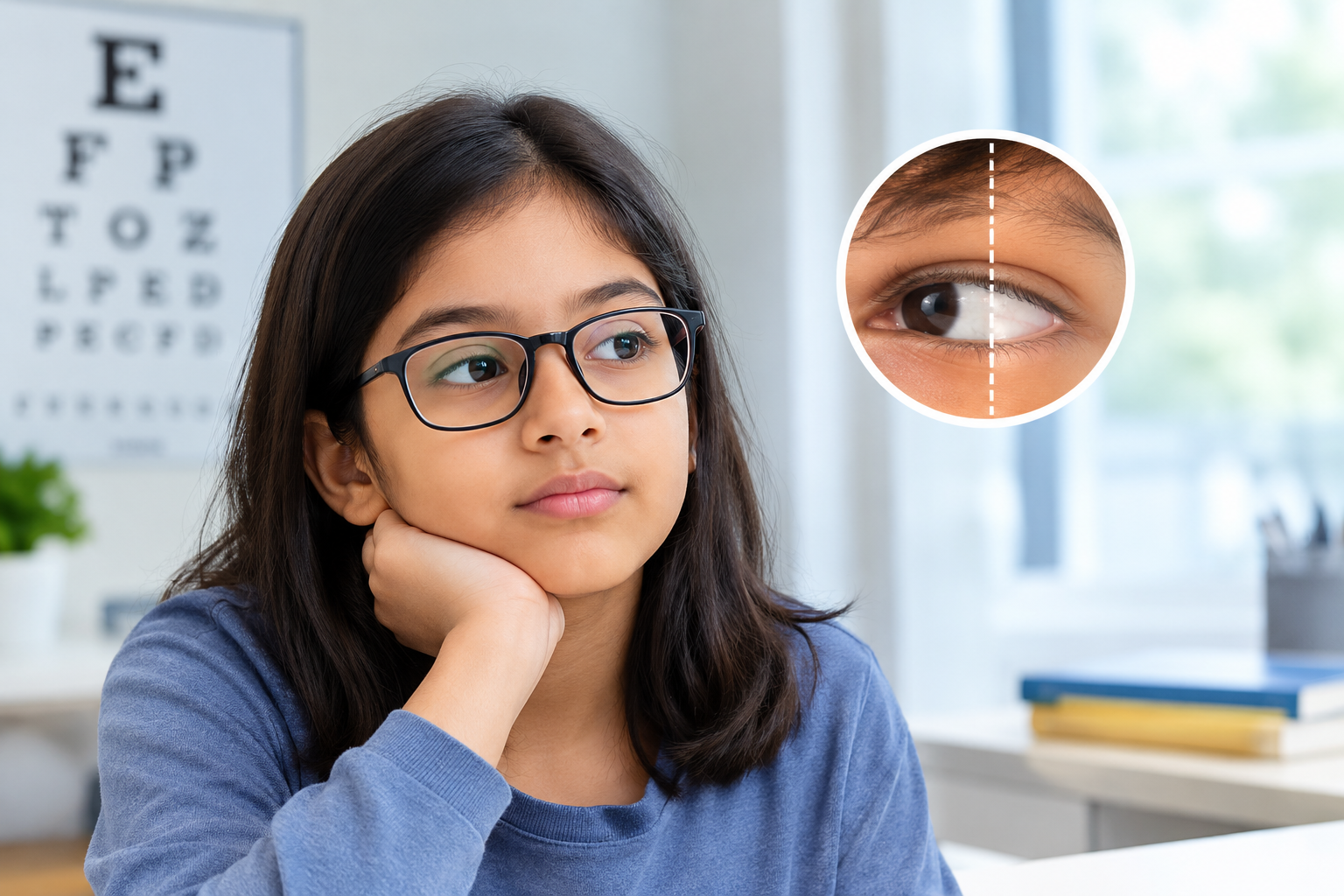
Lazy Eye in Older Children: What East Delhi Parents Can Still Do After the Critical Window
The appointment that breaks a parent's heart is not always the one where amblyopia is first diagnosed. It is often the one where they are told, several years later, that they did not know about it in time.
A family from East Delhi came to Samyak Eye Care Clinic with their 11-year-old son. He had been wearing glasses for myopia since age 7, but no one had ever checked whether both eyes were actually contributing to his vision. At his examination, we found significant amblyopia in his right eye: a visual acuity of 6/36 compared to 6/6 in the left. His prescription had been updated three times since age 7. No one had tested each eye independently. No one had noticed that one eye was barely functioning.
The parents asked the question I expected: can it be fixed? My answer was the honest clinical one, and it is the answer this blog is built around. At 11, the treatment window for amblyopia is not fully closed, but it is significantly narrowed. What is possible at 11 is not what was possible at 4. And what is possible at 14 is less again. Understanding this spectrum, rather than simply hearing a yes or a no, is what allows families to make informed decisions about pursuing treatment.
As the vision therapy specialist serving East Delhi families from our clinic in Vaishali, Ghaziabad, I want to address this honestly. This blog is not for parents who want reassurance. It is for parents who want the truth and want to know what to do with it.
What the Critical Period Actually Means and Why It Is Not a Hard Cutoff
The clinical teaching around amblyopia has historically emphasised a rigid critical period ending at 7 to 8 years of age, after which treatment was considered largely ineffective. This framing, while grounded in real biology, is now understood to be an oversimplification.
The visual cortex does retain plasticity beyond age 8, but this plasticity decreases progressively with age. The PEDIG (Pediatric Eye Disease Investigator Group) trials from the United States, which represent the largest and most rigorous body of amblyopia treatment research available, produced findings that changed clinical thinking meaningfully:
In children aged 7 to 12, patching treatment for amblyopia produced clinically meaningful visual improvement in the majority of participants, with an average gain of approximately 2.4 lines of visual acuity.
Children aged 13 to 17 showed smaller but still statistically significant improvements with patching, challenging the traditional view that treatment after adolescence onset is futile.
Response to treatment was better in children who had not previously received any amblyopia treatment, regardless of age at presentation.
What this means clinically: an 11-year-old with amblyopia who has never been treated is not in the same position as an 11-year-old who was treated at 5 and did not respond. For the previously untreated older child, meaningful improvement is achievable, even if the ceiling is lower than it would have been at age 4.
What Treatment for Older Children Involves
The principles of amblyopia treatment do not change with age: improve the clarity of the image reaching the amblyopic eye, and force the brain to use that eye by reducing or eliminating the input from the stronger eye. What changes is the combination of approaches and the realistic expectations for outcome.
Optical correction first
The most consistently effective first step, at any age, is ensuring the amblyopic eye has the best possible optical correction. In many older children who were missed during the early years, the refractive error in the amblyopic eye was either uncorrected or under-corrected. Full optical correction alone, worn consistently for 18 to 24 weeks, produces measurable visual improvement in a significant proportion of children before any additional treatment is started. This is the foundation.
Patching and atropine penalisation
Patching the stronger eye to force the brain to use the amblyopic eye remains a core treatment approach for older children. The PEDIG research confirms it produces meaningful improvement in children through at least age 12, and some benefit in teenagers. The challenge with older children is compliance: a 12-year-old is significantly more socially aware than a 5-year-old and far more resistant to wearing a visible eye patch at school.
Atropine penalisation, using drops in the stronger eye to temporarily blur its vision, is often more acceptable to older children because it is invisible. The clinical outcomes are comparable to patching in many studies. For families in East Delhi and surrounding areas where school social dynamics are a barrier to patch compliance, atropine deserves serious consideration.
Vision therapy for amblyopia
This is where the approach for older children, particularly those with access to a qualified vision therapy programme, differs meaningfully from the patching-only approach. Active vision therapy using binocular treatment activities, where both eyes are engaged simultaneously but in a way that forces the amblyopic eye to contribute, has shown promising results in older children and adults in clinical research.
Binocular treatment approaches, including dichoptic therapy (where different images are presented to each eye, requiring the amblyopic eye to process its input for the full image to be visible) and game-based visual training, have produced improvements in visual acuity and stereoacuity in older amblyopes that patching alone does not achieve. At Samyak Eye Care Clinic, our Eye Gym vision therapy programme incorporates these techniques as part of a structured treatment plan tailored to the individual child's acuity, age, and previous treatment history.
What Cannot Be Promised and Why That Honesty Matters
I am not going to tell every family with an older amblyopic child that treatment will restore full normal vision. For some children, it will not, and a clinician who promises otherwise is not being fair to the family.
The realistic goals for treatment of amblyopia in children aged 9 to 14 are:
Meaningful improvement in the acuity of the amblyopic eye, typically 1 to 3 lines of Snellen improvement with consistent treatment
Improvement in the functional use of both eyes together, even if perfect stereopsis is not achievable
Prevention of further deterioration, since untreated amblyopia does not remain static
Better functional vision for driving (which requires minimum standards in both eyes), career pathways, and daily tasks that require reliable binocular vision
These are meaningful goals. They are not the goals that were available at age 4, but they represent genuine clinical benefit that is worth pursuing. The family from East Delhi described at the opening of this blog pursued treatment for their 11-year-old. After 18 months of consistent patching combined with vision therapy sessions, his amblyopic eye improved from 6/36 to 6/12. Not normal. But a significant functional improvement that will matter for the rest of his life.
The Practical Questions East Delhi Parents Ask
How long will treatment take?
For older children, treatment programmes typically run for 12 to 24 months of consistent effort. Progress is slower than in young children because neural plasticity is reduced. Commitment and consistency from both the child and the family are essential. A child who patches for 2 hours daily and attends vision therapy sessions regularly will achieve better outcomes than one who does so intermittently.
Will treatment interfere with school?
This is a real concern for families in East Delhi where academic pressure is significant. I work with families to schedule patching hours in ways that minimise school impact: evening patching after homework, atropine drops instead of visible patches, and vision therapy sessions at times that do not conflict with tuition classes. The treatment can be structured around a child's life, not the other way around.
Is it still worth starting if my child is 13 or 14?
Clinically, yes. The PEDIG research found benefits even in teenagers. The absolute improvement may be smaller, but preventing further deterioration and maximising the functional vision available from the amblyopic eye has lifelong value. An untreated amblyopic eye in an adult is at greater risk of functional disability if anything happens to the fellow eye.
Frequently Asked Questions
Q: Can lazy eye be treated after age 8?
A: Yes. Clinical research including the PEDIG trials demonstrates meaningful visual improvement with amblyopia treatment in children aged 7 to 12, and some benefit in teenagers. The improvement is smaller than what is achievable before age 7, but clinically significant. An untreated amblyopic child should always be assessed for treatment potential, regardless of age.
Q: What is the best treatment for lazy eye in older children?
A: Full optical correction is the non-negotiable first step. Atropine penalisation is often preferred over patching in older children for compliance reasons. Active vision therapy, particularly binocular treatment approaches, can produce improvements in visual acuity and binocular function that patching alone does not achieve. A personalised combination based on the child's age, acuity level, and prior treatment history is the correct approach.
Q: At what age can lazy eye no longer be corrected?
A: There is no absolute age at which treatment becomes completely futile. The potential for improvement decreases with age, but even adults with amblyopia have shown measurable responses to structured treatment in research settings. For children under 14, a trial of treatment with realistic expectations set upfront is always clinically justified.
Q: My child is 10 and was just diagnosed with lazy eye. What should I do?
A: Begin treatment without delay. Every month at this age still has clinical value. Start with a comprehensive eye examination to establish exact acuity levels, confirm the optical correction is optimal, and discuss the treatment plan. Contact Samyak Eye Care Clinic in Vaishali, Ghaziabad for an assessment. We serve families from across East Delhi and NCR.
Q: Where can I find vision therapy for lazy eye near East Delhi?
A: Samyak Eye Care Clinic in Vaishali, Ghaziabad offers comprehensive lazy eye management and vision therapy through our Eye Gym, serving families from East Delhi, Indirapuram, Kaushambi, and Surya Nagar. Visit our clinic to book an assessment.
Later Than Ideal Is Not Too Late
That 11-year-old from East Delhi has a visual acuity in his amblyopic eye today that is three times better than when he first came to us. His parents grieve the years that were lost. That is understandable. But they also made a decision to act with the time that remained, and it made a real difference to their son's visual future.
If your child has been diagnosed with lazy eye at an age that feels too late, visit our clinic for an honest assessment of what is achievable. We will not make promises that are not supported by evidence. But we will not give up on your child's vision without a thorough attempt.
Book a Lazy Eye Assessment for Your Child Today
Dr. Shalini Jain | Samyak Eye Care Clinic | Vaishali, Ghaziabad
Call: 98999 60700


