
Keratoconus: Your Questions Answered by an Eye Care Expert
"Doctor, my glasses prescription keeps changing every few months. The optician says my cornea looks different. What's happening to my eyes?"
This is one of the most common ways patients first describe keratoconus to us. They've often been to multiple opticians, tried several glasses, and still can't see clearly. By the time they reach a specialist, they're confused and worried.
If you're searching for answers about keratoconus symptoms or wondering whether you might have this condition, this guide answers the questions we hear most often at our clinic.
What Exactly is Keratoconus?
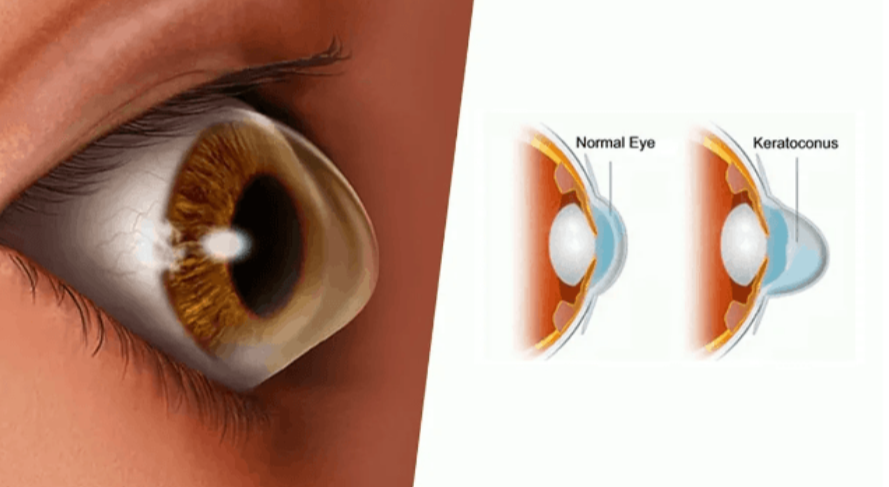
Keratoconus is a progressive eye condition where your cornea – the clear, dome-shaped front surface of your eye – gradually thins and bulges outward into a cone shape. Instead of being round like a football, the cornea becomes shaped more like a rugby ball.
This irregular shape causes light to scatter instead of focusing properly on the retina, resulting in distorted, blurry vision that glasses often can't fully correct.
The condition typically begins in the teenage years or early twenties and may progress for 10-20 years before stabilising. However, the rate of progression varies greatly from person to person.
What Are the Early Warning Signs of Keratoconus?
Early keratoconus symptoms are often subtle and easily mistaken for ordinary vision problems. Watch for these signs:
Frequent prescription changes – Needing new glasses every few months
Glasses don't help anymore – Even new glasses don't give clear vision
Ghosting or double vision – Seeing multiple images from one eye
Light sensitivity – Glare and halos around lights, especially at night
Blurred vision at all distances – Neither distance nor reading glasses work well
Eye strain and headaches – From constantly straining to see clearly
Difficulty driving at night – Streaking lights and poor contrast vision
If you're experiencing any of these symptoms, especially if you're under 30, it's worth getting checked by a keratoconus specialist.
Worried about your symptoms? Book a comprehensive corneal evaluation. Call 98999 60700
What Causes Keratoconus? Did I Do Something Wrong?
This is a question we hear often, and the answer is: no, you didn't cause this. Keratoconus develops due to a combination of factors:
Genetics – About 10% of keratoconus patients have a family member with the condition
Eye rubbing – Chronic, vigorous eye rubbing is strongly linked to keratoconus progression
Allergies – People with allergies tend to rub their eyes more frequently
Other conditions – Sometimes associated with Down syndrome, connective tissue disorders, and certain eye conditions
One thing we always emphasise: stop rubbing your eyes. If you have allergies that make your eyes itchy, get them treated properly. Eye rubbing can accelerate keratoconus progression significantly.
How is Keratoconus Diagnosed?
Keratoconus cannot be diagnosed with a basic eye test. At our Vaishali clinic, we use specialised corneal imaging technology that maps the shape and thickness of your cornea in detail.
The diagnostic process includes:
Corneal topography – Creates a colour-coded map of your cornea's surface curvature
Pachymetry – Measures corneal thickness at multiple points
Slit-lamp examination – Direct visualisation of corneal changes
Refraction testing – Checking for irregular astigmatism that doesn't correct fully
Early detection is crucial. The sooner we diagnose keratoconus, the more treatment options are available.
What Are the Treatment Options for Keratoconus?
Treatment depends on how advanced your keratoconus is and how quickly it's progressing. Here's what's available:
Early Stage: Glasses and Soft Contact Lenses
In mild cases, regular glasses or soft contact lenses may still provide acceptable vision. However, as the condition progresses, these typically become inadequate.
Moderate Stage: Speciality Contact Lenses
This is where most keratoconus patients find the best vision correction:
Rigid Gas Permeable (RGP) lenses – Create a smooth optical surface over the irregular cornea
Scleral lenses – Larger lenses that vault over the entire cornea, providing excellent comfort and vision. We offer advanced Scleral lens fitting at our clinic.
Hybrid lenses – Rigid centre with soft skirt, combining clarity with comfort
To Halt Progression: Corneal Cross-Linking (C3R)
If keratoconus is progressing, corneal cross-linking can strengthen the cornea and stop further thinning. This procedure uses UV light and riboflavin (vitamin B2) drops to create new bonds between corneal fibres, essentially "hardening" the cornea.
Cross-linking doesn't improve vision on its own, but it can prevent the condition from getting worse, which is why early detection matters so much.
Advanced Stage: Corneal Transplant
In severe cases where contact lenses no longer work and the cornea has significant scarring, corneal transplantation may be necessary. However, with modern treatments, fewer than 20% of keratoconus patients ever need a transplant.
Will I Go Blind from Keratoconus?
This is often the biggest fear patients have. The reassuring answer: keratoconus does not cause complete blindness. With proper management, most people with keratoconus maintain functional vision throughout their lives.
The key is appropriate treatment. Whether that's speciality contact lenses, cross-linking to stop progression, or in rare cases transplantation – there are effective options at every stage.
Can Children Have Keratoconus?
Yes, and in fact, keratoconus often begins in the teenage years. Children with rapidly changing prescriptions, especially those with allergies and a habit of rubbing their eyes, should be screened.
Our paediatric eye examinations include screening for corneal irregularities, allowing us to catch keratoconus early when intervention is most effective.
Keratoconus Management at Samyak Eye Care
Managing keratoconus requires specialised expertise – not every eye clinic is equipped to diagnose and treat this condition properly. At Samyak Eye Care Clinic, our keratoconus management programme offers:
Advanced corneal imaging for accurate diagnosis and monitoring
Expert fitting of Scleral lenses, RGP lenses, and hybrid options
Cross-linking referral coordination when needed
Ongoing monitoring to track progression
25+ years of experience managing complex corneal conditions
Have More Questions? We're Here to Help
Keratoconus can feel overwhelming when you first learn about it. But with the right specialist and proper management, most people with this condition lead completely normal lives with excellent functional vision.
At Samyak Eye Care Clinic, we've helped patients from Vaishali, Ghaziabad, Indirapuram, Kaushambi, Surya Nagar, and East Delhi manage their keratoconus successfully. If you have questions or concerns about your corneal health, we're here to provide answers – and solutions.
BOOK YOUR KERATOCONUS CONSULTATION TODAY
Call: 98999 60700
Website: www.samyakeyecare.com
Location: Gaur Heights, Sector 4, Vaishali, Ghaziabad
Serving East Delhi | Vaishali | Ghaziabad | Indirapuram | Kaushambi | Surya Nagar | Delhi NCR


