
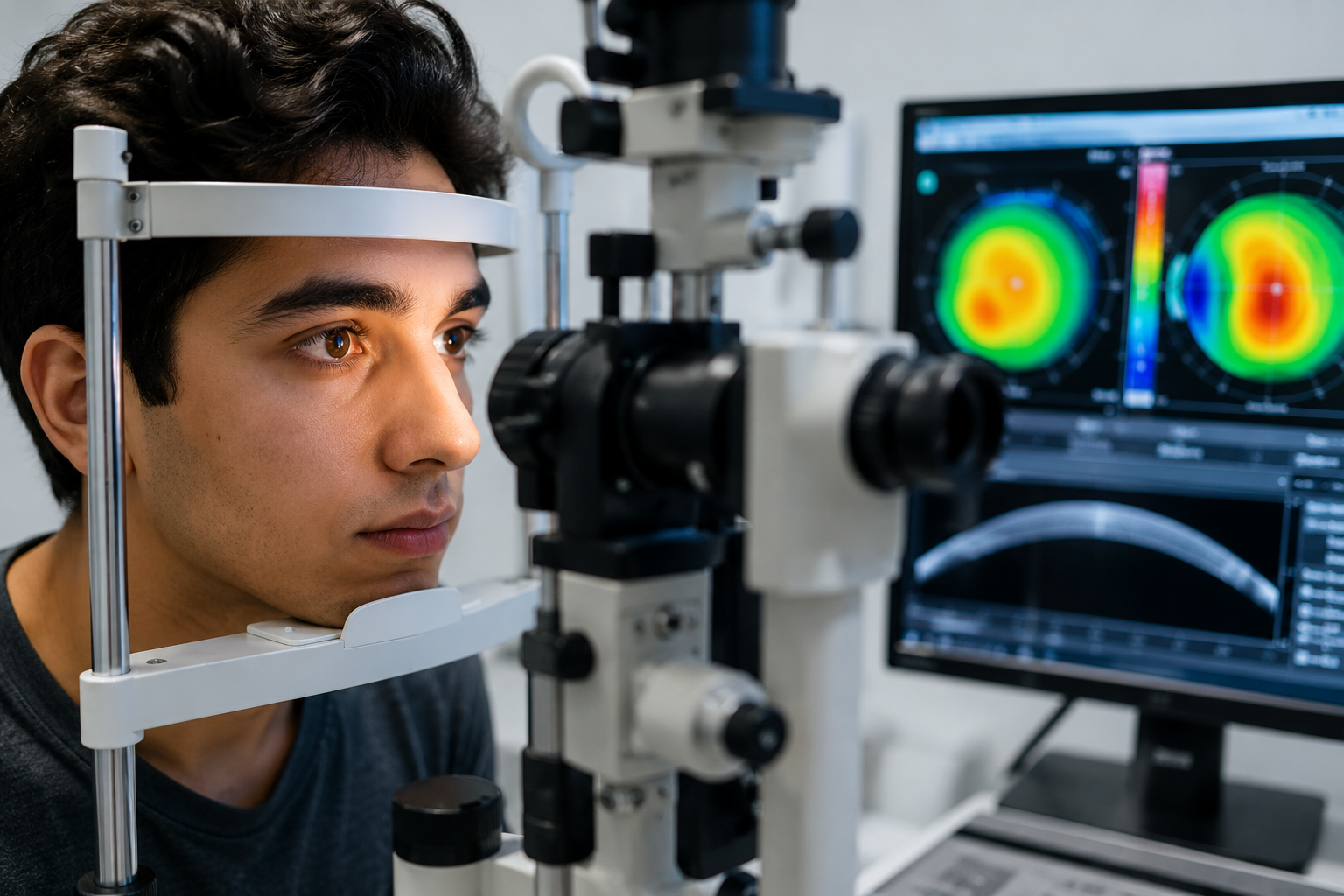
Keratoconus in Young Adults: Early Signs and Treatment Options
A 19-year-old engineering student from Indirapuram came to see me after his optician suggested something was wrong with his cornea. His glasses prescription had changed three times in two years, each time failing to provide the clear vision he remembered having in school. His new glasses never felt quite right — vision remained slightly blurry, particularly at night. The diagnosis was keratoconus, and we had caught it at a pivotal moment.
Keratoconus affects approximately 1 in 2,000 people, though recent studies suggest it may be more common than previously recognised. It typically begins during adolescence or early adulthood, progressing through the twenties before usually stabilising in the thirties. This timing coincides with critical years for education and career development, making early detection and proper management essential.
As the best eye specialist near Indirapuram with extensive experience managing keratoconus, I help young adults understand this condition, recognise early warning signs, and access treatments that can preserve vision and prevent progression.
Understanding Keratoconus
Keratoconus is a progressive condition in which the cornea — the clear front surface of the eye — gradually thins and bulges outward into a cone-like shape. This structural change distorts vision in ways that glasses cannot fully correct, because the irregular corneal surface creates optical aberrations that standard lenses cannot compensate for.
The condition typically affects both eyes, though often asymmetrically. One eye may progress faster or become more severe than the other. Vision may fluctuate, with good days and bad days that seem unpredictable.
Why keratoconus develops remains incompletely understood. Genetic factors play a role — if a parent or sibling has keratoconus, the risk increases significantly. Eye rubbing, particularly vigorous and chronic rubbing, appears to contribute to progression. Certain systemic conditions and allergies correlate with a higher incidence.
The best eye doctor in Indirapuram screens for keratoconus in young patients with changing prescriptions, unexplained visual symptoms, or a family history of the condition.
Early Warning Signs
Early keratoconus often masquerades as ordinary refractive error. Vision becomes blurry, and glasses seem to help — at least initially. But certain patterns should raise suspicion:
Frequent prescription changes, particularly increases in astigmatism, may indicate corneal irregularity rather than simple refractive shift. If your prescription changes significantly every 6-12 months, especially during late teens or twenties, keratoconus deserves consideration.
Glasses that never seem quite right despite accurate prescriptions suggest optical aberrations that standard lenses cannot correct. Patients often describe vision as acceptable but not crisp, or report that new glasses work well initially but seem to deteriorate quickly.
Night vision difficulties — halos around lights, glare sensitivity, or reduced clarity in dim conditions — often appear before daytime vision is significantly affected. The irregular cornea scatters light in ways that become more apparent when pupils dilate in darkness.
Ghost images, double vision from a single eye, and distortion of straight lines (they appear wavy or tilted) suggest higher-order aberrations typical of keratoconus.
Why Early Detection Matters
Keratoconus is progressive during its active phase, typically from diagnosis through the mid-thirties. Vision lost to progression cannot be fully recovered — only preserved at its current level. This makes early detection crucial: the sooner keratoconus is identified, the more vision can potentially be preserved.
Modern treatments can halt or significantly slow progression when initiated early. Corneal cross-linking, in particular, has transformed keratoconus management by strengthening the cornea and preventing further bulging. This treatment works best when performed before significant progression has occurred.
Vision correction options are also more effective in earlier stages. Mild keratoconus may be manageable with glasses or standard soft contact lenses. Moderate cases require speciality lenses. Advanced cases may eventually require corneal transplantation — a more invasive intervention with longer recovery and less predictable outcomes.
Our keratoconus management programme emphasises early detection, regular monitoring, and timely intervention to preserve the maximum possible vision.
Diagnostic Approaches
Keratoconus is diagnosed through corneal topography — specialised imaging that maps the shape of the cornea with microscopic precision. This technology detects even subtle irregularities that routine eye examinations miss, allowing diagnosis at earlier stages than was previously possible.
Corneal thickness measurement (pachymetry) identifies the thinning characteristic of keratoconus. Advanced imaging can track changes over time, detecting progression before it becomes visually significant.
The best eye specialist in Indirapuram uses these technologies routinely when evaluating young adults with suspicious symptoms or risk factors. Early-stage keratoconus identified through screening may have no symptoms at all — detection depends entirely on appropriate testing.
Treatment Options for Young Adults
Vision Correction:
In early stages, glasses or soft contact lenses may provide adequate vision. As the cornea becomes more irregular, speciality lenses become necessary. Scleral lenses — large-diameter rigid lenses that vault over the cornea — provide excellent vision for many keratoconus patients by creating a smooth optical surface over the irregular cornea. These lenses also provide superior comfort to smaller rigid lenses and can be worn throughout long academic or work days.
Corneal Cross-Linking:
This outpatient procedure uses riboflavin (vitamin B2) drops and ultraviolet light to strengthen corneal collagen fibres, halting or significantly slowing progression. Cross-linking does not restore lost vision but prevents further deterioration. For young adults with documented progression, early cross-linking can preserve the current level of vision for decades.
Intracorneal Ring Segments:
These small plastic inserts, implanted within the cornea, can reshape the irregular surface and improve glasses or contact lens correction. They are often used in combination with cross-linking for moderate keratoconus.
Corneal Transplantation:
Reserved for advanced cases where other treatments are insufficient, transplantation replaces the damaged cornea with a healthy donor cornea. Modern techniques have improved outcomes, but recovery is prolonged, and some degree of speciality lens wear often remains necessary. The goal of earlier intervention is to prevent the need for transplantation.
Living with Keratoconus as a Young Adult
A keratoconus diagnosis can feel overwhelming, particularly when it comes during crucial academic or early career years. Understanding that modern management options exist — and that most people with keratoconus maintain functional vision throughout their lives — provides important reassurance.
Adaptation to speciality lenses typically requires patience. Scleral lenses, while highly effective, involve a learning curve for insertion, removal, and care. Most young adults master the techniques within a few weeks and find that clear, comfortable vision justifies the effort.
Avoiding eye rubbing becomes essential. Vigorous rubbing can accelerate progression and should be eliminated regardless of how itchy or tired the eyes feel. If allergies drive the urge to rub, treating the allergies becomes part of keratoconus management.
Regular monitoring allows timely intervention if progression occurs. At our clinic, we schedule follow-ups based on individual risk profiles, ensuring that any changes are detected and addressed promptly.
Frequently Asked Questions
Q: Can keratoconus be cured?
A: Keratoconus cannot be cured in the sense of returning the cornea to normal shape. However, progression can be halted with cross-linking, and vision can be effectively corrected with speciality lenses. Most patients maintain excellent functional vision throughout their lives with proper management.
Q: Will I eventually need a corneal transplant?
A: Most keratoconus patients never require transplantation, particularly with early detection and modern management. A transplant is reserved for advanced cases where other options are insufficient. Early intervention specifically aims to prevent reaching this stage.
Q: Can I still pursue my career with keratoconus?
A: Most careers remain fully accessible with proper vision correction. Even careers requiring excellent vision — medicine, engineering, design — are typically compatible with well-managed keratoconus. Specific requirements (such as military or pilot standards) may need individual assessment.
Q: Is keratoconus hereditary? Should my siblings be checked?
A: Keratoconus has genetic components. If you have keratoconus, siblings and children face an elevated risk and should undergo screening, even if asymptomatic. Early detection in family members allows preventive monitoring.
Q: How often should I have my keratoconus monitored?
A: During active progression years (typically teens through thirties), monitoring every 6-12 months is recommended. The best eye doctor in Indirapuram adjusts frequency based on individual progression patterns and treatment status.
Q: Where can I get keratoconus treatment near Indirapuram?
A: Dr. Shalini Jain at Samyak Eye Care — the best eye specialist near Indirapuram — provides comprehensive keratoconus management, including speciality lens fitting. Our Vaishali clinic is easily accessible from Indirapuram.
Take Control of Your Vision
That engineering student from Indirapuram? After cross-linking halted his progression and properly fitted Scleral lenses restored clear vision, he completed his degree without further visual deterioration. He now works as a software developer, wearing his lenses comfortably through long workdays. Early detection and appropriate management preserved his options.
If you are experiencing changing prescriptions, persistent blur despite glasses, or night vision difficulties, do not assume these are normal variations. Have your corneas evaluated properly. Visit our clinic for a comprehensive assessment that can detect keratoconus at its earliest, most manageable stage.
Get Your Corneas Evaluated
Dr. Shalini Jain | Samyak Eye Care Clinic | Vaishali, Ghaziabad
Call: 98999 60700


