
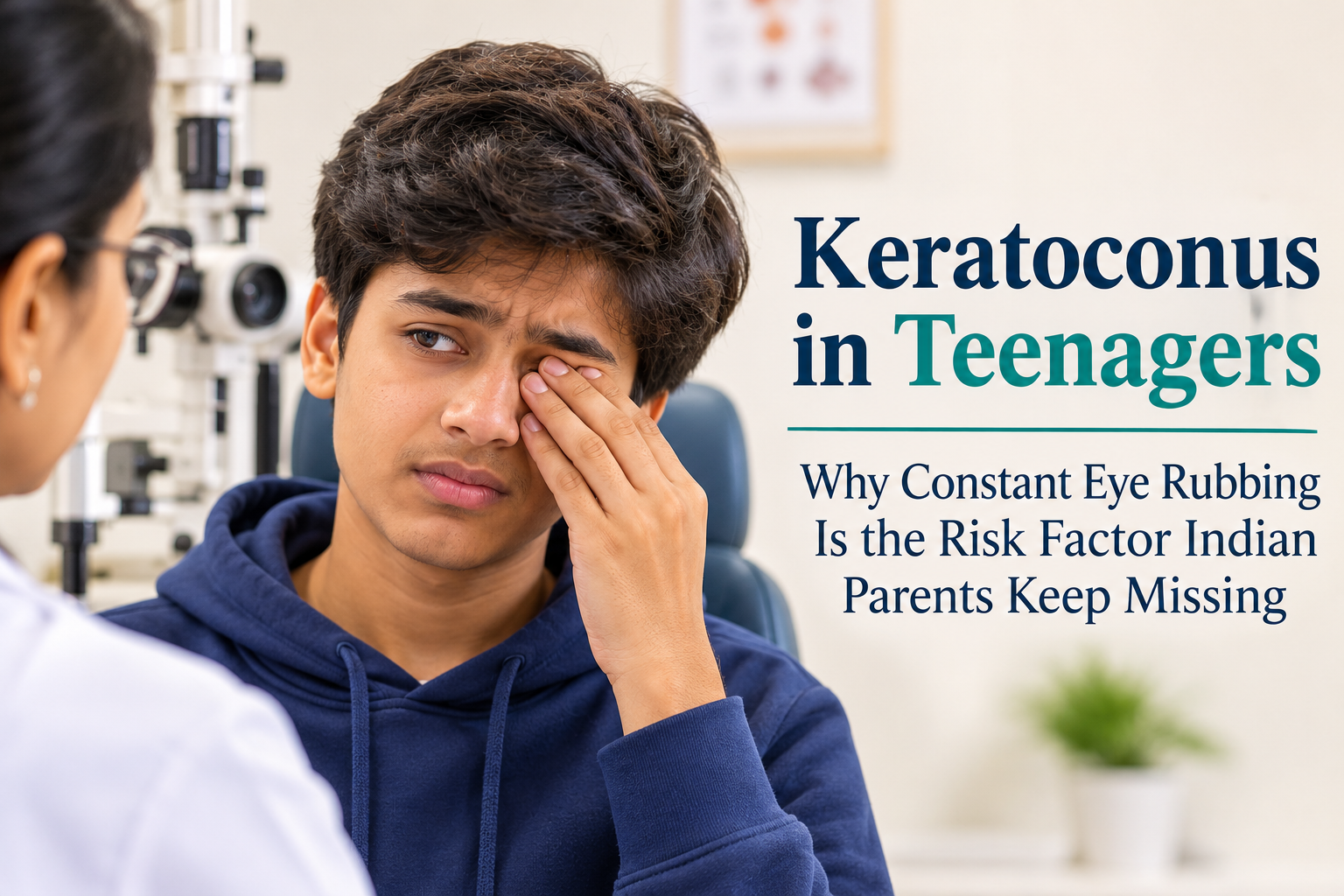
Keratoconus in Teenagers: Why Constant Eye Rubbing Is the Risk Factor Indian Parents Keep Missing
In my clinical experience at Samyak Eye Care Clinic, the most common statement from the parents of a teenager newly diagnosed with keratoconus is a variation of the same thing: I thought rubbing eyes was just a habit. Or, all children rub their eyes. They did not know that in a person with genetic susceptibility to keratoconus, vigorous and persistent eye rubbing is not a harmless habit. It is a mechanism that can actively drive the progression of a sight-threatening corneal condition.
A 16-year-old from Ghaziabad presented to our clinic with a three-year history of increasing prescription changes and persistent eye rubbing that his parents had attributed to seasonal allergies. Corneal topography revealed moderate keratoconus in both eyes, more advanced in the right. When I took his history carefully, a clear picture emerged: he had allergic conjunctivitis that had never been adequately managed, had been rubbing his eyes vigorously for most of his waking hours for years, and had a family history of one parent with a high, irregular prescription that had never been formally evaluated. All three factors were present simultaneously.
As the keratoconus specialist at Samyak Eye Care Clinic, Vaishali, Ghaziabad, I want to explain the eye rubbing connection clearly, because it is the most actionable risk factor in keratoconus that families can identify and address before significant corneal damage has occurred.
The Relationship Between Eye Rubbing and Keratoconus
Keratoconus is a progressive corneal condition in which the cornea gradually thins and steepens into an irregular cone shape, distorting vision in ways that glasses and standard contact lenses cannot fully correct. It has a significant genetic component; relatives of a keratoconus patient have substantially elevated risk compared to the general population.
The role of eye rubbing in keratoconus is not merely correlational. Research has proposed and increasingly supported a biomechanical mechanism: vigorous eye rubbing generates elevated intraocular pressure within the eye for the duration of the rubbing episode, and this pressure is applied to a cornea that, in susceptible individuals, has structurally weaker collagen crosslinks than a normal cornea. Over years of repeated vigorous rubbing, this mechanical stress degrades the already-weakened corneal structure and accelerates the thinning and steepening that characterise keratoconus progression.
A review published in the journal Eye found that eye rubbing was reported in up to 66 per cent of keratoconus patients, and that vigorous rubbing specifically (as opposed to gentle dabbing) was associated with more rapid progression. The clinical implication is not that eye rubbing causes keratoconus from nothing, but that in a person with the underlying genetic susceptibility, it is one of the most significant modifiable acceleration factors.
Why Allergic Conjunctivitis Is the Driver in Most Indian Teenagers
The most common reason teenagers rub their eyes vigorously is allergic conjunctivitis. And here is the clinically important link: India has high rates of allergic conjunctivitis, driven by the combination of year-round dust and pollen, and from October onwards, the severe air pollution season in North India. Delhi NCR in October and November is one of the highest-pollution urban environments in the world, and particulate matter and allergens are both potent triggers for allergic eye symptoms.
A teenager with allergic conjunctivitis experiences intense, persistent itching that is temporarily relieved by rubbing. The relief is short-lived because rubbing releases more histamine from mast cells in the conjunctiva, which intensifies the itch, prompting more rubbing. This cycle, without adequate treatment of the underlying allergy, continues for years. During those years, if the teenager has the genetic susceptibility to keratoconus, the corneal damage accumulates.
The clinical priority: identify and adequately treat allergic conjunctivitis in teenagers with a family history of keratoconus, irregular prescriptions, or who show any early corneal topographic changes. Treating the allergy effectively removes the primary driver of the eye rubbing.
The Early Signs of Keratoconus in Teenagers That Parents Miss
Keratoconus in teenagers is frequently mistaken for simple myopia or astigmatism, because the early symptoms are nearly identical. The distinction that matters clinically is the pattern of change over time and the specific quality of the visual disturbance.
Rapidly changing prescription
In simple myopia, prescriptions change progressively but within expected ranges, typically 0.5 to 1 dioptre per year. In keratoconus, prescription changes are often larger, more irregular, and include increasing astigmatism with a shifting cylinder axis. A teenager whose prescription has changed significantly in both sphere and cylinder over two consecutive years, particularly with the astigmatism component increasing, warrants corneal topography to exclude keratoconus.
Glasses that do not seem to correct vision fully
Parents frequently describe this: the new glasses were prescribed just a few months ago, and their teenager is already saying vision is not quite right. In keratoconus, the irregular corneal surface scatters light in a way that standard sphero-cylindrical spectacle lenses cannot fully correct. The prescription may be as accurate as a standard refraction can measure, but the visual quality through the corrected glasses remains suboptimal. This complaint, current prescription does not seem to work properly, is a significant clinical flag.
Ghost images or shadow alongside objects
Monocular diplopia, where covering one eye still produces a doubled or shadowed image, is characteristic of irregular corneal surfaces including keratoconus. A teenager who describes seeing a ghost or shadow alongside objects when one eye is covered should have corneal topography performed. This symptom is pathological; myopia alone does not cause it.
Night glare and halos
The irregular corneal surface of keratoconus produces pronounced halos and glare around lights in low-light conditions, more severe than would be expected from the prescription alone. Many teenagers describe difficulty with night driving even at relatively mild prescription levels, or seeing multiple halos around streetlights and car headlights. In the context of a changing prescription and eye rubbing history, this symptom pattern warrants urgent corneal assessment.
Why the Timing of Diagnosis Determines the Treatment Options
This is the central clinical argument for early identification of keratoconus in teenagers, and it is the reason the eye rubbing connection matters so much in practice.
Corneal collagen cross-linking (C3R) is the intervention that halts keratoconus progression. It uses UV light and riboflavin (vitamin B2) drops to create additional cross-links between corneal collagen fibres, strengthening the corneal tissue and stopping the progressive thinning and steepening. The evidence for cross-linking in arresting keratoconus progression is robust and consistent across multiple clinical trials. Most patients who receive cross-linking at the appropriate time show stabilisation of their keratoconus with no further progression in long-term follow-up.
Cross-linking halts progression. It does not reverse existing corneal changes. This means the visual quality a patient achieves after cross-linking is determined by how much corneal irregularity existed at the time of treatment. A teenager treated at mild-to-moderate keratoconus achieves significantly better long-term vision than one treated at advanced keratoconus, even though the cross-linking itself is equally effective at halting further change in both cases.
For the 16-year-old from Ghaziabad, moderate keratoconus in both eyes required cross-linking followed by scleral lens fitting to achieve functional vision correction. Had his keratoconus been identified two to three years earlier, when his prescription was beginning to change and his corneal topography would have shown early changes, cross-linking at an earlier stage would have preserved a significantly better corneal profile and likely allowed correction with well-fitted rigid lenses or even glasses for longer.
What to Do If Your Teenager Rubs Their Eyes Constantly
This is the practical section that most parents in Ghaziabad and across NCR need most.
Step 1: Treat the underlying allergy
If a teenager is rubbing their eyes persistently, the first step is identifying and managing the cause. In India, allergic conjunctivitis is the most common driver. Appropriate management includes allergen avoidance where possible, antihistamine eye drops, mast cell stabiliser drops, and in some cases, low-potency steroid drops for acute flares under specialist supervision. The goal is to reduce the itch to the point where the rubbing becomes unnecessary, not merely less frequent.
Step 2: Establish the no-rubbing rule with genuine reinforcement
Stopping a habitual behaviour requires more than asking the teenager to stop. It requires understanding why they are rubbing (the itch) and providing an alternative (cold compresses or gentle dabbing with a clean cloth for temporary relief) while the underlying allergy is treated. The teenager needs to understand the clinical reason for the rule, not just experience it as an arbitrary parental instruction.
Step 3: Book a corneal topography assessment
Any teenager with persistent eye rubbing, particularly one with a family history of keratoconus or unusual prescriptions, or one whose prescription has been changing rapidly, should have corneal topography. This two-minute, non-invasive scan definitively reveals whether the cornea shows early keratoconus changes. Early topographic changes can be present years before any clinical symptoms develop, which is precisely the window in which preventive action is most effective.
Frequently Asked Questions
Q: Can rubbing your eyes cause keratoconus?
A: Eye rubbing does not cause keratoconus from nothing, but research strongly suggests that in individuals with genetic susceptibility to keratoconus, vigorous eye rubbing is a significant accelerating factor that drives progression. Studies report eye rubbing in up to 66 per cent of keratoconus patients, and vigorous rubbing specifically is associated with more rapid progression. Eliminating vigorous eye rubbing is a clinically important part of keratoconus management.
Q: At what age does keratoconus usually start?
A: Keratoconus typically becomes clinically apparent in the teenage years to early twenties, though topographic changes can be present earlier. The condition is most progressive during the teenage and young adult years, when corneal tissue is most susceptible to the mechanical and biomechanical forces that drive progression. This is why early identification during this period and prompt cross-linking when progression is confirmed produces the best long-term outcomes.
Q: What are the earliest signs of keratoconus in a teenager?
A: Early signs include rapidly changing prescription, particularly with increasing astigmatism and shifting cylinder axis; glasses that do not seem to correct vision fully despite a recent update; monocular ghost images or shadows alongside objects; and pronounced night glare and halos. These signs, combined with persistent eye rubbing and a family history of keratoconus, warrant urgent corneal topography assessment at a keratoconus specialist clinic in Ghaziabad.
Q: How can keratoconus progression be stopped?
A: Corneal collagen cross-linking (C3R) is the evidence-based treatment for halting keratoconus progression. It strengthens the corneal collagen structure and stops further thinning and steepening. Eliminating vigorous eye rubbing and treating the underlying cause (typically allergic conjunctivitis) is an essential complementary measure. Cross-linking is most effective when performed at mild to moderate stages, before significant corneal irregularity has accumulated.
Q: Where can I get my teenager's cornea assessed for keratoconus in Ghaziabad?
A: Samyak Eye Care Clinic in Vaishali, Ghaziabad provides comprehensive keratoconus evaluation and management, including corneal topography, tomography, and referral for cross-linking when indicated. We serve patients from across Ghaziabad, Vaishali, Indirapuram, Kaushambi, and NCR. Visit our clinic for an assessment.
The Habit That Was Not Just a Habit
The 16-year-old from Ghaziabad has had cross-linking in both eyes. His progression has been halted. His allergic conjunctivitis is now properly managed with appropriate drops, and the constant rubbing has stopped. His scleral lenses give him functional vision that allows him to attend school and study without significant difficulty. His parents wish, openly and without reservation, that someone had connected the rubbing to the keratoconus two years earlier.
If your teenager rubs their eyes constantly, do not accept it as just a habit. Ask why, treat the cause, and book corneal topography. Visit our clinic at Samyak Eye Care, Vaishali, Ghaziabad, for the assessment that tells you whether action is needed now.
Book Your Teenager's Keratoconus Screening Today
Dr. Shalini Jain | Samyak Eye Care Clinic | Vaishali, Ghaziabad
Call: 98999 60700


