
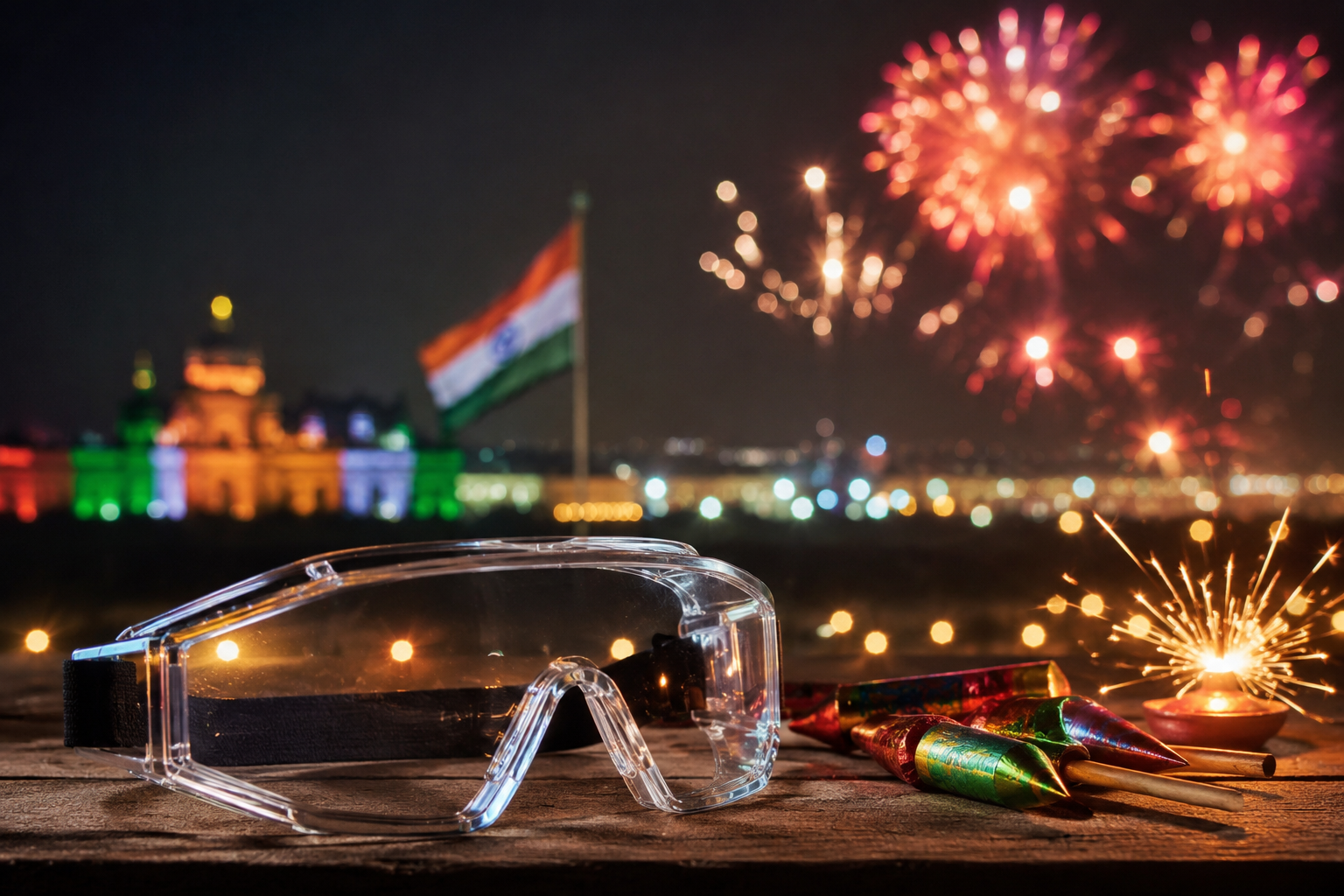
Independence Day Eye Safety: Protecting Eyes from Fireworks and Celebrations
Independence Day celebrations bring our nation together in a spectacular display of patriotism, pride, and pyrotechnics. Across Indirapuram and throughout India, families gather to watch fireworks paint the night sky in brilliant colours. Children wave sparklers with delight. Communities celebrate freedom with light and sound.
But every year, this joyous occasion brings a shadow of preventable tragedy. Emergency rooms across the country treat hundreds of eye injuries from fireworks — burns, chemical damage, penetrating injuries, and in the worst cases, permanent blindness. Many victims are children. Many injuries occur to bystanders, not just those handling fireworks.
As the best eye doctor near Indirapuram, I have treated firework eye injuries that haunt me still. A teenager who lost an eye to a malfunctioning rocket. A child burned by a sparkler that seemed harmless. A father blinded while trying to relight a dud. These tragedies were preventable. This Independence Day, let us celebrate our freedom without sacrificing our sight.
Understanding the Risks
Fireworks cause eye injuries through multiple mechanisms, each presenting distinct dangers.
Thermal burns:
Fireworks generate extreme heat. Sparklers, often considered safe for children, burn at temperatures exceeding 1000°C — hot enough to melt glass. Contact with eyes causes immediate thermal burns to the cornea and surrounding tissues.
Chemical burns:
The chemicals that create fireworks' brilliant colours are toxic and corrosive. Potassium nitrate, barium, strontium, and other compounds cause severe chemical burns when they contact eye tissues. These burns may continue damaging tissue even after initial contact.
Blast injuries:
Exploding fireworks generate powerful pressure waves. At close range, these blasts can rupture the eyeball, dislocate the lens, or cause retinal detachment. Even without direct contact, the concussive force can cause permanent damage.
Penetrating injuries:
Fragments from exploding fireworks become high-velocity projectiles. Cardboard, plastic, metal, and burning debris can penetrate the eye, causing catastrophic damage that may require surgical removal of the eye.
The best eye specialist in Indirapuram emphasises that even sparklers — handed to young children as safe alternatives — cause hundreds of eye injuries annually. No firework is truly safe.
Who Is Most at Risk?
Children face the highest risk. Their curiosity overcomes caution. They may not understand proper handling. Their smaller stature places their eyes closer to ground-level fireworks. And their developing eyes are more vulnerable to permanent damage.
Bystanders account for nearly half of all firework eye injuries. You do not need to be holding a firework to be injured — being nearby when something goes wrong is enough. This means that even families who choose not to use fireworks remain at risk in environments where others are celebrating.
Males of all ages suffer disproportionately, likely reflecting greater involvement in handling and lighting fireworks. Teenagers and young adults, who may take risks that younger children and mature adults would avoid, represent another high-risk group.
Alcohol consumption during celebrations increases risk by impairing judgment and coordination, making accidents more likely and responses to emergencies slower and less effective.
Prevention: Your Best Protection
The safest choice:
Attend professional firework displays rather than using fireworks at home. Professional shows use commercial-grade fireworks under controlled conditions with trained operators and safety perimeters. Your family enjoys the spectacle without the risk.
If you choose to use fireworks:
Purchase only from licensed vendors. Illegal or homemade fireworks pose dramatically higher risks due to unpredictable behaviour.
Designate a sober adult to handle all lighting. Keep children and spectators at a safe distance — at least 10 metres for most fireworks, further for larger ones.
Never attempt to relight a firework that fails to ignite. Wait 20 minutes, then soak it in water before disposal. Many serious injuries occur when duds suddenly ignite during relighting attempts.
Keep a bucket of water and a fire extinguisher nearby. Having water available enables quick response to both fires and burns.
Never hold fireworks in your hand while lighting them, and never point fireworks toward people, buildings, or flammable materials.
Protective eyewear:
Safety glasses or goggles provide meaningful protection for both handlers and spectators. Polycarbonate lenses resist impact far better than regular glasses. While not foolproof, eye protection significantly reduces injury severity when accidents occur.
Supervise children constantly:
If children will be near fireworks, constant adult supervision is essential. Even sparklers require direct supervision and should never be given to children under 5. Teach children never to pick up firework remnants, which may still be hot or unexploded.
What to Do If an Eye Injury Occurs
Despite precautions, injuries happen. Knowing how to respond can mean the difference between recovery and permanent vision loss.
DO:
Seek emergency medical care immediately. Eye injuries from fireworks are emergencies requiring professional treatment without delay.
Protect the injured eye from further damage. If possible, loosely cover it with a clean cloth or cup without applying pressure.
Keep the person calm and as still as possible. Movement can worsen certain injuries.
If chemicals are involved, gently flush the eye with clean water for at least 15-20 minutes while arranging transport to emergency care.
DO NOT:
Rub the eye. Rubbing can cause embedded fragments to cause more damage or can worsen corneal injuries.
Apply pressure to the eye. If the eyeball is ruptured, pressure can cause permanent damage.
Attempt to remove any object embedded in the eye. This requires surgical expertise.
Apply ointments, drops, or medications without medical direction.
Delay seeking care, even if the injury seems minor. Some serious injuries do not initially appear severe.
Types of Injuries and Their Outcomes
Firework eye injuries range from minor to catastrophic, with outcomes depending heavily on injury type and treatment speed.
Corneal abrasions and minor burns:
Superficial injuries may heal completely with proper treatment. However, even minor injuries can become infected or cause lasting scarring without appropriate care.
Chemical burns:
Outcomes depend on the chemical involved and exposure duration. Immediate flushing improves prognosis significantly. Severe chemical burns can cause permanent scarring and vision loss.
Penetrating injuries:
Foreign bodies within the eye require surgical removal. Outcomes vary widely based on what structures are damaged. Some penetrating injuries result in permanent blindness or loss of the eye.
Ruptured globe:
The most severe injury — when the eyeball itself is torn open — often results in permanent vision loss despite emergency surgery. In many cases, the eye cannot be saved.
At our clinic, we provide urgent evaluation and treatment for eye injuries. However, severe firework injuries often require hospital-based emergency care with surgical capabilities.
Teaching Children About Firework Safety
Children learn safety through clear instruction, consistent example, and appropriate supervision.
Explain that fireworks are not toys — they are explosives that can cause serious injuries. Use age-appropriate language but do not minimise the danger.
Teach children never to pick up fireworks from the ground, even if they appear unused. Duds can explode unexpectedly.
Model safe behaviour. Children learn more from what they see than what they hear. If you handle fireworks carelessly, children will internalise that behaviour.
Consider celebrating with safer alternatives — glow sticks, ribbon wands, colourful flags, or noisemakers that create a festive atmosphere without fire or explosion risks.
Frequently Asked Questions
Q: Are sparklers really dangerous? They seem so harmless.
A: Sparklers burn at over 1000°C and cause hundreds of eye and burn injuries annually, particularly to children. They are the most common cause of firework injuries in young children. They should never be considered safe toys.
Q: What kind of safety glasses should we wear around fireworks?
A: Polycarbonate safety glasses or goggles provide the best protection. Regular prescription glasses offer some protection but are not impact-rated. Wraparound styles protect better than standard frames.
Q: Should I try to remove debris from someone's eye after a firework injury?
A: No. Never attempt to remove embedded objects. Loosely cover the eye without applying pressure and seek immediate emergency care. Improper removal attempts can cause additional damage.
Q: How quickly do I need to get to a doctor after an eye injury?
A: Immediately. Firework eye injuries are emergencies. Delays in treatment worsen outcomes, sometimes dramatically. Do not wait to see if the injury improves on its own.
Q: Can firework eye injuries be fully treated?
A: Outcomes vary enormously based on injury severity. Minor injuries often heal completely. Severe injuries — penetrating trauma, ruptured globe — frequently result in permanent vision loss despite best treatment. Prevention is far more effective than treatment.
Q: Where can I get emergency eye care near Indirapuram?
A: For minor injuries, Dr. Shalini Jain at Samyak Eye Care — the best eye specialist near Indirapuram — provides urgent evaluation. For severe injuries, proceed directly to a hospital emergency department with ophthalmology services. After initial emergency treatment, visit our clinic for follow-up care.
Celebrate Freedom Without Sacrificing Sight
Independence Day celebrates our nation's hard-won freedom. Let us honour that freedom by protecting something equally precious — our ability to see the world we have built together.
This August 15th, choose safety. Attend professional displays when possible. If using fireworks at home, follow all precautions rigorously. Supervise children constantly. Wear protective eyewear. And know that the most spectacular celebration is one where everyone returns home with their sight intact.
Should any eye emergency arise, visit our clinic or proceed to the nearest emergency facility immediately. Your vision is irreplaceable — protect it as the treasure it is.
Stay Safe This Independence Day
Dr. Shalini Jain | Samyak Eye Care Clinic | Vaishali, Ghaziabad
Call: 98999 60700


