
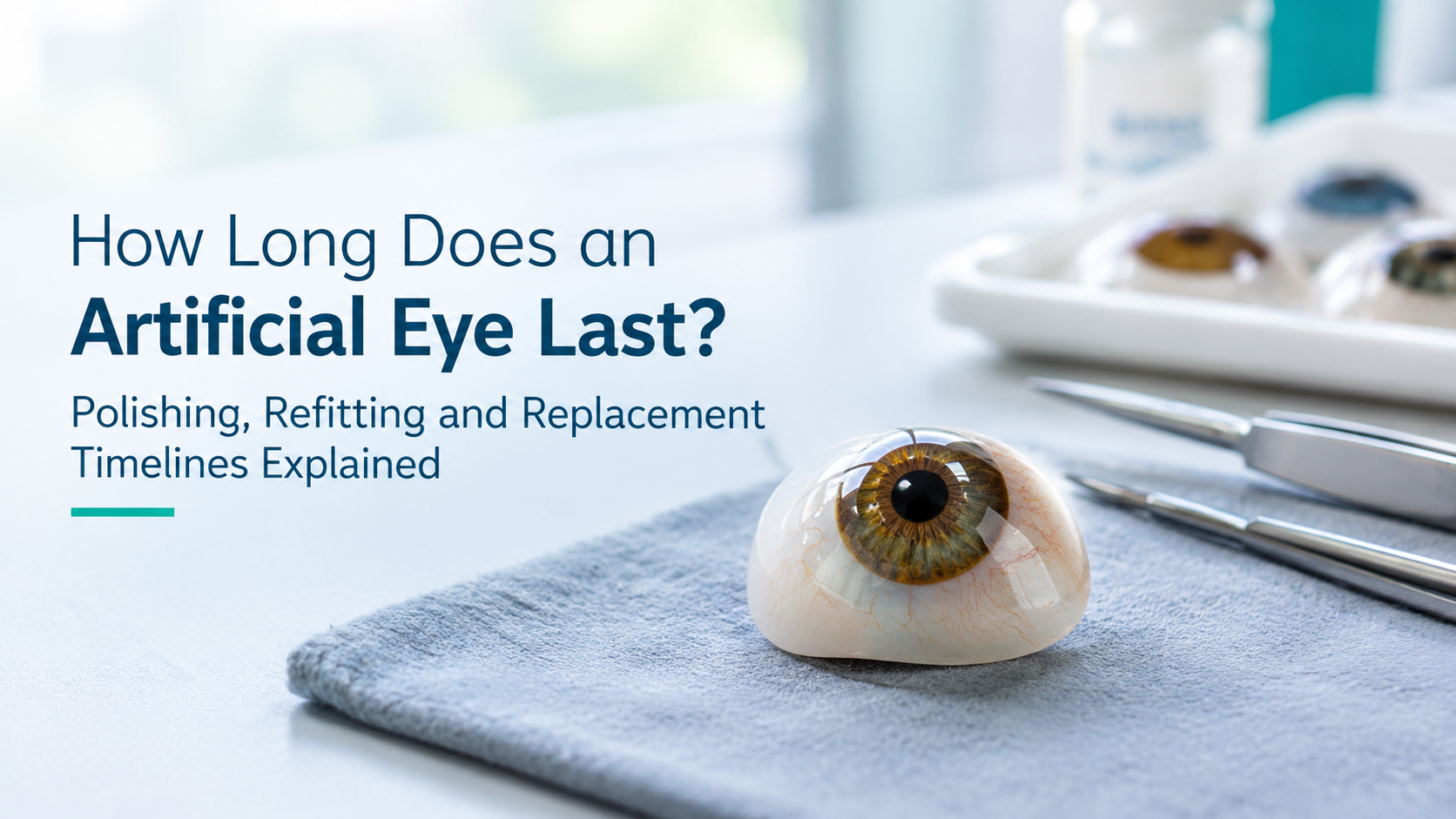
How Long Does an Artificial Eye Last? Polishing, Refitting and Replacement Timelines Explained
One of the most practical questions patients ask after being fitted with an ocular prosthesis is one they often feel awkward raising: how long will this last, and what happens when it stops working well? It is a completely reasonable question with a clear clinical answer, yet it is often not addressed thoroughly at the time of fitting, leaving patients uncertain about what to expect over the months and years ahead.
A woman from Indirapuram who had worn a custom ocular prosthesis for six years came to Samyak Eye Care Clinic with a concern she had been quietly managing for several months. Her prosthesis had gradually become less comfortable, with more discharge than before and a slight change in how well it fitted. She had assumed this was normal and had not sought advice because nobody had explained to her at fitting that ocular prostheses require periodic professional maintenance, that surface changes accumulate over time, and that there is an expected timeline for polishing, refitting, and eventual replacement.
As the ocular prosthesis specialist at Samyak Eye Care Clinic in Vaishali, Ghaziabad, I want to answer this question clearly and completely so that every patient we see understands exactly what to expect from their prosthesis over time, and when to seek professional maintenance.
The Short Answer: It Depends on the Type
The lifespan of an ocular prosthesis depends primarily on whether it is a stock (ready-made) or custom-made prosthesis, and on how well it is maintained during its period of use.
Stock prosthesis: Typically requires replacement every 12 months. The acrylic surface deteriorates faster due to the friction of an imperfect socket fit, and the socket changes over time mean the fit becomes progressively less adequate. Annual replacement is the clinical standard for stock prostheses.
Custom prosthesis: Typically lasts 5 to 10 years or more with appropriate maintenance. Aravind Eye Care System, one of India's most respected tertiary eye centres, notes that custom prostheses do not need to be replaced for a long time when properly cared for. However, they require periodic professional polishing and, as the socket changes with time, periodic refitting.
The difference in lifespan reflects the difference in fit quality. A prosthesis that fits the socket precisely experiences less friction and mechanical wear. A prosthesis that approximates the socket shape experiences continuous friction against the conjunctival lining, accelerating surface deterioration and causing socket changes that further compromise the fit.
What Happens to a Prosthesis Over Time
Surface dulling and deposit accumulation
The outer surface of an ocular prosthesis is polished acrylic. Over time, this surface becomes microscopically scratched through daily insertion, removal, and cleaning. Protein deposits from the tear film gradually build up in the surface irregularities. The prosthesis begins to look less glossy, less vital. The surface changes also increase the tendency for mucous discharge to accumulate on the prosthesis and in the socket, because a smooth surface resists deposit accumulation better than a roughened one.
This is the primary reason that professional polishing is recommended at regular intervals. Polishing restores the surface to a condition close to its original state, significantly improving comfort, reducing discharge, and extending the prosthesis's functional life.
Socket volume changes
The orbital socket changes in volume and shape over time, even in the absence of active disease or complications. The orbital implant settles. Orbital fat atrophies gradually with age. The soft tissue relationships around the socket shift. These changes mean that a prosthesis fitted at year one may not fit with the same precision at year five, even if the prosthesis itself is in good condition.
Subtle socket changes are one of the reasons that annual professional review of the prosthesis is recommended, even when the patient is not experiencing obvious symptoms. Small changes detected early can be addressed with minor modifications to the prosthesis rather than requiring complete refitting or replacement.
Colour fading
The hand-painted iris and scleral details of a custom prosthesis are protected by layers of clear acrylic, but very gradual fading does occur over years of use. This is typically first noticed as a slight reduction in the depth or vibrancy of the iris colour. It is rarely a concern in the first five years of a well-made prosthesis but becomes more apparent as the prosthesis approaches the end of its functional life.
The Recommended Maintenance Schedule
This schedule applies to a custom ocular prosthesis in a patient with a healthy, stable socket. Individual circumstances may require modification.
Daily care by the patient
The prosthesis should be cleaned as recommended by the treating specialist. For custom prostheses, monthly cleaning with a gentle soap and rinse is typically appropriate. The socket should be irrigated with saline or artificial tears as directed. Patients should not use alcohol, bleach, or abrasive cleaning materials on the prosthesis. The hands should always be thoroughly washed before handling the prosthesis.
Every 6 to 12 months: Professional review
An annual professional review at a qualified ocular prosthesis clinic allows assessment of the prosthesis surface, the socket health, and the quality of the fit. Early signs of socket changes, surface deterioration, or conjunctival irritation can be identified and addressed before they become significant problems. This review appointment should not be skipped simply because the patient is comfortable.
Every 1 to 2 years: Professional polishing
Professional polishing restores the surface of the prosthesis using specialised polishing compounds and equipment that cannot be replicated at home. The prosthesis is temporarily removed, polished in the clinic, and refitted. The improvement in comfort and appearance after professional polishing is often immediately apparent. The frequency of polishing depends on the individual's tear film chemistry and cleaning habits, but every 12 to 24 months is a general guideline.
Every 3 to 5 years: Assessment for refitting
As the socket changes with time, a formal assessment of prosthesis fit is warranted every 3 to 5 years, or earlier if the patient reports changes in comfort, increased discharge, or altered prosthesis positioning. Refitting may involve modifications to the existing prosthesis or the fabrication of a new custom shell based on a fresh socket impression.
Every 5 to 10 years: Replacement
Even a well-maintained custom prosthesis reaches the end of its functional life as cumulative surface changes, colour fading, and socket volume changes make the existing prosthesis less optimal than a new one. The replacement process mirrors the original fitting: a new socket impression, new shell fabrication, and new iris painting to match the current state of the fellow eye, which may itself have changed in colour or character over the years.
Signs That Your Prosthesis Needs Professional Attention
Patients should not wait for their scheduled review if they notice any of the following:
Increased discharge or mucous from the socket
Redness or irritation of the socket lining that does not resolve with cleaning
The prosthesis feels less stable or tends to move out of optimal position during the day
Visible scratches or dullness on the prosthesis surface
Lower eyelid sagging or change in eyelid position around the prosthesis
Any change in the appearance of the prosthesis, including colour shift or surface changes
Pain or discomfort that was not present previously
The woman from Indirapuram described at the opening of this blog presented with several of these signs. After professional polishing and a minor socket assessment, her comfort improved significantly within a week. She was overdue for review by about two years. The problems she had been quietly managing for months resolved with a single professional appointment.
Special Considerations: Children and Teenagers
For children wearing ocular prostheses, the replacement schedule is significantly more frequent than for adults, because the socket grows as the child develops. A prosthesis fitted at age 5 will not adequately fill the socket at age 8. For young children, prosthesis review every 3 to 6 months is typically appropriate, with refitting as growth dictates.
Maintaining appropriate prosthesis fit during childhood is clinically important beyond cosmetic appearance. A well-fitted prosthesis that appropriately fills the socket contributes to normal orbital and facial development. An undersized or poorly fitting prosthesis can contribute to orbital asymmetry that becomes more pronounced with growth. This is one of the key reasons that paediatric ocular prosthesis management requires specialist oversight rather than management at intervals appropriate for adults.
Frequently Asked Questions
Q: How often should a prosthetic eye be replaced?
A: A stock prosthesis requires annual replacement. A custom prosthesis typically lasts 5 to 10 years with appropriate maintenance before replacement is needed. The exact timeline depends on the individual's socket anatomy, tear film chemistry, care habits, and the rate of socket volume change with time. Annual professional review at a qualified ocular prosthesis clinic is the most reliable way to assess when replacement is approaching.
Q: Why does an artificial eye need polishing?
A: Over time, the polished acrylic surface of the prosthesis becomes microscopically scratched through daily use, and protein deposits from the tear film accumulate in the surface irregularities. This leads to reduced lustre, increased discharge, and reduced comfort. Professional polishing restores the surface, significantly improving comfort and appearance and extending the prosthesis's functional life.
Q: What happens if you never replace an ocular prosthesis?
A: An ageing prosthesis with accumulated surface changes and a fit that no longer matches the evolved socket causes chronic socket irritation, increased discharge, progressive socket contracture, and lower eyelid laxity. These complications are more difficult and costly to manage than timely prosthesis replacement. Prolonged use of an inadequate prosthesis, particularly a stock prosthesis, can cause socket changes that compromise the fit of subsequent prostheses.
Q: How much does artificial eye polishing cost in India?
A: The cost of professional polishing varies by clinic and by the complexity of the procedure. At Samyak Eye Care Clinic in Vaishali, Ghaziabad, we provide complete ocular prosthesis care including polishing and review. Please contact us on 98999 60700 or visit our clinic for current information.
Long-Term Care Is Part of the Treatment
An ocular prosthesis is not a one-time fitting and a lifetime of independence. It is a device that needs professional oversight at defined intervals to maintain the socket health, the quality of the cosmetic appearance, and the patient's long-term comfort and confidence.
The patients we see who have the best long-term outcomes are those who attend their annual reviews, who come for polishing at recommended intervals, and who contact us promptly when something changes rather than managing deteriorating comfort silently. Samyak Eye Care Clinic in Vaishali serves patients from across Ghaziabad, Indirapuram, Kaushambi, Surya Nagar, and NCR. Visit our clinic to schedule your prosthesis review or to discuss a new fitting.
Book Your Ocular Prosthesis Review or Polishing Appointment
Dr. Shalini Jain | Samyak Eye Care Clinic | Vaishali, Ghaziabad
Call: 98999 60700


