
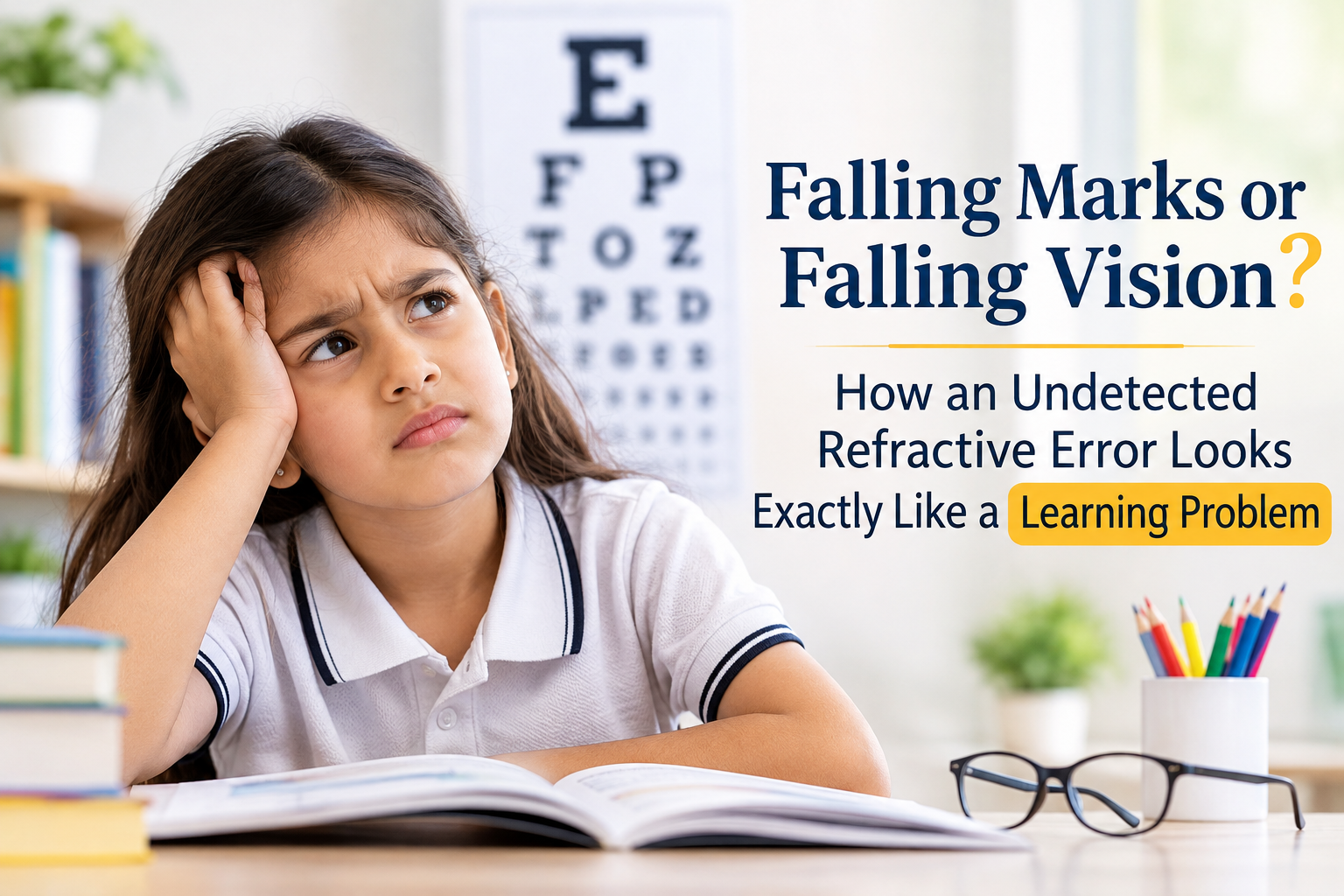
Falling Marks or Falling Vision? How an Undetected Refractive Error Looks Exactly Like a Learning Problem
Winter in Ghaziabad means mid-term results. For most families in Raj Nagar Extension and across NCR, the next few weeks bring a familiar conversation: the report card, the comparison with previous terms, and in some households, the quiet worry about a child who is clearly intelligent but consistently underperforming without any obvious explanation.
Before the extra tuition class is booked, before the learning difficulty assessment is arranged, before the assumption is made that the child simply needs to work harder, there is one investigation that should precede everything else, and that is almost never the first thing parents think of: a comprehensive eye examination.
An uncorrected refractive error in a child produces a specific pattern of academic difficulty that is, in its external presentation, nearly indistinguishable from a learning problem or an attention deficit. The child is genuinely struggling. The struggle is genuinely real. But its cause is optical, not cognitive, and it resolves completely when the correct prescription is given. Extra tuition for a child with uncorrected hyperopia is like asking someone to read a book through a smeared window and then blaming them for reading slowly.
As the best child eye specialist at Samyak Eye Care Clinic, Vaishali, serving families from Raj Nagar Extension, Vaishali, and across Ghaziabad, this is the October blog I most want parents to read after mid-term results.
The Three Refractive Errors That Most Commonly Masquerade as Learning Problems
Hyperopia: the hidden farsightedness that exhausts young eyes
Hyperopia (farsightedness) is the refractive error most likely to be missed in school-age children, and the one most likely to present as a classroom performance problem. Unlike myopia, where the child clearly cannot see the board and eventually squints visibly, hyperopia in young children is often entirely invisible to parents and teachers because the child's powerful ciliary muscle compensates for the focusing deficiency automatically.
Here is what this compensation costs: the ciliary muscle is working continuously throughout the school day to provide the clear vision that would naturally be present with a correct prescription. By mid-morning, the muscle is fatigued. By afternoon, the headaches begin. By the time the child comes home for homework, the visual system is in a state of accumulated strain that makes near work genuinely difficult. The child does not say their eyes hurt; they say they do not want to do homework. The parent sees avoidance. The teacher sees inattention.
Standard school vision screenings check distance visual acuity. A child with moderate hyperopia who has been compensating with ciliary muscle effort passes this test because their distance vision is clear at the time of the test. The hyperopia is never detected. This child may spend years in extra tuition classes for an academic difficulty that a pair of reading glasses would resolve in a week.
Astigmatism: blurry at all distances, often unnoticed
Astigmatism occurs when the cornea is not perfectly spherical, causing light to focus at multiple points rather than a single clean focal point. The result is blurry or distorted vision at all distances, not just near or distance. Text on the board and text in the textbook are both slightly degraded. The child sees well enough to function but is always operating with suboptimal visual input.
Children with uncorrected astigmatism frequently develop the habit of tilting their head or squinting slightly to find a viewing angle where the blur is minimised. These compensatory strategies become habitual and may not even be noticed by parents. The academic consequence is reduced visual efficiency: tasks that should take 15 minutes take 25 because the visual system is less efficient at processing the information it is receiving. Over a school day, this cumulative inefficiency manifests as a child who appears slower, less engaged, or less capable than their actual intelligence warrants.
Myopia: the one parents usually do know about, but sometimes detect too late
Myopia (short-sightedness) is the refractive error parents most often identify, because the classic signs of sitting close to the television and squinting at the board are widely known. However, even myopia is sometimes detected later than it should be.
A child who develops myopia during the school year may go six to twelve months with a worsening prescription before the school screening catches it, because screenings happen once a year at best. During those months, the child is sitting in a classroom where the board is becoming increasingly difficult to read. They may not report this because they assume it is normal, or because they have found a coping strategy such as copying from a neighbour or simply not engaging with board work at all. What the teacher sees is a child who is not paying attention to the board. What is actually happening is a child who cannot see the board.
The School Vision Screening Problem in Ghaziabad
This is the conversation that many parents in Raj Nagar Extension and across Ghaziabad have not had clearly: school vision screenings, wherever they are conducted, check only one thing. They check whether a child can read a Snellen chart at a fixed distance. This test, administered by a teacher or school nurse with minimal training, identifies moderate to severe myopia. It does not identify hyperopia. It does not identify astigmatism reliably. It does not test near vision, binocular function, eye movement, or focusing ability. It does not reveal whether the child can sustain clear vision over a school day of near work.
A child who passes the school vision screening has demonstrated only that they can read a specific chart from a specific distance at a specific moment. They have not demonstrated that their visual system is adequate for the sustained, binocular, near-and-far-switching visual demands of a full school day.
The appropriate investigation is a comprehensive paediatric eye examination that includes cycloplegic refraction (drops that relax the ciliary muscle and reveal the true prescription including hidden hyperopia), assessment of near and distance vision, binocular vision evaluation, and eye movement assessment. This is what Samyak Eye Care Clinic provides for every child referred for a school performance concern.
A Practical Decision Guide for Post-Mid-Term Parents
If your child's mid-term results are below their usual standard, or below what you expected given their evident intelligence, here is a practical sequence:
Step 1: Book a comprehensive eye examination before anything else
Before engaging a learning specialist, before increasing tuition hours, and before attributing the underperformance to effort or attitude, book a paediatric eye examination at a qualified clinic. This takes 60 to 90 minutes, is entirely non-invasive, and will either identify a correctable visual problem or clearly exclude vision as a contributing factor. Either outcome is useful.
Step 2: Bring the specific academic concerns to the examination
Tell the examining clinician specifically what the teacher has observed: difficulty copying from the board, losing place while reading, short attention span for written work, headaches on school days, avoiding homework. These details guide the examination toward the specific visual functions that are most likely to be implicated. A general check-up and a check-up focused on academic performance concerns are different in what they prioritise.
Step 3: If the eyes are clear, pursue learning assessment
If a comprehensive examination reveals no refractive error, no binocular vision problem, and no eye movement deficit, then the visual system can be confidently excluded as the cause and a learning assessment is the appropriate next step. This sequence prevents the common scenario where a child undergoes extensive learning assessments, is labelled as having a learning difficulty, and is in a remediation programme for two years before someone checks their eyes and finds uncorrected hyperopia.
What a Child Experiences When They Have Uncorrected Vision and Receive the Correct Prescription
Parents who have witnessed this are often moved by it. A child who has been managing with a blurred or strained visual world for months or years, who has developed coping strategies and accepted a suboptimal academic experience as simply how things are, suddenly has clear, comfortable vision. They say the board is sharp. They say reading does not give them a headache. They say homework is less hard. Teachers notice the change within weeks.
A 9-year-old from Raj Nagar Extension came to Samyak Eye Care Clinic after three consecutive terms of declining marks. His parents had enrolled him in extra classes in two subjects and had arranged a learning assessment. His school screening had been passed. His examination revealed significant bilateral hyperopia with astigmatism that had been completely masked by his ciliary muscle compensation. With the correct prescription, his homework time halved within a fortnight. His teacher called his mother to ask what had changed. Nothing had changed except that he could now see.
Frequently Asked Questions
Q: Can poor eyesight affect school performance?
A: Yes, significantly. Uncorrected refractive errors, particularly hyperopia (farsightedness) and astigmatism, produce visual fatigue, headaches during close work, and reduced efficiency for reading and writing tasks that directly affect academic performance. A child struggling with an uncorrected refractive error appears inattentive or slow, not because of any cognitive limitation but because their visual system is working under sustained strain.
Q: What are signs that a child cannot see the blackboard?
A: Signs that vision may be affecting a child's ability to see the board include: sitting forward in class or tilting the head, slow or incomplete copying from the board compared to peers, marked difference in academic performance between subjects requiring near work versus those relying on listening, and teacher comments about the child not paying attention to the board. These signs warrant a comprehensive paediatric eye examination rather than additional tuition.
Q: Is a school vision screening enough?
A: No. School vision screenings test only distance visual acuity at a specific distance at a single moment. They miss hyperopia, astigmatism, binocular vision problems, accommodative dysfunction, and eye movement deficits; all of which can significantly affect a child's academic performance. A child who passes a school screening should still receive a comprehensive paediatric eye examination if there are academic or attentional concerns.
Q: How is a child's eye power measured accurately?
A: Accurate measurement in children requires cycloplegic refraction, where eye drops temporarily relax the ciliary muscle that children use to compensate for hyperopia. Without these drops, a standard refraction can significantly underestimate the hyperopic component of the prescription. At our clinic in Vaishali, Ghaziabad, cycloplegic refraction is performed whenever the examination findings or symptom pattern suggest it is necessary.
Q: Where can I get my child's eyes examined near Raj Nagar Extension?
A: Samyak Eye Care Clinic in Vaishali, Ghaziabad is easily accessible from Raj Nagar Extension, Vasundhara, and surrounding areas. We provide comprehensive paediatric eye examinations including cycloplegic refraction, binocular vision assessment, and a full discussion of findings with specific reference to the child's academic concerns. Visit our clinic to book an appointment.
The Extra Class That Is Not the Answer
The 9-year-old from Raj Nagar Extension is now in the top half of his class. His parents discontinued one of the extra tuition classes because it was no longer needed. The other class, for a subject he genuinely found challenging, he now engages with fully because he can actually see what is being written on the board and in his workbook.
If your child's mid-term results have concerned you, give the eye examination its place in the sequence before extra tuition, before learning assessments, and before the assumption that trying harder is the answer. Visit our clinic at Samyak Eye Care, Vaishali, Ghaziabad, and find out whether vision is part of the picture. If it is, the resolution is faster and simpler than almost any other intervention available.
Book Your Child's Post-Mid-Term Eye Examination Today
Dr. Shalini Jain | Samyak Eye Care Clinic | Vaishali, Ghaziabad
Call: 98999 60700


