
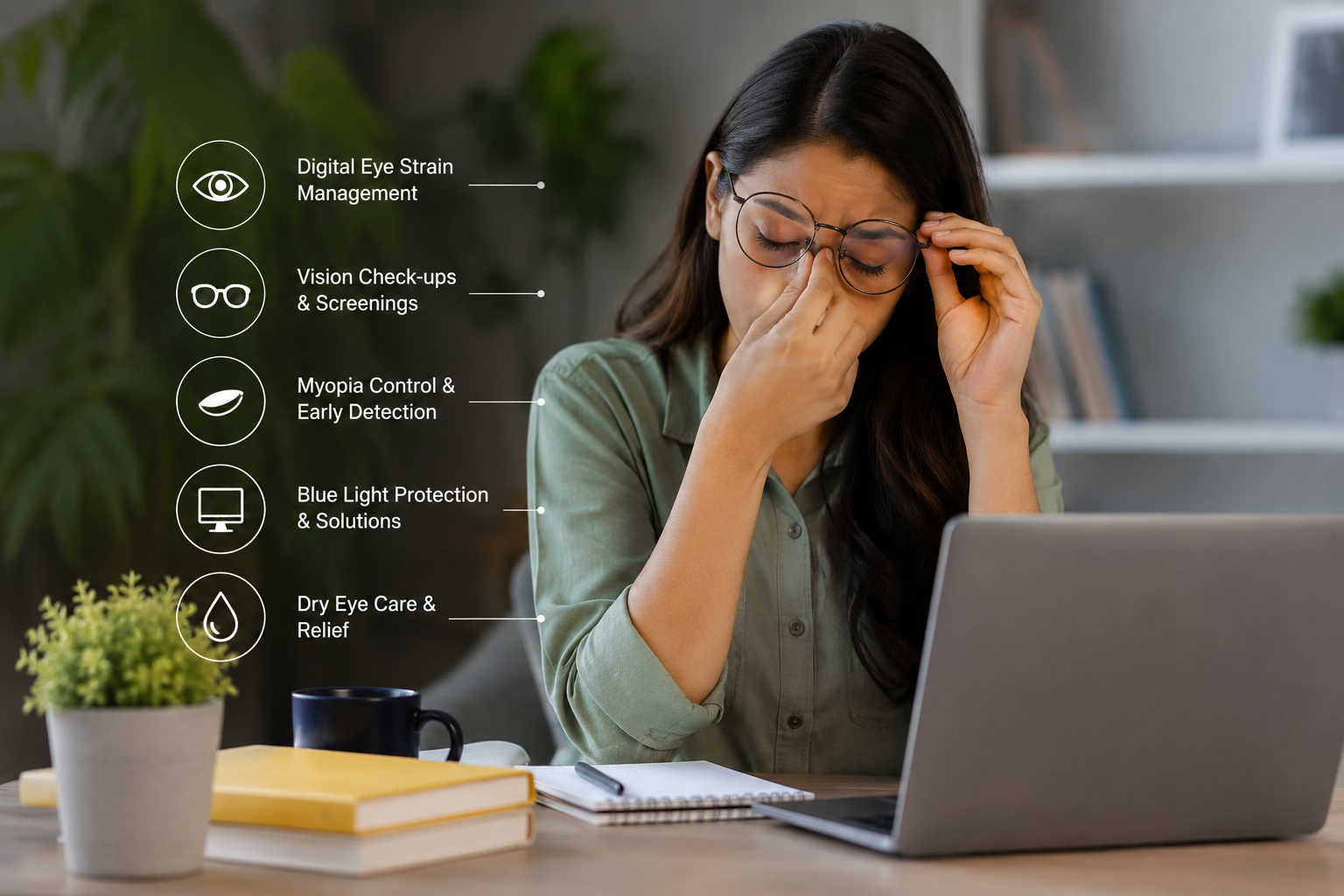
Eye Care for Students and Working Professionals: Services for the Digital Generation
The morning starts with checking phones. Then come hours of laptop work — classes for students, office tasks for professionals. Evenings bring more screens: online homework, emails that could not wait, streaming entertainment. By bedtime, a typical Surya Nagar resident has spent 8-12 hours staring at digital displays. Their eyes have worked overtime, and the strain shows.
Students preparing for competitive examinations study 10-12 hours daily, much of it on screens. IT professionals in nearby Noida complete 8-hour shifts, then commute home to more screen time. The visual demands placed on modern eyes exceed anything previous generations experienced.
As the best eye specialist near Surya Nagar, I serve both populations extensively. Their challenges overlap significantly: eye strain, headaches, blur, dryness, and progressive myopia. Understanding these shared concerns — and the solutions available — helps students and professionals protect their most essential sensory organ.
The Reality of Digital Eye Strain
Digital eye strain — also known as computer vision syndrome — affects an estimated 50-90% of people who work at screens. Symptoms include tired, aching eyes, headaches (particularly around the forehead and temples), blurred vision at distance or near, dry, irritated eyes, and neck or shoulder pain from poor posture.
Several factors contribute. We blink significantly less when focused on screens — roughly one-third of our normal blink rate. Reduced blinking leads to tear film instability and dryness. Screen positioning often requires sustained near focus that strains the focusing system. Blue light emission, glare, and poor contrast add additional stress.
The best eye doctor in Surya Nagar sees these complaints daily. Fortunately, most cases respond well to appropriate intervention. Our Digital Vision Syndrome management addresses these modern visual challenges comprehensively.
Special Concerns for Students
Students face unique challenges. Board examination preparation demands intense, prolonged near work exactly when myopia progression accelerates. Online learning has added screen hours without reducing traditional studying. The competitive pressure to study longer often overrides sensible visual hygiene.
Myopia progression during school years is a genuine concern. A student who enters Class 6 with mild myopia may graduate from Class 12 with moderate to high myopia if progression goes unmanaged. This is not just about thicker glasses — high myopia carries real risks for long-term eye health.
Our myopia control clinic offers evidence-based interventions including Ortho-K lenses, atropine drops, and specialised contact lenses that slow progression while providing clear vision. The best eye specialist in Surya Nagar evaluates each student's progression rate and recommends appropriate management.
Students with visual processing difficulties — problems with tracking, focusing, or eye coordination — may struggle academically despite adequate intelligence and effort. Vision therapy addresses these functional vision problems, often producing remarkable improvements in reading speed, comprehension, and sustained attention.
Special Concerns for Working Professionals
Professionals face different challenges. Presbyopia — the age-related loss of near focusing — typically begins affecting vision in the early 40s, creating difficulty with screens and documents that once posed no problem. Progressive lenses, occupational lenses, or reading glasses become necessary.
Dry eye disproportionately affects office workers. Air conditioning reduces humidity, screens reduce blink rate, and sustained concentration prevents the complete blinks that spread tears effectively. Many professionals suffer unnecessarily from discomfort that proper treatment could alleviate.
Professionals who wear contact lenses may find them increasingly uncomfortable during long workdays. Lens dehydration in air-conditioned environments, combined with reduced blinking, can make afternoon hours miserable. Alternative lens types or wearing schedules may help.
The best eye doctor in Surya Nagar understands these occupational demands and recommends solutions that fit real work environments rather than idealised conditions.
Practical Strategies for Visual Wellness
The 20-20-20 rule provides a simple framework: every 20 minutes, look at something 20 feet away for 20 seconds. This brief break relaxes the focusing system and encourages complete blinks. Setting regular reminders helps establish the habit.
Screen positioning matters enormously. Displays should sit at arm's length, with the top of the screen at or slightly below eye level. Looking slightly downward reduces exposed eye surface and slows tear evaporation. Proper chair height and desk setup support this positioning.
Lighting requires attention. Eliminate glare on screens by positioning them perpendicular to windows. Use indirect lighting rather than bright overhead fixtures. Consider screen filters or anti-reflective coatings on glasses.
Blink consciously and completely. When focused on screens, remind yourself to blink fully — not the half-blinks that become habitual during concentration. Complete blinks spread tears across the eye surface and prevent the dryness that causes discomfort.
Preservative-free artificial tears can supplement natural tear production. Used proactively rather than only when symptoms appear, they help maintain comfort throughout extended screen sessions.
When Professional Evaluation Becomes Essential
Self-care strategies help many people, but certain situations demand professional evaluation. Persistent symptoms despite implementing good visual hygiene suggest underlying issues requiring diagnosis. Headaches concentrated around the eyes warrant assessment. Blur that does not resolve with rest indicates possible prescription changes.
Progressive worsening of symptoms over time, difficulty performing essential work or study tasks, and any sudden changes in vision all require professional attention. At our clinic, we provide comprehensive evaluations that identify specific contributing factors and guide targeted intervention.
For students, annual examinations monitor prescription changes and catch developing problems early. For professionals, examinations every 1-2 years ensure prescriptions remain accurate and eye health stays sound. The best eye specialist in Surya Nagar recommends examination frequency based on individual risk factors and findings.
Specialised Solutions for Digital Demands
Computer glasses — optimised specifically for screen distances — provide sharper vision and reduced strain compared to general-purpose prescriptions. These may incorporate blue light filtering, anti-reflective coatings, and prescriptions calculated for your typical working distance.
For contact lens wearers struggling with dryness, daily disposable lenses, specialised materials, or alternative modalities like Ortho-K may provide better comfort during long work hours. The elimination of daytime lens wear makes Ortho-K particularly attractive for those whose eyes tyre of contacts by afternoon.
Comprehensive dry eye treatment addresses underlying tear film dysfunction rather than just masking symptoms with drops. Identifying whether you have aqueous deficiency, evaporative dry eye, or mixed-type dry eye guides appropriate treatment selection.
Frequently Asked Questions
Q: Do I need special computer glasses if I already wear glasses?
A: Possibly. General-purpose glasses optimise vision at distance or standard reading distance, neither of which matches typical screen placement. Computer-specific prescriptions, calculated for your working distance, often provide noticeably greater comfort during extended screen use.
Q: Is blue light from screens really harmful?
A: The evidence for serious harm from screen blue light is limited. However, some people find that blue light filtering reduces eye strain and improves sleep when using screens in the evening. It is reasonable to try, but it should not be considered essential for everyone.
Q: My eyes feel fine during screen work but ache afterwards. Is this normal?
A: This pattern suggests your visual system is working hard to compensate during use, then experiences fatigue when demands cease. It indicates room for improvement — better ergonomics, appropriate glasses, or treatment for underlying dry eye.
Q: Can screen use permanently damage my eyes?
A: There is no evidence that typical screen use causes permanent eye damage in adults. However, sustained near work may accelerate myopia progression in children and young adults. Proper management during these years can reduce the long-term impact.
Q: How do I know if my symptoms are from screens or something else?
A: A comprehensive examination distinguishes screen-related strain from other conditions. Some symptoms attributed to screens actually reflect prescription problems, dry eye disease, or other treatable conditions. Proper diagnosis guides effective treatment.
Q: Where can I get evaluated for digital eye strain near Surya Nagar?
A: Dr. Shalini Jain at Samyak Eye Care — the best eye doctor near Surya Nagar — provides a comprehensive evaluation for digital vision syndrome and related concerns. Our Vaishali clinic is easily accessible from Surya Nagar.
Invest in Your Visual Future
Your eyes enable your work, your study, and much of your life. The hours you spend staring at screens are unlikely to decrease — if anything, digital demands will continue growing. Protecting your vision now prevents cumulative damage and maintains the visual comfort you need to succeed.
Whether you are a student preparing for competitive examinations, a professional navigating the digital workplace, or someone who simply spends too many hours on screens, your eyes deserve attention. Visit our clinic for an evaluation that addresses your specific visual demands and provides solutions that fit your real life.
Protect Your Digital-Age Vision
Dr. Shalini Jain | Samyak Eye Care Clinic | Vaishali, Ghaziabad
Call: 98999 60700


