
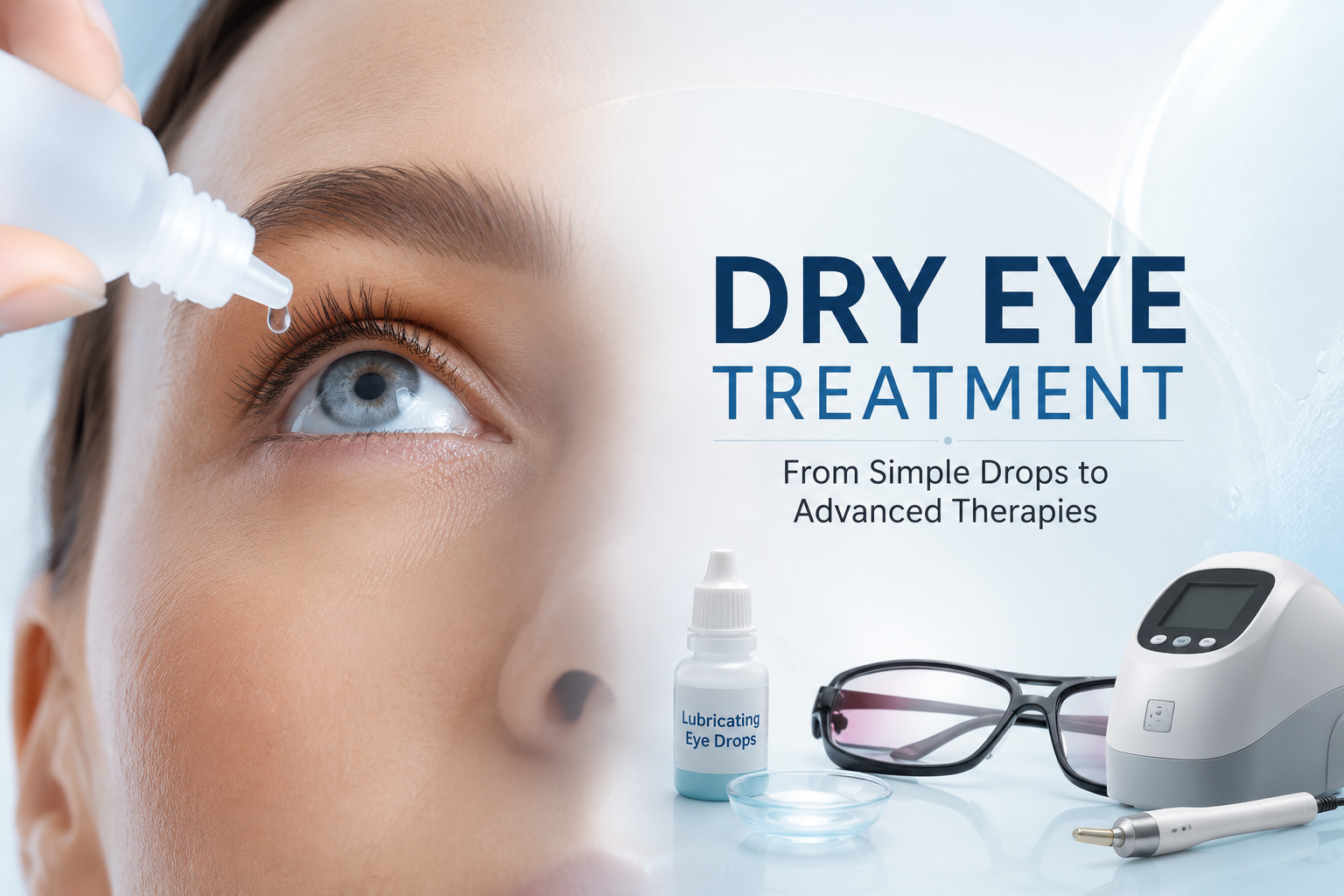
Dry Eye Treatment: Understanding Your Options from Simple Drops to Advanced Therapies
"I have tried every eye drop in the pharmacy. Nothing works." This frustrated statement from an IT professional in Indirapuram captures what many dry eye sufferers experience. They grab lubricating drops, use them for a few days, feel minimal improvement, and conclude that dry eye cannot be fixed.
The reality is more nuanced. Dry eye is not one condition but a spectrum of problems requiring targeted treatment. Using the wrong approach — even with a good product — for your specific type of dry eye produces disappointing results. Proper diagnosis determines proper treatment.
As the best eye specialist near Indirapuram with extensive experience in dry eye management, I help patients understand their options and find approaches that actually work. Here is the treatment landscape from simplest to most advanced.
Understanding Why Your Eyes Are Dry
The tear film is surprisingly complex — three layers working together. The outer oily layer prevents evaporation. The middle watery layer provides most of the moisture. The inner mucin layer helps tears spread evenly and stick to the eye surface. Problems with any layer cause different types of dry eye.
Aqueous deficiency means your eyes do not produce enough watery tears. This can result from ageing, autoimmune conditions like Sjögren's syndrome, certain medications, or damage to tear-producing glands.
Evaporative dry eye is more common — your eyes produce adequate tears, but they evaporate too quickly. The usual culprit is meibomian gland dysfunction (MGD), where the oil glands in your eyelids become blocked or produce poor-quality oil. Without this protective oil layer, tears evaporate rapidly.
Many patients have mixed-type dry eye. The best eye doctor in Indirapuram determines which components contribute to your symptoms, guiding treatment selection.
First-Line Treatments: Artificial Tears and Lifestyle Modifications
Artificial tears remain the foundation of dry eye treatment. However, not all artificial tears are equal. Different formulations address different problems. Watery drops help aqueous deficiency but evaporate quickly. Lipid-containing drops supplement the oil layer, reducing evaporation. Gel drops provide longer-lasting relief but blur vision temporarily.
Preservative-free formulations matter for frequent use. Preservatives in multi-dose bottles can irritate already compromised eyes. Single-dose vials eliminate this concern, though they cost more. If you use drops more than four times daily, preservative-free options are strongly recommended.
Environmental modifications help significantly. Humidifiers combat dry indoor air — essential in air-conditioned offices and homes. Positioning computer screens below eye level reduces exposed eye surface and evaporation. Taking regular breaks from screens using the 20-20-20 rule (every 20 minutes, look at something 20 feet away for 20 seconds) reduces strain.
Hydration matters — adequate water intake supports tear production. Omega-3 fatty acids from fish oil or flaxseed may improve tear quality. The best eye specialist in Indirapuram discusses these lifestyle factors with every dry eye patient.
Prescription Medications: When Over-the-Counter Is Not Enough
When artificial tears provide insufficient relief, prescription options expand treatment possibilities. Anti-inflammatory drops like cyclosporine reduce the inflammation that often perpetuates dry eye. These medications require consistent use over months — they modify the disease process rather than providing instant relief.
Lifitegrast is another prescription option that blocks inflammatory pathways. Some patients respond better to one medication than another; treatment may require trial periods to identify the best fit.
Short-term steroid drops can break inflammatory cycles, providing rapid improvement while longer-acting medications take effect. However, steroid use requires careful monitoring due to potential side effects, including increased eye pressure.
Autologous serum tears — made from your own blood serum — contain natural growth factors and nutrients that promote healing. They are reserved for severe cases unresponsive to other treatments.
Treating Meibomian Gland Dysfunction
Since evaporative dry eye from MGD is so common, treatments targeting the meibomian glands deserve special attention. Warm compresses soften blocked oils, allowing glands to express their contents. However, homemade warm compresses cool quickly and rarely reach therapeutic temperatures. Purpose-designed heat masks maintain appropriate warmth longer.
Eyelid hygiene removes debris and bacteria that contribute to gland blockage. Specialised lid scrubs or diluted baby shampoo applied with clean fingertips clean the lid margins where gland openings are located. This should become part of daily routine for MGD sufferers.
In-office procedures can express blocked glands more effectively than home treatment. Manual expression applies controlled pressure to evacuate thickened secretions. Newer devices use heat and pressure simultaneously for deeper gland expression.
The best eye doctor in Indirapuram evaluates meibomian gland structure and function, determining whether home treatments suffice or in-office procedures would help.
Advanced Treatment Options
Punctal plugs offer a different approach — instead of adding moisture, they prevent drainage. These tiny devices block the tear drainage channels, keeping natural tears on the eye surface longer. They can be temporary (dissolvable) or permanent (silicone). Some patients experience dramatic improvement; others find them insufficient alone.
Intense pulsed light (IPL) therapy, originally developed for skin conditions, shows promise for meibomian gland dysfunction. It reduces inflammation around the eyelids and improves gland function. Multiple sessions are typically needed.
For severe dry eye resistant to other treatments, Scleral lenses provide remarkable relief. These large contact lenses vault over the cornea, creating a fluid reservoir that bathes the eye continuously. Our clinic has extensive experience fitting Scleral lenses for severe dry eye cases.
Creating Your Treatment Plan
Effective dry eye treatment is rarely single-pronged. Most patients benefit from combining approaches — artificial tears for immediate comfort, prescription medications to address underlying inflammation, lid hygiene for gland health, environmental modifications to reduce aggravating factors.
Patience is essential. Unlike pain medications that work immediately, dry eye treatments often require weeks to months of consistent use before maximum benefit appears. Stopping treatment prematurely leads to the false conclusion that nothing works.
Regular follow-up allows treatment adjustment based on response. The best eye specialist in Indirapuram monitors progress and modifies approaches until optimal comfort is achieved.
Frequently Asked Questions
Q: Can dry eye be cured permanently?
A: Some causes are reversible — medication side effects, for example. However, most chronic dry eye requires ongoing management rather than a one-time cure. The goal is to achieve comfortable, stable eyes with sustainable treatment.
Q: Why do my eyes water if they are dry?
A: Paradoxically, dry eye often triggers reflex tearing. When the eye surface becomes irritated from dryness, it produces emergency watery tears. These reflex tears lack proper composition and evaporate quickly, creating a cycle of dryness and watering.
Q: Does screen use cause dry eye?
A: Screen use contributes significantly. We blink far less frequently when focused on screens — roughly one-third of our normal blink rate. Reduced blinking means less tear distribution and more evaporation. Digital vision syndrome management addresses this specifically.
Q: Are expensive eye drops better than cheaper ones?
A: Price does not always correlate with effectiveness. The best drop is one matched to your specific type of dry eye. An expensive lipid-based drop will not help aqueous deficiency; an inexpensive watery drop will not address evaporative dry eye.
Q: How do I know if my dry eye is severe enough for professional help?
A: If symptoms persist despite over-the-counter drops, if discomfort affects daily activities, if you use drops more than four times daily, or if you experience vision fluctuations — professional evaluation is warranted.
Q: Where can I get dry eye treatment near Indirapuram?
A: Dr. Shalini Jain at Samyak Eye Care — the best eye doctor near Indirapuram — provides comprehensive dry eye evaluation and treatment.
Find the Relief You Deserve
That IT professional from Indirapuram who had tried everything? After a proper diagnosis revealed meibomian gland dysfunction as his primary problem, targeted treatment transformed his comfort. He uses different drops now — ones matched to his condition — along with lid hygiene and environmental modifications. His eyes no longer dominate his workday.
Dry eye is manageable. The key is accurate diagnosis and appropriately targeted treatment. Visit our clinic for expert evaluation and a personalised treatment plan.
Get Relief from Dry Eye
Dr. Shalini Jain | Samyak Eye Care Clinic | Vaishali, Ghaziabad
Call: 98999 60700


