
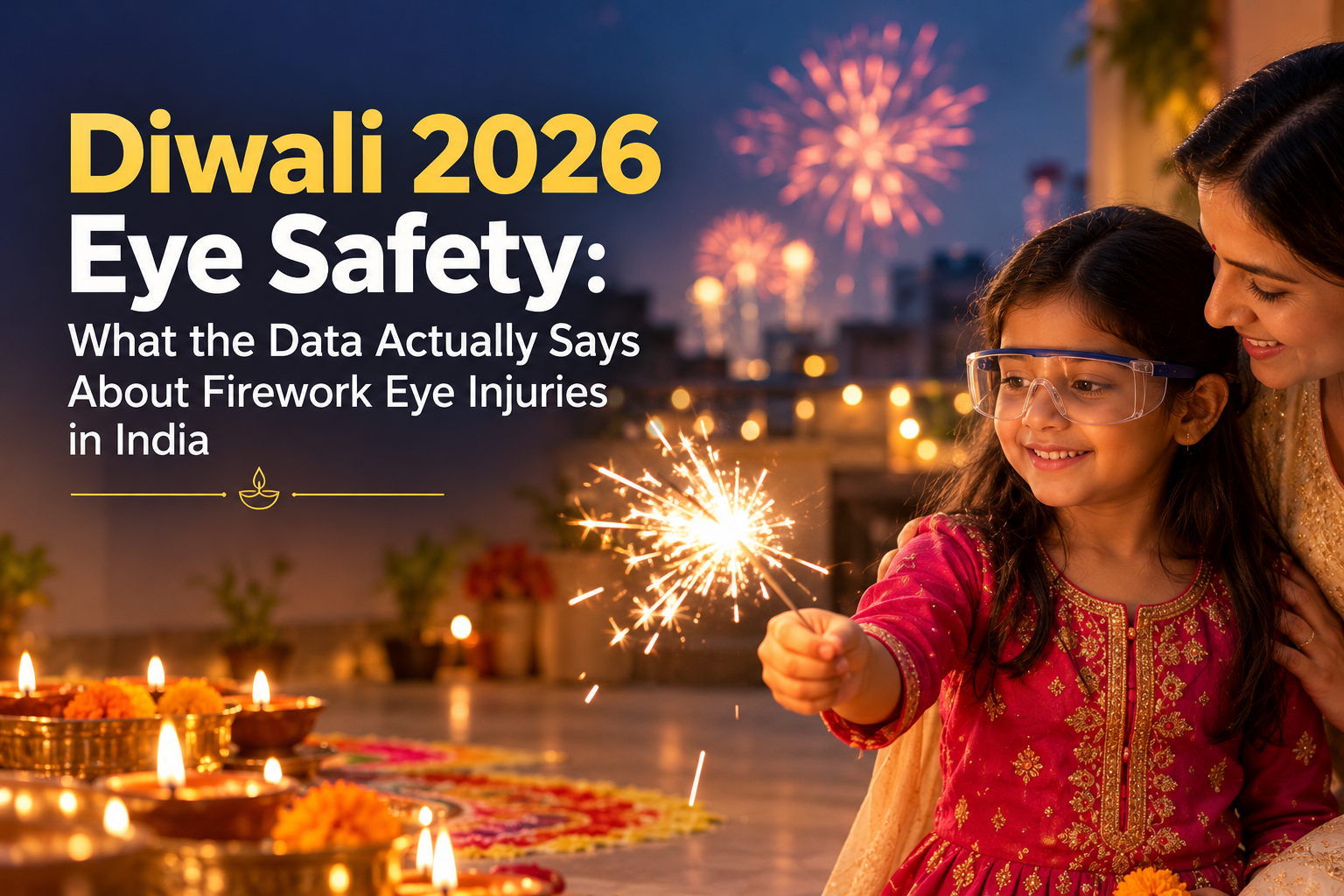
Diwali 2026 Eye Safety: What the Data Actually Says About Firework Eye Injuries in India
Every year the same advice circulates before Diwali: stand back from fireworks, supervise children, wear glasses. And every year, emergency departments across India fill up anyway. AIIMS Delhi's Dr. Rajendra Prasad Centre for Ophthalmic Sciences recorded 190 cases of eye trauma during the ten days of Diwali 2025, a 19 per cent rise from the previous year. Of those 190 cases, 44 per cent required emergency surgical intervention to save vision.
These are not numbers from a rural health crisis with limited access to eye care. These are patients presenting to a tertiary eye hospital in the national capital. They are families from urban Delhi NCR who had access to information about firework safety, who probably read the same generic advice that circulates every October, and whose eyes were injured anyway.
As the best eye doctor in East Delhi, I want to give families in East Delhi, Indirapuram, Kaushambi, Surya Nagar, and across East Delhi the specific information that the annual generic articles do not. The data tells us something precise about who gets injured, how, and what actually prevents it. This Diwali, that is what I want to share.
The Finding That Most Diwali Eye Safety Articles Miss
Here is the clinical finding from multiple peer-reviewed Indian studies that changes how Diwali eye safety should be understood: between 55 and 60 per cent of firework-related eye injury victims in India were bystanders. They were not the person holding or lighting the firecracker. They were standing nearby, watching, often at what they believed was a safe distance.
A study published in the Indian Journal of Ophthalmology examining Diwali eye injuries in Eastern India found that 60 per cent of 65 patients with ocular injuries had not been actively involved with the firecrackers at the time of injury. A North India tertiary centre study found that bystanders accounted for 55.5 per cent of cases. The Delhi-specific data on the impact of firecracker bans found that among 40 bystander victims, 27 were under 18 years of age.
The clinical reason: the person lighting a firecracker typically turns away at the moment of ignition, activating a natural protective response. Bystanders are caught unaware. They have no time to turn, blink, or shield their eyes before a misfired rocket, a fragment, or an unexpected explosion reaches them. A child standing 5 metres away watching a neighbour light a bomb cracker has no more protection than the person holding it.
This is the fact that makes standard Diwali eye safety advice incomplete. Telling people to be careful when they light fireworks addresses 40-45 per cent of the problem. The other 55-60 per cent are injured despite not touching a single cracker.
The New Threat in 2025: Carbide Guns
AIIMS Delhi specifically highlighted a new category of injury in their 2025 Diwali data: 18 to 20 cases linked to carbide guns, crude devices assembled from calcium carbide and water. Dr. Radhika Tandon, chief of the RP Centre, described these as chemical bombs, not traditional fireworks. They cause severe chemical and thermal burns simultaneously, and several patients in this category experienced irreversible vision loss.
Carbide guns are not commercially sold as fireworks. They are assembled from materials available at hardware stores. They are more common in Uttar Pradesh and the surrounding NCR region than in many other parts of India. Families in East Delhi and East Delhi should be aware that the injury profile from these devices is significantly more severe than from standard commercial fireworks, and that no safe viewing distance has been established for them.
If you encounter carbide guns being used in your neighbourhood during Diwali celebrations, move indoors. This is not an overcautious recommendation. The chemical injury pattern from these devices is categorically different from a standard firecracker.
The Clinical Picture: What Firework Eye Injuries Actually Look Like
Parents often assume that a firework eye injury looks like something obvious: a visible burn, an eye that is clearly damaged. In reality, some of the most serious injuries present with deceptively mild initial symptoms that worsen significantly over hours.
Chemical and thermal burns
Hot particles, sparks, and chemical compounds from fireworks cause burns to the cornea and conjunctiva. Initial symptoms are redness, watering, and discomfort. Without prompt irrigation and treatment, corneal burns scar and permanently affect vision. The critical window for first aid is the first 10 to 15 minutes after exposure.
Intraocular foreign body
High-velocity fragments from bombs and rockets can penetrate the eye without leaving an obvious entry wound. The eye may look relatively normal externally. Vision may be only mildly affected initially. Without imaging to detect the foreign body and surgical removal, severe intraocular infection (endophthalmitis) develops within 24 to 48 hours and can destroy the eye completely.
Open globe injury
The most severe category. A high-velocity impact ruptures the outer coat of the eye. In the North India study, 9.4 per cent of Diwali eye injuries were open globe injuries. These almost always require emergency surgical repair, and visual outcomes are poor even with prompt intervention. 15 per cent of eyes in that study had final vision of less than 3/60, which is legally blind.
Retinal detachment and vitreous haemorrhage
Concussive force from explosions can cause internal eye damage without any penetrating injury. The retina may detach, or bleeding may occur inside the eye. These conditions can present with floaters, flashes, or a shadow in the visual field hours after the injury. Any of these symptoms after Diwali require same-day assessment at a qualified eye clinic in East Delhi.
What Actually Works: Evidence-Based Diwali Eye Protection
Polycarbonate protective eyewear for children
Standard spectacle lenses, even prescription ones, do not provide adequate protection against firework fragments. Polycarbonate safety glasses or goggles certified to impact resistance standards are the appropriate choice for children in close proximity to fireworks. In the multiple Indian studies reviewed, none of the patients with serious eye injuries were wearing any form of eye protection at the time of injury. Not one.
A defined exclusion zone, not a general concept of standing back
The phrase safe distance is clinically meaningless without a number. Bottle rockets and bombs, the fireworks responsible for the majority of serious eye injuries in Indian studies, can travel unpredictably and send fragments over distances that most people would consider safe. For community Diwali events in residential areas of East Delhi or Indirapuram, indoors behind a closed window is the genuinely safe position for young children and for adults who are not actively managing the fireworks.
Never approach a failed or partially lit cracker
In the Delhi bystander data, a significant category of injuries involved children approaching crackers that had not fully ignited, to check whether they were still burning. The cracker then exploded at close range. A failed cracker should be left untouched for a minimum of 30 minutes, then soaked with water before disposal. This rule should be communicated explicitly to children before celebrations begin.
Immediate first aid that is actually correct
If a spark, fragment, or chemical enters the eye: irrigate immediately and continuously with clean water for a minimum of 15 minutes. Do not rub the eye. Do not attempt to remove any visible object. Cover the eye gently with a clean cloth and proceed directly to an emergency eye clinic. Time between injury and treatment is the single most important factor in outcome.
What Diwali Symptoms Need Immediate Attention
After Diwali celebrations, seek same-day emergency eye assessment for:
Persistent redness, pain, or watering that does not resolve within a few hours
Any reduction in vision compared to normal, even mild blurring
Floaters, flashes, or a dark shadow anywhere in the visual field
A sensation of something inside the eye, even if no visible object is present
Swelling around the eye or eyelid that prevents normal opening
Any injury where the eye was directly struck by a fragment or object
None of these symptoms should be managed at home with over-the-counter drops and a wait-and-see approach. The injuries that result in permanent vision loss in the Indian clinical data are consistently those where presentation to a specialist was delayed beyond 24 to 48 hours.
Frequently Asked Questions
Q: What should I do immediately if a firecracker injures my eye?
A: Irrigate the eye immediately with clean water for a minimum of 15 minutes. Do not rub, press, or apply any home remedy. Cover the eye gently and go directly to an emergency eye clinic. Do not eat or drink in case surgical intervention is needed. Time to treatment is the most critical factor in the outcome of a firework eye injury.
Q: How far should you stand from fireworks to protect your eyes?
A: There is no clinically established safe distance for bystanders from community fireworks in residential settings. Indian clinical data shows that 55 to 60 per cent of Diwali eye injuries occur in bystanders who were not handling fireworks. For young children, remaining indoors during fireworks in the immediate vicinity is the most protective option.
Q: Are carbide guns more dangerous than standard fireworks?
A: Yes. AIIMS Delhi specifically flagged carbide guns in their 2025 Diwali data as causing chemical and thermal burns simultaneously, with several cases resulting in irreversible vision loss. They are not commercial fireworks and produce an injury profile significantly more severe than standard crackers. Avoid any proximity to carbide guns during celebrations.
Q: My child got a spark in their eye during Diwali. Is it serious?
A: It should be assessed by an eye specialist the same day, even if the initial symptoms seem mild. Corneal burns from sparks can appear minor initially and worsen significantly within hours. Intraocular foreign bodies from high-velocity fragments sometimes present with deceptively mild early symptoms. Do not wait to see if it resolves. Visit our clinic or the nearest emergency eye facility immediately.
Q: Can Diwali firework injuries cause permanent blindness?
A: Yes. The North India Diwali injury data shows that 15 per cent of injured eyes had final vision below 3/60, which is the legal blindness threshold. Open globe injuries, intraocular foreign bodies, and delayed presentations to care are the factors most associated with permanent vision loss. Prompt first aid and immediate specialist assessment are the most effective preventive measures.
Celebrate the Festival of Lights with Your Vision Intact
Diwali is worth celebrating. The lights, the community, the joy of the festive season are genuinely valuable. What is not worth is a preventable eye injury that changes a child's visual future, or a Diwali evening that ends in an emergency room rather than at home with the family.
The data tells us clearly who is at risk and what reduces that risk. Children standing nearby, not just children holding crackers. Bystanders who considered themselves safely positioned. Adults who approached a failed cracker to check. These are the situations that fill eye emergency departments every November in India.
If you or any member of your family sustains an eye injury during Diwali celebrations, do not delay. Visit our clinic at Samyak Eye Care, East Delhi, or proceed to the nearest emergency eye facility immediately. We serve families from across East Delhi, Indirapuram, Kaushambi, Surya Nagar, and the wider NCR region. Have a safe and joyful Diwali.
If You Need Emergency Eye Care This Diwali, Contact Us Immediately
Dr. Shalini Jain | Samyak Eye Care Clinic | East Delhi
Call: 98999 60700


