
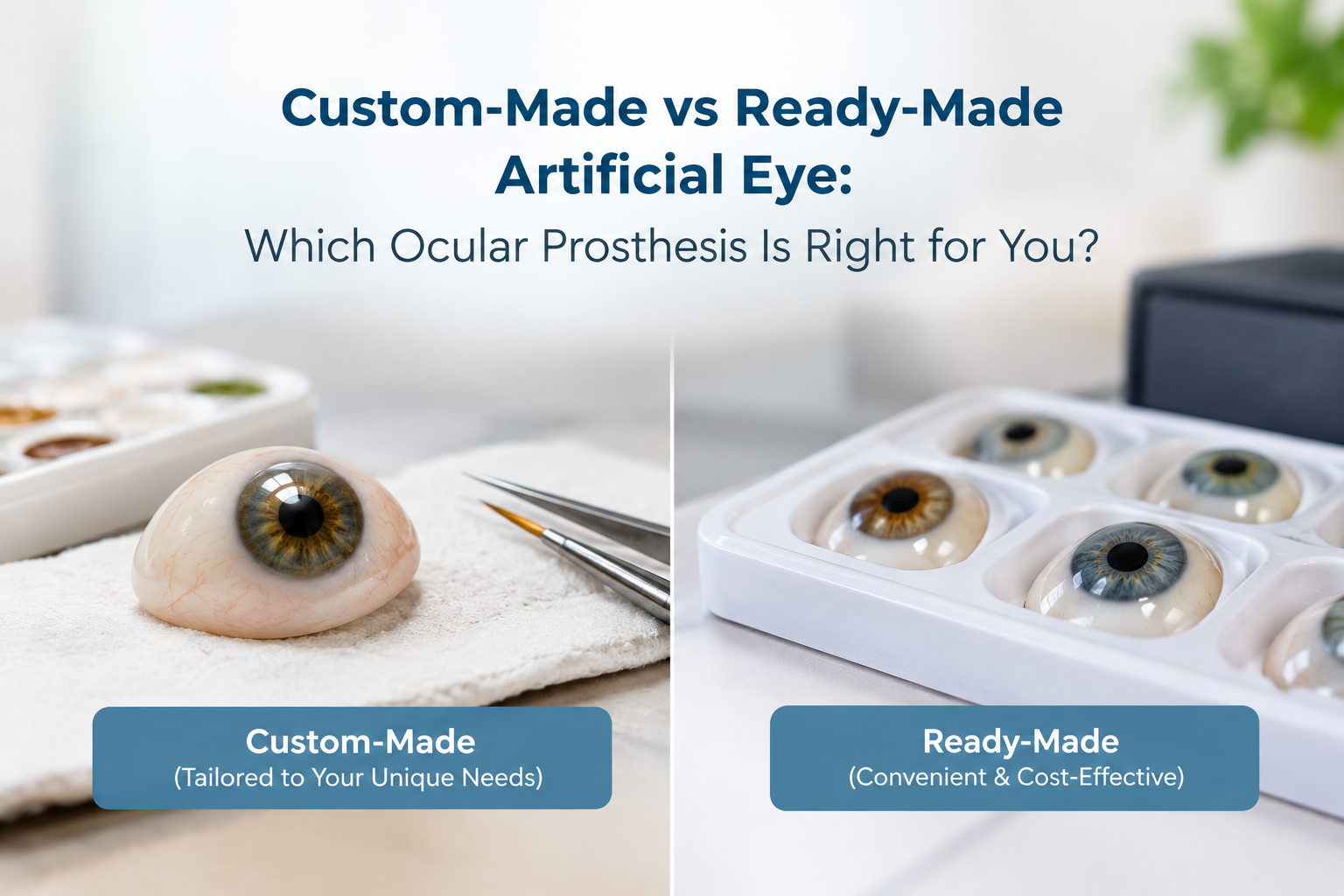
Custom-Made vs Ready-Made Artificial Eye: Which Ocular Prosthesis Is Right for You?
The moment a patient is told they need an artificial eye, they typically have no framework for what the decision actually involves. They know they need a prosthesis. They do not know that there are fundamentally different types, that those types produce dramatically different outcomes in terms of appearance, comfort, and long-term socket health, and that the choice made in those early weeks after eye loss has consequences that extend over years or decades.
A man from Ghaziabad came to Samyak Eye Care Clinic eighteen months after losing his left eye to ocular trauma. He had been fitted with a stock prosthesis at another facility shortly after surgery. By the time he reached us, his socket was showing early signs of contracture from the ill-fitting shell, he was experiencing chronic discharge, and the cosmetic match was poor enough that he had withdrawn from most social situations. The prosthesis had technically done its job: it occupied the socket. But it had not restored his appearance or his confidence, and the socket damage from prolonged wear of an ill-fitting shell was now a clinical complication that needed management.
As the artificial eye and ocular prosthesis specialist at Samyak Eye Care Clinic, I want to give patients and families in Ghaziabad, Vaishali, Indirapuram, and across India the information they need to make this decision correctly at the outset, not eighteen months later after a preventable problem has developed.
Understanding the Two Types of Ocular Prosthesis
Stock (Ready-Made) Ocular Prosthesis
A stock prosthesis is a mass-produced shell of standard dimensions, available in a limited range of iris colours and sizes. It is not made for any individual patient. It is selected from an inventory of pre-manufactured shells and fitted to the patient based on approximate size matching.
Stock prostheses have a limited role in clinical practice. They are sometimes used as a temporary conformer in the immediate post-surgical period to maintain socket shape while healing occurs, before a definitive prosthesis is fitted. They can also be appropriate in specific situations where a permanent custom prosthesis is not yet feasible.
However, as a long-term solution, stock prostheses carry significant disadvantages:
They do not fit the individual socket shape, leading to movement that causes chronic friction against the socket lining
The cosmetic match is approximate at best, with iris colour, pupil size, and scleral pattern rarely matching the fellow eye convincingly
They require replacement every 12 months as the acrylic deteriorates and the socket shape changes
Long-term wear of a poorly fitting stock prosthesis contributes to socket contracture, a progressive shrinkage of the socket that makes later fitting of a custom prosthesis more difficult
They produce more discharge than custom prostheses due to the friction of an imperfect fit against the conjunctival lining
Custom-Made Ocular Prosthesis
A custom prosthesis is fabricated specifically for an individual patient by a trained ocularist. The process begins with taking a detailed impression of the patient's socket, capturing its exact three-dimensional shape. From this impression, a prosthesis is crafted to fit that socket precisely. The iris colour, pupil size, scleral pattern, blood vessel detail, and overall dimensions are all individually matched to the patient's fellow eye.
The custom prosthesis is hand-painted by the ocularist in a process that can take several sessions to achieve an optimal cosmetic match. The result, when done well, is an eye that is indistinguishable from the fellow eye in photographs and in face-to-face interaction at normal conversational distance.
The key clinical advantages of a custom prosthesis:
It fits the socket precisely, eliminating the friction and chronic irritation associated with stock prostheses
It provides superior cosmetic matching, with iris colour, pupil size, and vascular pattern individually replicated
It lasts significantly longer, typically 5 to 10 years or more with appropriate care, compared to annual replacement for stock eyes
It requires less frequent cleaning, monthly rather than weekly, because the precise fit minimises discharge
It maintains socket health over time rather than contributing to contracture
It provides better movement in response to eye muscle activity, as the precise fit allows the prosthesis to respond to the residual orbital muscles
The Fitting Process for a Custom Ocular Prosthesis
Understanding what the fitting process involves helps patients and families approach it with realistic expectations and appropriate preparation.
Stage 1: Healing and conformer placement
After enucleation or evisceration surgery, the socket needs time to heal before a definitive prosthesis can be fitted. During this period, a conformer, a clear acrylic shell, is placed in the socket to maintain its shape and prevent contracture during healing. This typically takes 6 to 8 weeks, though it varies based on the surgical procedure and individual healing.
Stage 2: Socket impression
Once healing is adequate, the ocularist takes a detailed impression of the socket. This is a comfortable procedure similar to a dental impression. The impression material captures the exact three-dimensional contour of the socket, including its depth, width, and the position of the orbital implant.
Stage 3: Prosthesis fabrication
Using the socket impression as the basis, the prosthesis shell is fabricated from medical-grade polymethylmethacrylate (PMMA) acrylic, a material chosen for its biocompatibility, durability, and optical properties. The shell is shaped and polished before the painting process begins.
Stage 4: Iris painting and matching
This is the most skilled and time-intensive stage. The ocularist hand-paints the iris, pupil, and scleral details of the prosthesis to match the fellow eye. This involves mixing custom colours to replicate the exact iris pigmentation pattern, which is unique to each individual. Multiple layers of paint and protective acrylic coating are applied. Several fitting appointments may be needed to refine the colour match under different lighting conditions.
Stage 5: Fitting and adjustment
The completed prosthesis is fitted and evaluated for comfort, movement, and cosmetic match. Adjustments are made as needed. The patient is trained in insertion, removal, and daily care of the prosthesis.
The Honest Cost Comparison
The higher upfront cost of a custom prosthesis is a genuine consideration for many families in Ghaziabad and across India. However, a direct cost comparison over time typically favours the custom option:
A stock prosthesis requires annual replacement. Over a 10-year period, this represents 10 replacement prostheses, each with an associated fitting cost. A custom prosthesis, maintained correctly, typically lasts 5 to 10 years before replacement is needed. Over the same 10-year period, a patient with a custom prosthesis may need only one replacement, compared to 10 for a stock prosthesis.
Beyond the direct cost, the clinical consequences of long-term stock prosthesis wear, including socket contracture requiring surgical intervention, add costs that are not reflected in the initial prosthesis price comparison. The man from Ghaziabad described at the opening of this blog required additional treatment to address the socket changes that had accumulated during 18 months of stock prosthesis wear. Those costs were not anticipated when the stock option was chosen.
Who Should Consider a Custom Prosthesis
At Samyak Eye Care Clinic, I recommend custom ocular prosthesis as the standard recommendation for virtually all patients who have lost an eye and are medically stable for fitting. The specific situations where a stock shell may be more appropriate are:
The immediate post-surgical period as a temporary conformer before healing is complete
Situations where the socket anatomy is significantly abnormal and requires surgical correction before a custom fit is possible
Interim management while waiting for the socket to mature after recent surgery
For children who have lost an eye, the situation requires particular attention. Children's sockets grow as they develop, meaning the prosthesis will need more frequent refitting than in adults. However, custom fitting remains important even in children, because a well-fitted prosthesis contributes to normal socket and facial development. This is discussed in more detail in our blog on paediatric ocular prosthesis.
Frequently Asked Questions
Q: What is the difference between a custom and stock artificial eye?
A stock artificial eye is mass-produced and selected from inventory without individual fitting. A custom artificial eye is individually fabricated from a socket impression, hand-painted to match the fellow eye, and precisely fitted to the individual socket. Custom prostheses last 5 to 10 years or more, provide superior cosmetic match and movement, and maintain socket health better than stock alternatives.
Q: Is a custom artificial eye worth the extra cost?
A: Over time, yes. A stock prosthesis replaced annually over 10 years costs more cumulatively than a custom prosthesis that lasts the same period. More importantly, the socket health complications associated with long-term stock prosthesis wear, including contracture and chronic discharge, carry additional clinical and financial costs that make the comparison even more favourable for the custom option.
Q: How is a custom ocular prosthesis hand-painted?
A: The ocularist mixes custom acrylic paints to match the iris pigmentation, pupil size, and scleral vascular pattern of the patient's fellow eye. Multiple layers are applied and evaluated under different lighting conditions across several fitting appointments. The painting process is the most skilled and time-intensive part of custom prosthesis fabrication, and the quality of the colour match depends significantly on the ocularist's experience and skill.
Q: Which type of artificial eye looks more natural?
A: A well-fabricated custom prosthesis, matched carefully to the fellow eye, is indistinguishable from the natural eye in photographs and face-to-face interaction at normal conversational distance. Stock prostheses, by their nature, produce an approximate match at best. For patients whose primary concern is natural appearance and social confidence, custom is unequivocally the appropriate choice.
Q: How long does the custom artificial eye fitting take?
A: The complete process, from initial consultation after healing to final fitting, typically takes 4 to 8 weeks. This includes the socket impression, prosthesis fabrication, painting, and multiple fitting appointments for refinement. Visit our clinic at Samyak Eye Care, Vaishali, Ghaziabad, for a personalised assessment and timeline.
The Right Beginning After Eye Loss
That man from Ghaziabad has now had a custom prosthesis for over a year. His socket has stabilised. The discharge has resolved. He returned to his workplace. He came back for his six-month review and told me that he had attended a family wedding for the first time since the injury because he finally felt comfortable in a social setting. The prosthesis had not restored his vision. But it had restored something that matters just as much.
If you or a family member has experienced eye loss and is navigating the decision about ocular prosthesis, visit our clinic at Samyak Eye Care, Vaishali, Ghaziabad. We provide comprehensive artificial eye and ocular prosthesis services including custom fabrication, fitting, follow-up care, and maintenance for patients from across Ghaziabad, Vaishali, Indirapuram, Kaushambi, and NCR.
Book Your Ocular Prosthesis Consultation Today
Dr. Shalini Jain | Samyak Eye Care Clinic | Vaishali, Ghaziabad
Call: 98999 60700


