
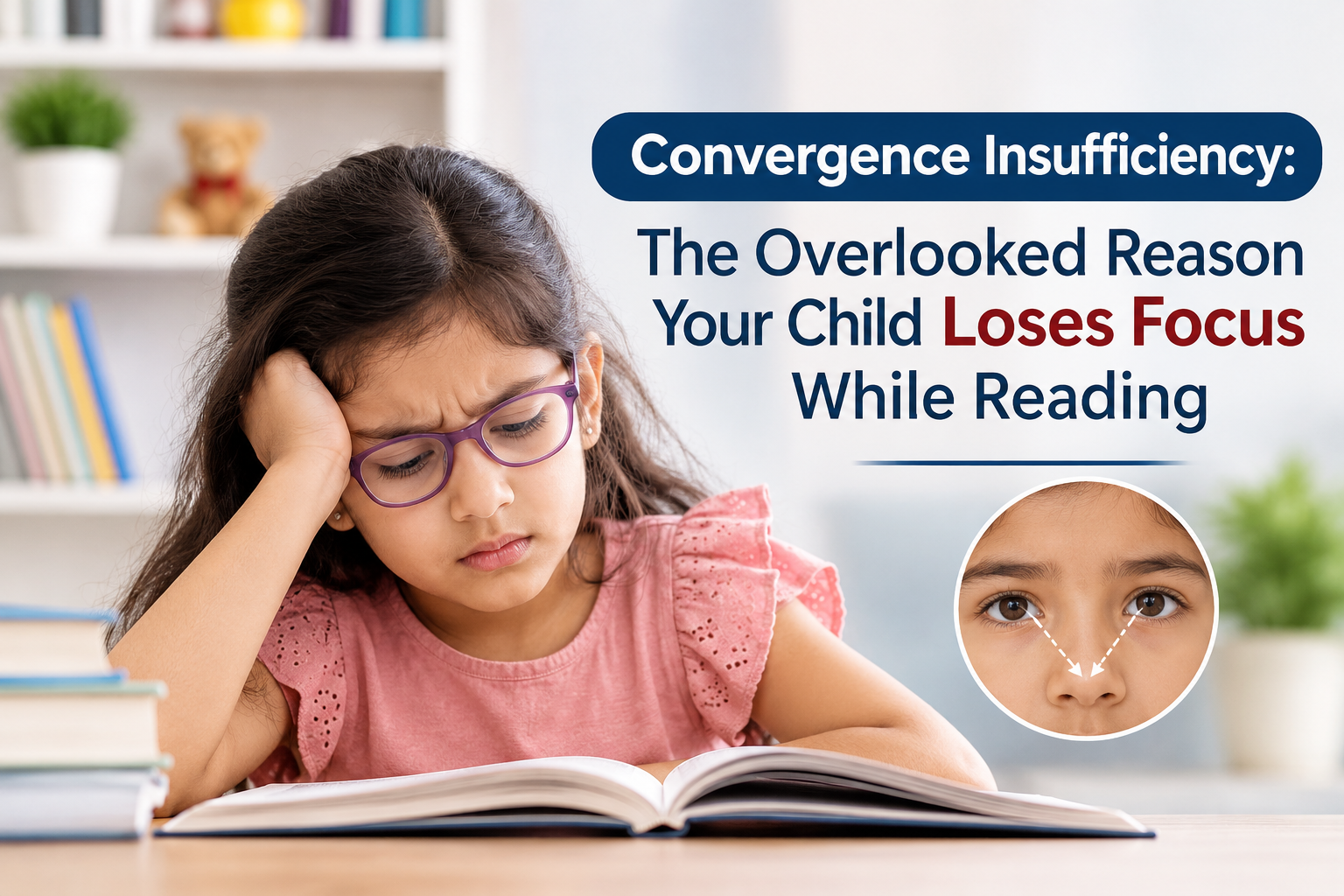
Convergence Insufficiency: The Overlooked Reason Your Child Loses Focus While Reading
There is a child in a school in Surya Nagar, Ghaziabad, who is sitting in the third row, five metres from the board, and can see every letter on it clearly. His teacher can confirm this; he read the chart without difficulty at the school screening. But when he opens his textbook, something shifts. Words seem to move. He loses his place constantly. He rereads the same line without realising it. By the end of a 45-minute class, he has a headache forming behind his eyes and has understood about half of what the class covered.
His parents have been told he is not concentrating. His teacher finds him inattentive. He has been assessed for learning difficulties. Nobody has assessed his convergence.
Convergence insufficiency (CI) is a condition in which the eyes cannot maintain coordinated inward focus for near tasks. The muscles that turn the eyes inward for close work function inadequately, leaving the visual system in a state of continuous effort to maintain single, clear binocular vision on the page. This effort is invisible to everyone in the room except the child experiencing it; and because it is invisible, it looks like inattention, reading aversion, or academic difficulty of unknown cause.
As the vision therapy specialist at Samyak Eye Care Clinic, Vaishali, serving families from Surya Nagar, Kaushambi, Indirapuram, and across Ghaziabad, I want to explain what CI is, why it is so frequently missed, and why vision therapy resolves it in the majority of cases within 12 to 15 weeks.
What Convergence Insufficiency Is and What It Is Not
Convergence is the inward turning movement of both eyes simultaneously when looking at a near object. To read a book held at 30 to 40 centimetres, the eyes must converge significantly inward. To look up at the board at 5 metres, they must diverge and straighten. This constant shifting between convergence and divergence throughout the school day is managed by the vergence system, which is controlled by the brain's visual processing areas rather than by simple optical prescription.
In convergence insufficiency, the vergence system cannot maintain the required degree of inward turn for near tasks without significant muscular effort. The eyes tend to drift outward. The brain continuously corrects this drift to prevent double vision, but this correction requires sustained effort. Over the course of a reading session, this effort accumulates into the symptoms parents and teachers observe: the child moving his finger along the line to hold his place, stopping frequently, complaining the words are moving, or simply closing the book after a short time.
CI is not a refractive error. A child with CI may have perfect 6/6 vision in both eyes and a fully up-to-date prescription. Standard chart testing will not detect it. It is not detected by distance vision screening at school. It requires specific binocular vision assessment that measures the near point of convergence, the positive fusional vergence range, and the relationship between near and distance phoria. These tests take approximately 20 minutes and are performed as part of a comprehensive binocular vision assessment at Samyak Eye Care Clinic.
The ADHD Connection: Why This Matters So Much in India
Here is the clinical finding that every parent of a child with reading or attention difficulties needs to know: children with convergence insufficiency are approximately three times more likely to be diagnosed with ADHD than their peers with normal binocular vision. Data from peer-reviewed research reveals that 60 per cent of children with CI report losing their place while reading, a behaviour that teachers consistently flag as inattentive ADHD rather than as the physical consequence of binocular misalignment.
A 2025 study published in Ophthalmic and Physiological Optics found a significantly higher prevalence of binocular vision problems, including convergence insufficiency, in children diagnosed with ADHD compared to controls. Importantly, the research also found that when children with both ADHD and CI received vision therapy for the CI, their reading improved and their ADHD-like attentional symptoms diminished significantly.
In India, where school curricula are academically demanding, classroom sizes are large, and the social consequence of being labelled a slow learner or inattentive affects a child's confidence and trajectory significantly, this misdiagnosis carries particularly high stakes. A child in Surya Nagar or Kaushambi who is sent to extra tuition classes for a reading difficulty that is actually convergence insufficiency will spend weeks of tuition time working on a problem that no amount of academic intervention will address. The problem is not in the brain's learning pathways. It is in how the eyes are delivering information to the brain.
How to Recognise Convergence Insufficiency in Your Child
The following symptoms, particularly when they appear specifically during near work (reading, writing, screen use) and ease after the child looks up or rests, should prompt a binocular vision assessment:
Losing place frequently when reading, often skipping lines or rereading the same line
Using a finger to track each line when reading, beyond the age at which this is expected
Headaches that appear specifically after reading or close work, not in the morning or on weekends
Covering or closing one eye when reading
Words appearing to move, blur, or double when reading for more than a few minutes
Short reading stamina: the child gives up or becomes distracted after a relatively brief period of near work compared to peers
Avoidance of homework, books, or any sustained close work, despite general intelligence and curiosity
Difficulty copying from the board when the information requires repeated near-to-far-to-near transitions
It is important to note that many children with CI have never experienced comfortable, effortless reading. They have no reference point for how reading should feel. They do not say their eyes hurt or that words are moving because they assume this is how everyone experiences reading. They simply avoid it. The parent and teacher see avoidance and label it reluctance or inattention.
What the Assessment for Convergence Insufficiency Involves
A CI assessment is not the same as a standard eye examination. The specific tests required are:
Near point of convergence (NPC)
A small target is slowly moved toward the child's nose while they maintain focus on it. The point at which one eye breaks away from the target and turns outward is the near point of convergence. Normal NPC is within 5 to 7 centimetres of the nose. In CI, this may be 15 to 25 centimetres or further, meaning the eyes cannot work together at the reading distance that daily schoolwork requires.
Positive fusional vergence (PFV)
The ability of the eyes to converge beyond the baseline point is measured using prisms. This test reveals how much convergence reserve the visual system has available. In CI, the PFV is significantly reduced; the eyes have very little reserve beyond the minimum required for normal viewing, which is why sustained near work depletes it so rapidly.
Near phoria
The baseline alignment of the eyes at near distance, when fusion is broken momentarily, reveals the underlying tendency toward outward drift. Significant exophoria at near, combined with reduced PFV and a receded NPC, establishes the diagnosis of convergence insufficiency.
These three tests together, combined with the symptom history, provide a definitive diagnosis. The entire assessment takes approximately 20 to 30 minutes and is routinely included in comprehensive binocular vision evaluations at Samyak Eye Care Clinic.
Vision Therapy: The Evidence-Based Treatment with an 85% Success Rate
The gold standard treatment for convergence insufficiency is vision therapy. The landmark Convergence Insufficiency Treatment Trial (CITT), funded by the US National Eye Institute, compared office-based vision therapy to placebo activities and to home-only exercises. The findings were conclusive: office-based vision therapy produced significantly better outcomes for both symptom reduction and objective improvement in NPC and PFV than either comparison group.
Research from 2025 reports an 85 per cent success rate for clinical cure of convergence insufficiency with vision therapy within 12 to 15 weeks. This means that in the vast majority of children, a 12 to 15 week programme of structured in-clinic sessions combined with daily home exercises normalises both the objective measures (NPC, PFV) and the subjective experience of reading comfort.
This is the outcome that extra tuition classes, reading glasses, and ADHD assessment cannot produce. It is specific to the visual system intervention. When the vergence system is rehabilitated through structured therapy, the reading difficulty, the place-losing, the avoidance, and in many children, the ADHD-like attentional symptoms that were driven by the visual effort all resolve together.
At our Eye Gym at Samyak Eye Care Clinic, the vision therapy programme for convergence insufficiency uses in-clinic sessions with specialised equipment and structured daily home exercises using the home therapy kit provided. Progress is measured objectively at each session, and the programme is adapted based on each child's response rate.
What Happens If CI Is Left Untreated
Convergence insufficiency does not reliably resolve on its own in school-age children. Without treatment, the child continues to struggle with near work throughout their school years. The academic consequences accumulate: reading delays, reduced comprehension, avoidance of written work, and potential labelling as a slow learner or inattentive student create a pattern that affects confidence and learning trajectory beyond the specific visual difficulty.
For children who genuinely have both ADHD and CI, the research cited earlier shows that untreated CI acts as a symptom magnifier. The brain's resources required for the muscular effort of maintaining convergence compete with the cognitive resources needed for information processing, producing 20 per cent lower reading comprehension in children with both conditions compared to those with ADHD and normal binocular vision. Treating the CI, even in children who do have genuine ADHD, produces measurable cognitive improvement in reading tasks.
Frequently Asked Questions
Q: What is convergence insufficiency?
A: Convergence insufficiency (CI) is a binocular vision condition in which the eyes cannot maintain the coordinated inward turn required for comfortable near work such as reading and writing. The eyes tend to drift outward under near-work demand, requiring continuous compensatory effort from the vergence system. This effort produces the symptoms of reading difficulty, place-losing, headaches, and near-task avoidance that characterise CI.
Q: Can convergence insufficiency be mistaken for ADHD?
A: Yes, and it frequently is. Children with CI lose their place while reading, avoid near work, have short attention spans for close tasks, and appear inattentive during class. These behaviours are identical to the presentation of inattentive ADHD. Research shows children with CI are three times more likely to be diagnosed with ADHD. A binocular vision assessment should always precede an ADHD assessment in children presenting with reading or attentional difficulties.
Q: How is convergence insufficiency tested?
A: The key tests are: near point of convergence (how close a target can be before the eyes cannot maintain it); positive fusional vergence (the convergence reserve available to the visual system); and near phoria (the baseline alignment tendency at near). These tests are included in a comprehensive binocular vision assessment at Samyak Eye Care Clinic, Vaishali, Ghaziabad.
Q: How long does vision therapy take to work for convergence insufficiency?
A: Research reports an 85 per cent success rate in achieving clinical cure within 12 to 15 weeks of structured office-based vision therapy combined with daily home exercises. Progress is typically measurable within the first four to six weeks, with full normalisation of convergence measures and symptom resolution occurring progressively through the programme.
Q: Where can I find vision therapy for convergence insufficiency near Surya Nagar?
A: Samyak Eye Care Clinic in Vaishali, Ghaziabad provides comprehensive vision therapy through our Eye Gym, serving families from Surya Nagar, Kaushambi, Indirapuram, Vaishali, and across NCR. The assessment and therapy programme for convergence insufficiency is available at appointment times that accommodate school schedules. Visit our clinic to book your child's binocular vision assessment.
The Child in the Third Row
That child in the third row of his Surya Nagar classroom deserves an answer that matches the actual problem. Not extra tuition. Not ADHD assessment before binocular vision is ruled out. A 20-minute binocular vision test and, if CI is confirmed, 12 to 15 weeks of vision therapy that gives him the reading experience his peers have been having without effort.
If your child loses their place while reading, avoids books, has headaches during or after homework, or has been struggling academically without a clear explanation, visit our clinic at Samyak Eye Care, Vaishali, Ghaziabad. Bring the child's school report, any assessment findings you have, and the concerns you have been carrying. The binocular vision assessment will tell us whether CI is part of the picture. If it is, the treatment is specific, evidence-based, and works in the majority of cases.
Book Your Child's Convergence Insufficiency Assessment Today
Dr. Shalini Jain | Samyak Eye Care Clinic | Vaishali, Ghaziabad
Call: 98999 60700


