
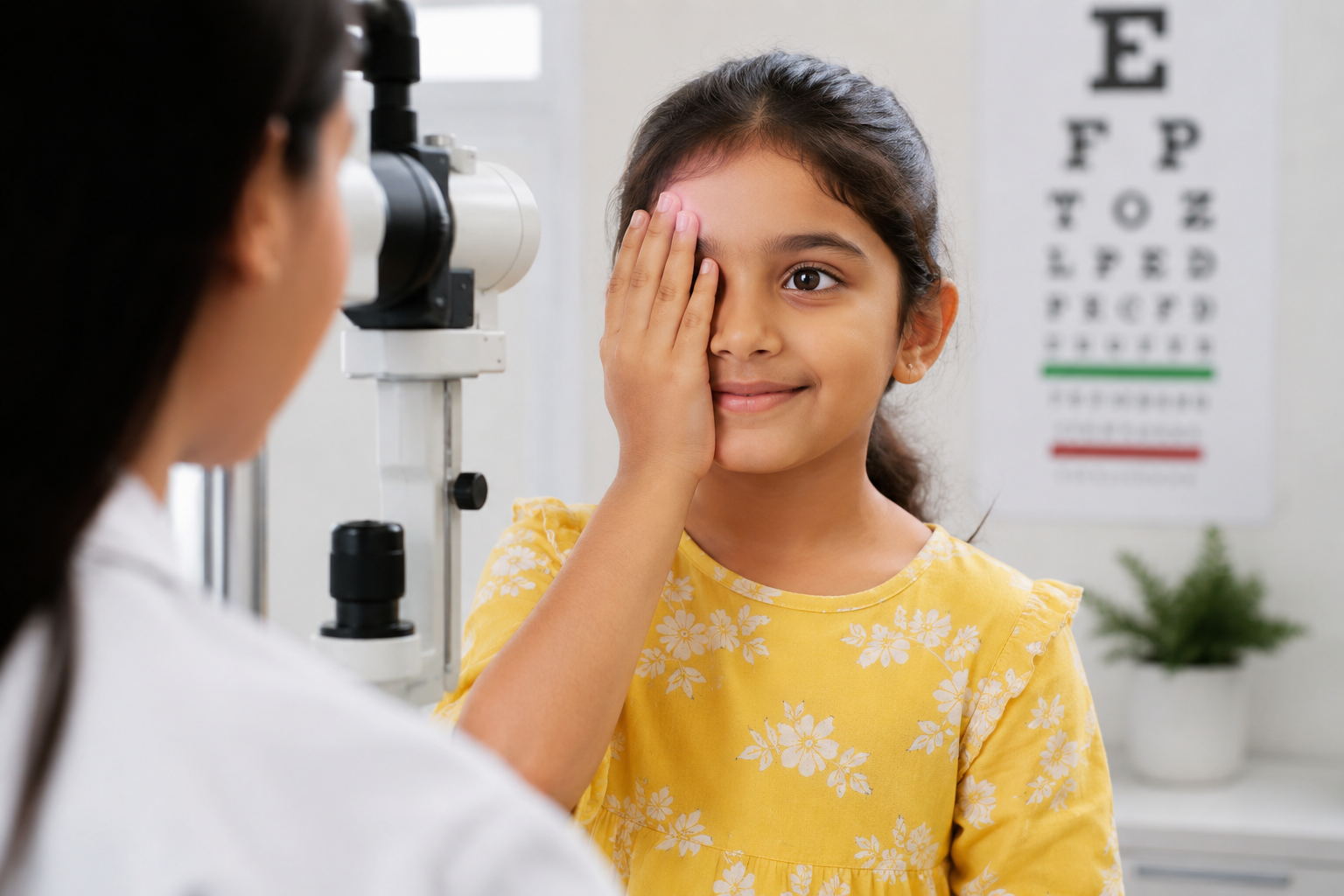
Children's Eye Health Month 2026: Protecting India's Future Generation's Vision
Every August, Children's Eye Health Month reminds us of something we should never forget: our children's vision shapes their entire future. How they see the world determines how they learn, how they play, how they connect with others, and ultimately, who they become. Yet across India, millions of children struggle with undetected vision problems that silently undermine their potential.
Last month, a mother from Vaishali brought her 7-year-old daughter for what she assumed would be a routine check before the new school year. The child had never complained about her vision. She seemed to read adequately. But examination revealed moderate myopia in both eyes and early amblyopia in one — conditions that had been developing silently for years. With proper intervention now, her visual future looks promising. Without detection, she would have faced permanent vision impairment in one eye.
As the best child eye specialist in Vaishali, Ghaziabad, I use Children's Eye Health Month as an opportunity to reach parents who may not realise how critical early eye care truly is. This month, let us commit to protecting India's future generation — one pair of young eyes at a time.
Why Children's Eye Health Deserves Special Attention
Children's eyes are not simply smaller versions of adult eyes. They are developing organs, actively building the neural connections between eye and brain that will determine visual capability for life. This development follows a critical timeline — certain interventions work only during specific windows, after which the opportunity closes permanently.
Amblyopia (lazy eye) provides the clearest example. If detected and treated before age 7-8, most children achieve excellent visual outcomes. Detected at age 12, treatment options are limited, and outcomes are often disappointing. Detected in adulthood, significant improvement becomes nearly impossible. The same eye, the same condition — but timing determines everything.
Beyond development, children face unique visual challenges. Modern childhood involves unprecedented screen exposure. Academic pressure starts earlier and intensifies faster. Outdoor time — protective against myopia — decreases as urban lifestyles dominate. The best eye doctor in Vaishali, Ghaziabad, sees these trends reflected in rising rates of childhood myopia and digital eye strain.
Common Eye Conditions Affecting Indian Children
Refractive Errors
Myopia (nearsightedness), hyperopia (farsightedness), and astigmatism are the most common childhood eye problems. Myopia particularly is reaching epidemic proportions — studies suggest over 30% of urban Indian schoolchildren are affected, with rates climbing annually. Our myopia control clinic addresses this growing concern with evidence-based interventions that slow progression.
Amblyopia (Lazy Eye)
Affecting 2-3% of children, amblyopia occurs when one eye does not develop normal vision, often because the brain suppresses input from an eye that sees less clearly. Without treatment during the critical developmental window, vision loss becomes permanent. Our lazy eye management achieves excellent results when initiated early.
Strabismus (Squint)
Eyes that do not align properly — pointing inward, outward, or vertically misaligned — indicate strabismus. Beyond cosmetic concerns, untreated strabismus often leads to amblyopia as the brain ignores input from the misaligned eye. Early intervention prevents this cascade of problems.
Allergic Conjunctivitis
Itchy, red, watery eyes affect many Indian children, particularly during certain seasons or in polluted urban environments. While not vision-threatening, allergic eye disease causes significant discomfort and can interfere with schoolwork and activities.
Digital Eye Strain
Screen-related symptoms — fatigue, headaches, dry eyes, blurred vision — increasingly affect school-age children. Our Digital Vision Syndrome management helps children navigate unavoidable screen demands while protecting visual comfort.
Warning Signs Every Parent Should Know
Children rarely complain about vision problems because they do not know how they are supposed to see. Parents must watch for behavioural clues that suggest visual difficulty.
Physical signs:
Squinting, head tilting, sitting very close to screens, holding books unusually near or far, frequent eye rubbing, one eye turning in or out, excessive tearing, and sensitivity to light.
Behavioural signs:
Avoiding reading or close work, losing place while reading, using a finger to track text, short attention span for visual tasks, covering one eye, and complaints of headaches or tired eyes after school.
Academic signs:
Declining grades without obvious cause, difficulty copying from the board, messy handwriting, and reluctance to participate in activities requiring good vision.
The best child eye specialist in Vaishali, Ghaziabad, recommends not waiting for obvious symptoms. Many serious conditions produce no visible signs until significant damage has occurred. Regular professional examinations catch what observation misses.
Recommended Eye Examination Schedule
Professional organisations recommend comprehensive eye examinations at specific intervals:
First examination: Age 6 months
This early check identifies congenital problems, significant refractive errors, and conditions like infantile cataracts that require immediate intervention.
Second examination: Age 3 years
By this age, children can participate in more detailed testing. This examination catches amblyopia, strabismus, and refractive errors while treatment remains most effective.
Pre-school examination: Age 5-6 years
Before academic demands intensify, ensure your child's visual system is ready for learning. Undetected problems at this stage often manifest as learning difficulties.
Annual examinations: Throughout school years
Children's eyes change rapidly during growth. Annual comprehensive eye examinations monitor development, track prescription changes, and catch emerging problems early.
Children with risk factors — family history of eye problems, premature birth, developmental delays, or previously identified conditions — may need more frequent monitoring.
Protecting Vision in the Digital Age
Screen use is now integral to education and entertainment. Complete avoidance is neither practical nor necessary. However, thoughtful management protects young eyes from cumulative strain and potentially slows myopia progression.
The 20-20-20 rule:
Every 20 minutes of screen time, look at something 20 feet away for 20 seconds. This simple practice relaxes focusing muscles and encourages complete blinking.
Outdoor time:
Research consistently shows that time spent outdoors protects against myopia development and progression. Aim for at least 1-2 hours of outdoor activity daily — a prescription that benefits overall health as well as eyes.
Screen positioning:
Screens should be at arm's length, with the top of the screen at or slightly below eye level. Proper positioning reduces strain and encourages healthy viewing habits.
Lighting:
Ambient lighting should be approximately half the screen brightness. Avoid using screens in dark rooms, which forces eyes to constantly adjust between bright screen and dark surroundings.
Modern Solutions for Childhood Vision Problems
Treatment options have advanced dramatically. Simple glasses remain the foundation for most refractive errors, but additional options serve specific needs.
Ortho-K lenses provide daytime freedom from glasses while actively slowing myopia progression — ideal for active children and those whose prescriptions are worsening rapidly.
Vision therapy addresses functional vision problems — tracking difficulties, focusing weakness, eye coordination issues — that glasses alone cannot correct. Many children with learning difficulties show dramatic improvement after vision therapy.
Atropine drops at very low concentrations can slow myopia progression with minimal side effects, offering another tool in the myopia control arsenal.
For complex conditions like keratoconus or high prescriptions, speciality contact lenses provide vision quality that standard glasses cannot match.
Frequently Asked Questions
Q: My child passed the school vision screening. Is an eye examination still necessary?
A: Yes. School screenings catch only obvious distance vision problems. They miss near vision issues, focusing difficulties, eye coordination problems, and conditions like amblyopia. A comprehensive examination provides much more complete information.
Q: At what age can children wear contact lenses?
A: There is no strict minimum age. Maturity and hygiene habits matter more than age. Ortho-K lenses, worn only during sleep, are particularly suitable for children since parents can supervise the process completely.
Q: Will wearing glasses make my child's eyes weaker?
A: No. This persistent myth has no medical basis. Glasses correct vision; they do not weaken eyes. Children's prescriptions often change during growth regardless of whether they wear glasses.
Q: How can I tell if my child's vision problem is affecting their learning?
A: Vision problems often masquerade as attention or learning difficulties. If your child avoids reading, loses place frequently, has messy handwriting, or struggles academically despite apparent intelligence, vision may be contributing. A comprehensive examination can identify or rule out visual factors.
Q: Is myopia progression preventable?
A: Myopia progression cannot be completely prevented, but it can be significantly slowed. Our myopia control clinic uses evidence-based interventions that typically reduce progression by 40-60% compared to glasses alone.
Q: Where can I get my child's eyes examined during Children's Eye Health Month in Vaishali?
A: Dr. Shalini Jain at Samyak Eye Care — the best child eye specialist in Vaishali, Ghaziabad — provides comprehensive paediatric eye examinations. Visit our clinic to schedule your child's examination.
This Month, Commit to Your Child's Vision
That 7-year-old from Vaishali with undetected myopia and amblyopia? She is now wearing glasses that let her see clearly for the first time, and patching therapy is strengthening her weaker eye while treatment can still make a difference. Her parents wish they had brought her sooner — but they are grateful they brought her in time.
Children's Eye Health Month is more than an awareness campaign. It is a call to action. Your child's vision is developing right now. Problems may be silently progressing. The window for optimal treatment may be closing. Do not wait for symptoms that may never appear. Schedule a comprehensive examination and know for certain that your child's visual future is protected.
Visit our clinic this August and give your child the gift of clear, healthy vision for life.
Schedule Your Child's Eye Health Examination
Dr. Shalini Jain | Samyak Eye Care Clinic | Vaishali, Ghaziabad
Call: 98999 60700


