
Children's Eye Exams: What Every Parent Should Know
The teacher's note came home in the school diary: "Please check if your child needs glasses. She squints at the board and often copies from her neighbour's notebook."
For many parents, this is the first indication that something might be wrong with their child's vision. But by the time a teacher notices, the problem has often been affecting the child's learning for months -- sometimes years.
The tricky thing about children's vision problems? Kids rarely complain. They assume everyone sees the world the way they do. A child who has always seen blurry text doesn't know that letters are supposed to be sharp and clear.
Why School Vision Screenings Aren't Enough
Many parents believe that if their child passes the school eye test, their vision must be fine. Unfortunately, this isn't always true.
School screenings typically only check distance vision -- whether a child can read letters on a chart from across the room. They miss:
• Near vision problems that affect reading and writing
• Eye coordination issues that cause words to jump or blur
• Lazy eye (amblyopia) in its early stages
• Colour vision deficiencies
• Eye health conditions that don't immediately affect vision
A comprehensive paediatric eye examination checks all of these -- not just whether your child can see the board.
Signs Your Child Might Have a Vision Problem
Since children rarely complain about vision problems, parents need to watch for behavioural signs. Here's what to look for:
At School:
• Sitting very close to the board or TV
• Losing place while reading or using a finger to track words
• Avoiding reading or homework (it might literally hurt)
• Copying from a neighbour instead of the board
• Declining grades despite being an intelligent child
Physical Signs:
• Squinting or tilting the head to see better
• Frequent eye rubbing (not due to sleepiness)
• Headaches, especially after school or reading
• One eye turning in or out
• Excessive blinking or watery eyes
Noticed any of these signs? Don't wait for the next school screening. Call 98999 60700 to schedule a comprehensive eye exam.
When Should Children Have Their First Eye Exam?
Many parents are surprised to learn that children should have their eyes examined well before they can read letters on a chart. Here's the recommended schedule:
• 6 months: First eye exam to check for major problems affecting visual development
• 3 years: Pre-school exam to detect lazy eye and other conditions
• 5-6 years: Before starting school -- this one is crucial
• Annually: Throughout school years, or more frequently if prescribed glasses
The pre-school years are especially critical because conditions like lazy eye (amblyopia) are much easier to treat before age 7. After this window, treatment becomes progressively more difficult.
What Happens During a Paediatric Eye Exam?
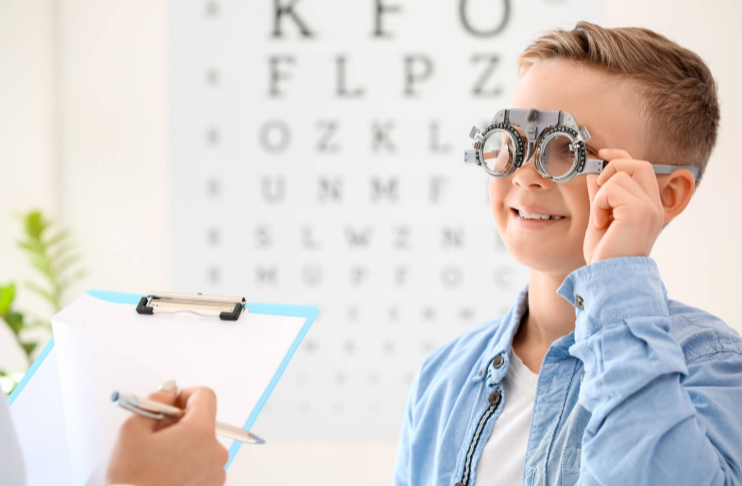
Worried that your young child won't be able to cooperate with an eye exam? Don't be. Paediatric eye specialists have techniques specifically designed for children who can't yet read or describe what they see.
At our clinic, a children's eye examination typically includes:
Visual acuity testing -- Using pictures or symbols instead of letters for younger children. We have special charts with shapes, animals, and objects that even 3-year-olds can identify.
Eye alignment check -- Ensuring both eyes work together as a team. Misalignment can lead to double vision or the brain ignoring one eye entirely.
Eye movement evaluation -- Checking whether the eyes can smoothly follow a moving object and jump accurately between targets -- skills essential for reading.
Refraction -- Determining if glasses are needed. For young children, we often use special eye drops and instruments that measure refractive error without requiring the child to respond.
Eye health examination -- Using specialised equipment to examine the internal structures of the eye, including the retina and optic nerve.
The Rising Problem: Myopia in School Children
One thing we're seeing increasingly at our clinic is children developing myopia (nearsightedness) at younger ages -- and their prescriptions increasing faster than previous generations.
The reasons? More screen time, more close-up work, less outdoor play. A child who spends hours on tablets and phones, then does homework, and rarely plays outside, is at significantly higher risk of developing and progressing myopia.
This matters because high myopia isn't just an inconvenience requiring thick glasses. It substantially increases the risk of serious eye conditions later in life, including retinal detachment, glaucoma, and macular degeneration.
The good news? We now have effective treatments to slow myopia progression. Our myopia control clinic offers options including Ortho-K lenses and specialised spectacle lenses that can reduce myopia progression by up to 50%.
Vision Problems That Affect Learning
Sometimes a child struggling in school doesn't need tutoring -- they need glasses. Or vision therapy.
Vision is more than just seeing clearly. It involves:
• Eye teaming: Both eyes working together
• Eye tracking: Following a line of text smoothly
• Focusing: Shifting focus between near and far objects
• Visual processing: Making sense of what the eyes see
A child with perfect 20/20 vision can still struggle with reading if their eyes don't track properly or can't sustain focus on near work. These functional vision problems don't show up in basic vision screenings but can significantly impact academic performance.
Give Your Child the Best Start
Children learn primarily through vision. When they can't see clearly or their visual system isn't working efficiently, everything from reading to sports to social interactions becomes harder.
At Samyak Eye Care Clinic, Dr. Shalini Jain has been caring for children's eyes for over 25 years. We understand that examining a fidgety 4-year-old requires patience and specialised techniques -- and that explaining findings to worried parents requires clarity and empathy.
Whether your child needs their first eye exam, is due for an annual check-up, or is showing signs of vision problems, we're here to help. Families from Surya Nagar, Vaishali, Ghaziabad, Indirapuram, and across Delhi NCR trust us with their children's vision.
BOOK YOUR CHILD'S EYE EXAMINATION TODAY
Call: 98999 60700
Website: www.samyakeyecare.com
Location: Gaur Heights, Sector 4, Vaishali, Ghaziabad
Serving families from Surya Nagar | Vaishali | Ghaziabad | Indirapuram | Kaushambi | East Delhi | Delhi NCR


