
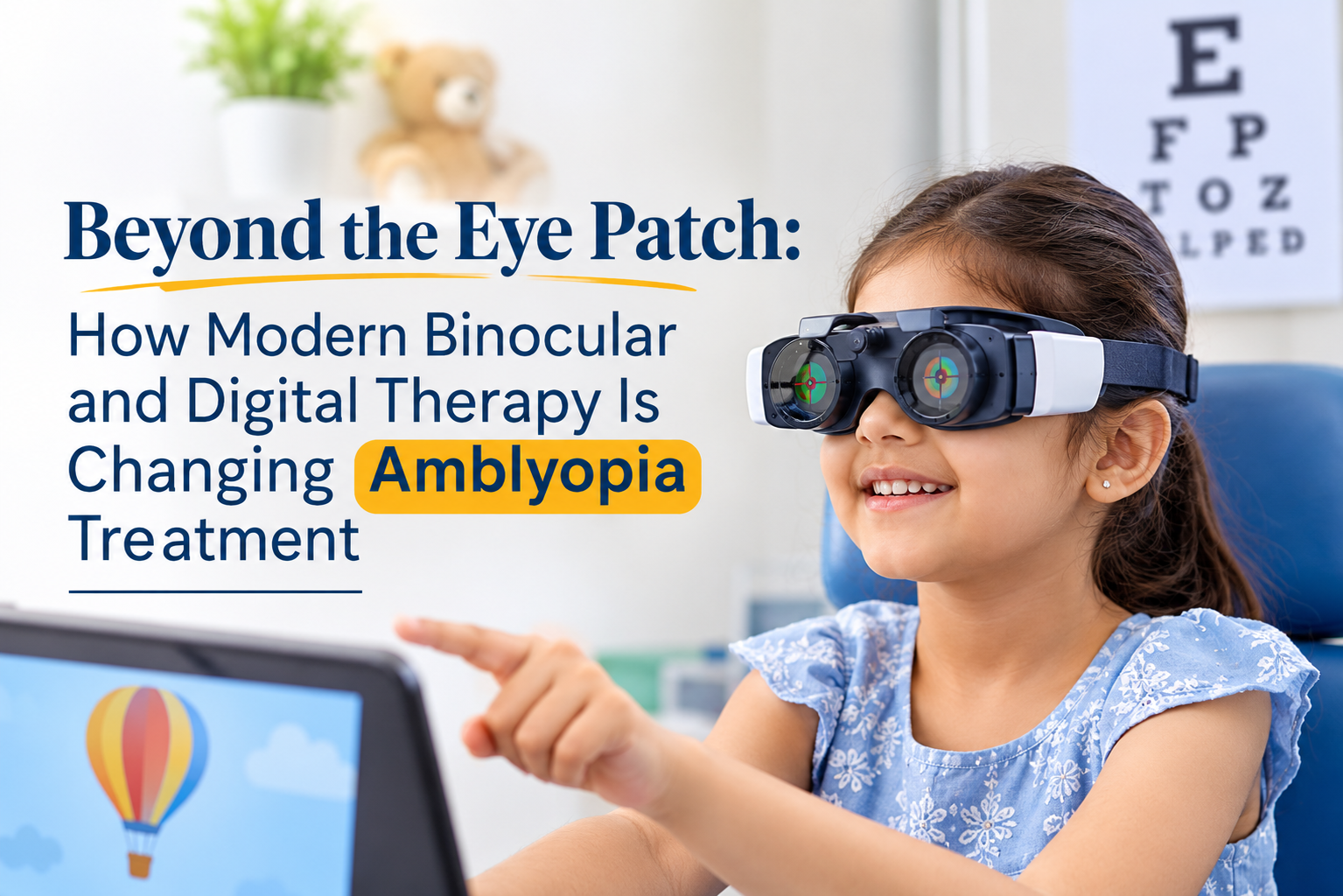
Beyond the Eye Patch: How Modern Binocular and Digital Therapy Is Changing Amblyopia Treatment
The eye patch has been the symbol of lazy eye treatment for decades. Children wear it, dislike it, resist it, and frequently remove it when parents are not watching. Parents struggle with compliance, teachers manage the social dynamics, and clinicians track acuity improvements that are sometimes real but often plateau without resolving the underlying binocular problem that the patch, by its nature, is not designed to address.
This is not an argument against patching. For young children within the critical period of visual development, patching remains an effective and clinically important treatment. But for older children, for children whose amblyopia has partially responded to patching but not resolved, and for families struggling with compliance, the clinical conversation has moved significantly in the past decade. Modern amblyopia treatment is not simply patching with better compliance support. It includes binocular treatment approaches that directly address the suppression mechanism underlying amblyopia rather than working around it, and digital therapy platforms that can achieve treatment outcomes that patching alone cannot.
As the amblyopia and vision therapy specialist at Samyak Eye Care Clinic, Vaishali, Ghaziabad, I want to explain the clinical evolution of amblyopia treatment and why families in Vasundhara, Ghaziabad, and across NCR whose children are currently being managed with patching alone should know what the complete clinical picture now includes.
What Patching Does and What It Does Not
Patching the stronger eye forces the brain to rely on the amblyopic eye for all visual input. This works because the visual cortex retains plasticity during the developmental period (up to approximately 7 to 8 years of age), and sustained use of the amblyopic eye stimulates the development of the neural pathways that underlie vision in that eye.
The mechanism is monocular stimulation: the patched eye sees nothing, the amblyopic eye does all the work, and with consistent treatment over weeks to months, the visual acuity of the amblyopic eye improves. For young children with adequate neural plasticity and good compliance, this produces genuine visual acuity gains.
What patching does not directly address is suppression. Suppression is the brain's active mechanism for avoiding the double vision that would otherwise result from the mismatch between inputs from the two eyes. In amblyopia, the brain has learned to suppress (ignore) the input from the amblyopic eye, not just passively, but through an active neural inhibition process. When the patch is removed and both eyes are open again, this suppression mechanism re-engages. The visual acuity gained through patching is often present, but the two eyes still do not work together naturally as a binocular team; the improved eye is still suppressed to a degree during binocular viewing.
This is why many children who complete a patching course and achieve improved acuity in the amblyopic eye still have reduced stereoacuity (depth perception) and continue to experience some degree of suppression during binocular activities. The eye can see better when tested in isolation, but the integrated function of both eyes together has not been fully restored.
Binocular and Dichoptic Treatment: Directly Targeting Suppression
Binocular treatment approaches for amblyopia, particularly dichoptic therapy, represent the most significant clinical advance in amblyopia treatment of the past decade. Where patching works by eliminating input from the stronger eye, dichoptic therapy works by presenting different information to each eye simultaneously, designed specifically to force the brain to integrate inputs from both eyes for a complete perception.
The dichoptic approach: using digital devices, different visual information is delivered to each eye. Typically, high-contrast elements of an image or game are shown to the amblyopic eye, while lower-contrast elements are shown to the stronger eye. The brain must use both eyes together to perceive the complete image. The suppression mechanism is directly challenged; if the amblyopic eye's input is suppressed, the image is incomplete. The brain must engage the amblyopic eye to see the full picture.
Research from multiple clinical trials, including studies published in peer-reviewed ophthalmology journals through 2024 and 2025, confirms that dichoptic treatment produces improvements in both visual acuity and stereoacuity that patching alone does not achieve. Stereoacuity improvement specifically reflects the binocular integration that dichoptic therapy targets directly, and it is the outcome that most accurately represents functional visual recovery rather than merely single-eye acuity on a chart.
FDA-Approved Digital Therapy: What It Means Clinically
FDA-approved software-based amblyopia therapy platforms are available for clinical use and are incorporated into the vision therapy programme at Samyak Eye Care Clinic's Eye Gym. FDA approval for these platforms means they have been evaluated for safety and efficacy in clinical trials demonstrating statistically significant improvements in visual outcomes for amblyopic children.
The clinical significance: these are not educational games or passive screen activities. They are medical devices designed to deliver specific visual stimuli that target the suppression and monocular calibration deficits of amblyopia. The treatment protocol is defined, the dose is measurable, and the outcomes are tracked objectively through the clinic's monitoring of session data.
For many children, particularly those who have struggled with patch compliance, the engagement factor of digital therapy platforms produces superior actual treatment dose delivery compared to patching. A child who wears a patch for 20 minutes while fidgeting and trying to remove it has received far less effective treatment than a child who spends 30 minutes actively engaged in a dichoptic treatment programme. The brain's level of engagement with the visual stimulus directly influences the neuroplastic response the treatment is designed to produce.
Home-Based Vision Therapy Kits: Extending Treatment Beyond the Clinic
At Samyak Eye Care Clinic, the amblyopia treatment programme is not limited to in-clinic sessions. Every child on the programme receives a structured home therapy kit developed specifically for use between clinic appointments. These kits include activities and exercises that extend the total treatment dose and reinforce the binocular integration work done during clinic sessions.
The home component is carefully designed by Dr. Shalini Jain to match the child's current treatment stage and to complement the in-clinic dichoptic work. Home activities are updated at each clinic appointment based on the child's progress, ensuring the exercises remain appropriately challenging as the amblyopic eye's performance improves.
This combined approach, in-clinic digital dichoptic therapy plus structured home programme, produces treatment outcomes that neither component alone consistently achieves. The clinic sessions provide the intensity and specialised equipment that home exercises cannot replicate. The home programme provides the daily reinforcement that weekly or biweekly clinic sessions alone cannot maintain.
Who Benefits Most from Modern Binocular Approaches
Modern binocular and digital amblyopia therapy is clinically most relevant for the following groups:
Children who have partially responded to patching but plateaued
Patching produces its most rapid gains in the early weeks of treatment. Many children experience a plateau where further improvement with continued patching is minimal. Introducing binocular therapy at this stage, rather than simply extending the patching duration, can produce additional visual acuity gains and, more importantly, improve the binocular integration that patching does not directly address.
Children with poor patch compliance
Compliance is the critical variable in patching outcomes, and compliance is notoriously difficult to achieve in school-age children who are socially aware of the patch's visibility. For children in Vasundhara, Ghaziabad, and across NCR whose parents are struggling with compliance, digital therapy platforms offer an alternative that many children engage with more readily. The treatment is done on a screen; it looks like a game; it does not require wearing something visible at school.
Older children beyond the traditional critical period
As discussed in our previous blog on lazy eye treatment in older children, patching produces smaller gains beyond age 8 to 9. Research on dichoptic and binocular therapy has produced encouraging results in older children and teenagers who are generally considered to have reduced treatment potential. The direct targeting of suppression mechanisms through dichoptic therapy appears to engage neural plasticity pathways that monocular patching does not access as effectively.
Children for whom binocular function is a specific treatment goal
Some children have good visual acuity in both eyes individually but significantly impaired binocular function and stereoacuity from amblyopia. For these children, patching the better eye would not produce meaningful acuity gains (since the amblyopic eye already has reasonable acuity), but binocular therapy directly targets the suppression and integration deficit that is causing the functional limitation.
Atropine Penalisation: The Alternative to the Physical Patch
For completeness, patching is not the only monocular treatment approach. Atropine eye drops applied to the stronger eye temporarily blur its near vision, effectively penalising it for near tasks and forcing the amblyopic eye to take over for reading and close work. Atropine penalisation has comparable efficacy to patching for moderate amblyopia in multiple clinical trials and has the significant practical advantage of being invisible.
For older children in Vasundhara and Ghaziabad who have refused or removed patches consistently, atropine penalisation combined with digital binocular therapy offers a compliance-friendly treatment approach that delivers monocular stimulation (via atropine) alongside binocular integration training (via digital therapy) in a combination that many families find achievable and sustainable.
Frequently Asked Questions
Q: Is patching still the best treatment for lazy eye?
A: Patching remains an effective and evidence-based first-line treatment for amblyopia in young children within the critical period. However, it addresses monocular acuity without directly targeting suppression. Modern binocular and dichoptic therapy approaches produce additional improvements in stereoacuity and binocular integration that patching alone cannot achieve. The most complete treatment programmes combine appropriate monocular stimulation with binocular therapy.
Q: What is binocular therapy for amblyopia?
A: Binocular therapy, specifically dichoptic therapy, presents different visual information simultaneously to each eye using digital devices, forcing the brain to integrate inputs from both eyes. This directly challenges the suppression mechanism that underlies amblyopia, producing improvements in binocular function and stereoacuity that monocular patching does not address. FDA-approved software platforms deliver this treatment in a clinical and home setting.
Q: Can lazy eye be treated after the age of 10?
A: Yes, with realistic expectations about the degree of improvement achievable. Patching produces smaller gains beyond age 8 to 9, but binocular and dichoptic therapy approaches have shown promising results in older children and teenagers. The direct targeting of suppression pathways through dichoptic treatment may access neural plasticity that monocular patching does not engage as effectively in older children. A detailed assessment at Samyak Eye Care Clinic determines what is achievable for each individual child.
Q: How long does amblyopia treatment take?
A: Treatment duration varies based on the severity of amblyopia, the child's age, the treatment approach used, and compliance quality. For young children with patching and vision therapy, meaningful improvement is typically seen within 12 to 24 weeks, with continued treatment often needed for consolidation and binocular integration gains. Older children may require longer treatment periods. Progress is monitored at every clinic appointment, and the programme is adjusted based on objective response data.
Q: Where can I find modern amblyopia treatment near Vasundhara Ghaziabad?
A: Samyak Eye Care Clinic in Vaishali, Ghaziabad offers comprehensive lazy eye management including FDA-approved digital therapy through our Eye Gym, home therapy kits, and atropine penalisation as alternatives to patching where appropriate. We serve families from Vasundhara, Kaushambi, Indirapuram, Vaishali, and across NCR. Visit our clinic to book your child's assessment.
The Treatment Has Moved Forward
Amblyopia treatment in 2026 is not the same as it was in 2016. The clinical understanding of suppression as an active mechanism, the development of dichoptic therapy approaches that directly target it, and the availability of FDA-approved digital platforms that make this treatment accessible outside of specialist research centres have all changed what is achievable and for whom.
If your child is currently on a patching programme, continue it if it is working and compliance is manageable. But if the patch is not being worn consistently, if progress has plateaued, or if your child is older and has been told treatment options are limited, visit our clinic at Samyak Eye Care, Vaishali, Ghaziabad. The conversation about what modern amblyopia treatment actually includes is worth having.
Book Your Child's Amblyopia Assessment and Treatment Consultation
Dr. Shalini Jain | Samyak Eye Care Clinic | Vaishali, Ghaziabad
Call: 98999 60700


