
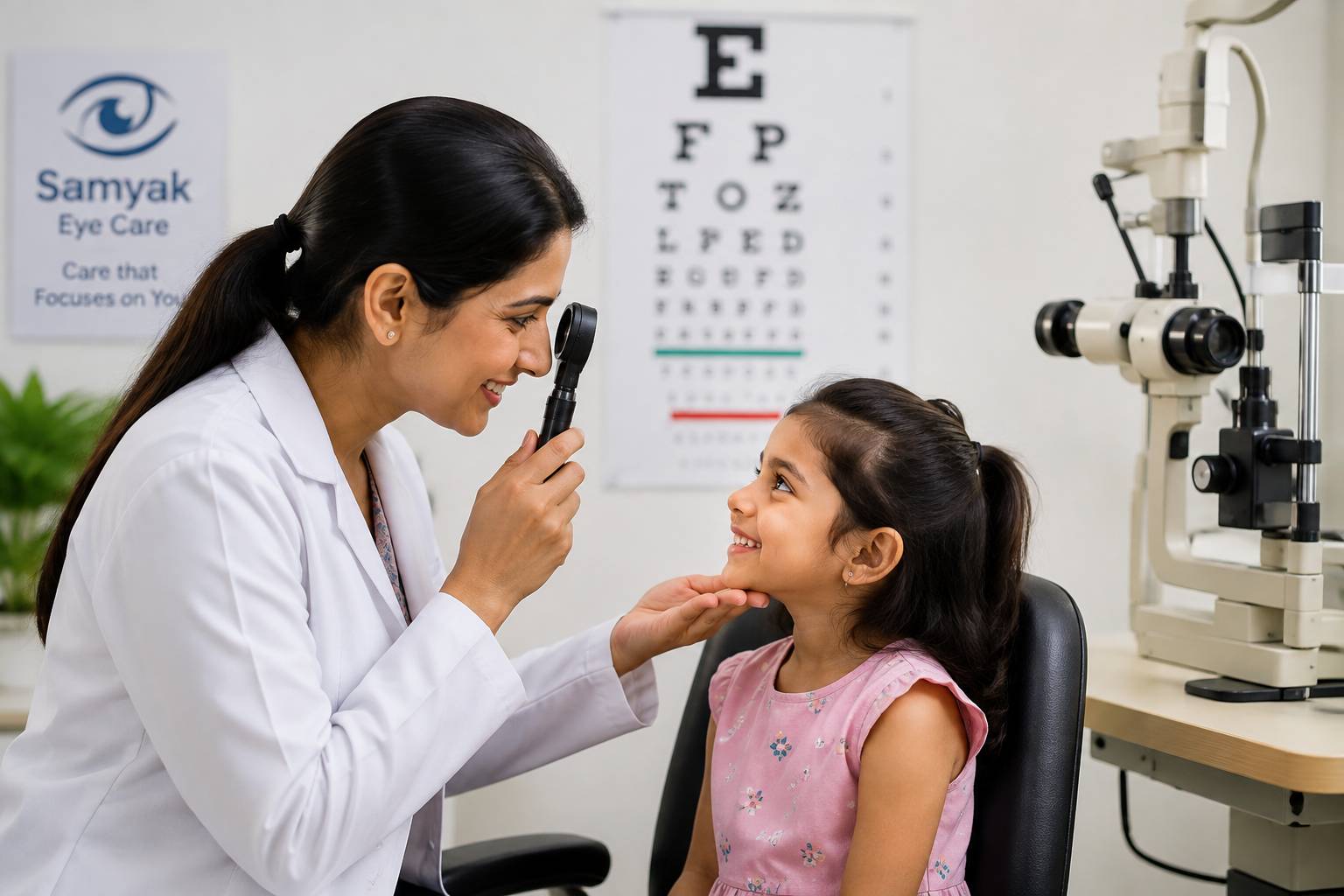
Best Paediatric Eye Specialist in Vaishali: Expert Care for Your Child's Vision
When your child's vision is at stake, you want more than a competent eye doctor — you want someone who truly understands children. Someone who can coax a reluctant toddler through an examination. Someone who recognises the subtle signs that indicate problems children cannot articulate. Someone who offers not just diagnosis but genuine partnership in protecting your child's visual future.
Finding such care matters enormously because children's eye care differs fundamentally from adult care. The conditions are different. The examination techniques must adapt to developmental stages. The treatment windows are often narrow, and missing them means accepting outcomes that could have been prevented.
As the best paediatric eye specialist in Vaishali, Ghaziabad, I have dedicated over 25 years to understanding and treating children's eyes. More than 37,500 patients — many of them children who are now adults with healthy vision — reflect this commitment. Here is what parents should look for in paediatric eye care and what makes truly excellent care possible.
Why Paediatric Eye Care Requires Specialised Expertise
Children are not small adults. This truth, obvious in paediatric medicine generally, applies powerfully to eye care.
Developmentally, children's visual systems are still forming. The connections between eyes and brain, the fine-tuning of focus and coordination, the establishment of binocular vision — all occur during childhood. Problems during this period can cause permanent deficits; interventions during this period can achieve results impossible later.
Communicatively, children cannot describe symptoms the way adults can. A child does not say, 'I have blurry vision at a distance with mild astigmatism.' They might not say anything at all, having never known clear vision. The paediatric specialist must elicit information through observation, appropriate testing, and understanding what behaviours indicate.
Emotionally, children may fear medical environments, resist examination, or become uncooperative when anxious. Creating a child-friendly atmosphere, building rapport quickly, and knowing how to examine even reluctant children are essential skills for paediatric eye care.
The best child eye doctor in Vaishali, Ghaziabad, combines clinical expertise with the interpersonal skills needed to care for young patients effectively.
Conditions Requiring Paediatric Eye Expertise
Paediatric eye specialists manage the full range of childhood eye conditions, some of which require early intervention for optimal outcomes.
Amblyopia (Lazy Eye)
When one eye does not develop normal vision — often because of uncorrected refractive error, strabismus, or obstruction — the brain learns to ignore that eye's input. Lazy eye management works best when initiated during the critical developmental period, typically before age 7-8. Treatment may involve glasses, patching, atropine drops, or vision therapy, tailored to each child's specific situation.
Strabismus (Squint)
Misaligned eyes — whether turning inward, outward, or vertically — require evaluation to determine the cause and appropriate management. Some forms resolve with glasses; others require surgery. Early treatment prevents the amblyopia that often accompanies untreated strabismus.
Refractive Errors
Myopia, hyperopia, and astigmatism affect children of all ages. The myopia control clinic specifically addresses progressive nearsightedness, which is reaching epidemic proportions among school-age children. Early intervention slows progression and protects long-term eye health.
Congenital Conditions
Some children are born with eye conditions requiring immediate or early attention — congenital cataracts, glaucoma, blocked tear ducts, and various structural abnormalities. Early identification and appropriate referral can prevent permanent vision loss.
Visual Processing Problems
Some children have healthy eyes but difficulty processing visual information — problems with tracking, focusing, eye teaming, or visual perception that affect reading and learning. Vision therapy addresses these functional issues that glasses alone cannot correct.
What Makes an Excellent Paediatric Eye Examination
A comprehensive paediatric eye examination goes far beyond reading a chart. At our clinic, examinations are tailored to each child's age and developmental level.
For infants and toddlers:
We use objective testing methods that require no verbal responses. Fixation patterns, pupil responses, and specialised instruments allow accurate assessment even in babies. Parents often wonder how we can examine children who cannot speak — the techniques are well-established and remarkably precise.
For preschoolers:
Picture charts, matching games, and engaging activities make examination feel more like play than testing. Building rapport before examination helps anxious children relax. Patience and flexibility allow us to obtain accurate results even from initially uncooperative children.
For school-age children:
More sophisticated testing becomes possible as children mature. We assess not only clarity of vision but eye coordination, focusing ability, eye movement skills, and eye health. These thorough eye examinations reveal problems that affect learning and development.
For teenagers:
Adolescent concerns — appearance with glasses, contact lens options, myopia progression, screen-related symptoms — receive attention alongside clinical examination. Teenagers often hide vision problems to avoid wearing glasses; skilful examination uncovers what they may not report.
Treatment Options for Young Patients
Treatment recommendations always consider the child's age, lifestyle, and family circumstances. Options include:
Glasses:
Still the foundation of most childhood vision correction. Modern frames are lightweight, durable, and available in designs children actually want to wear. Involving children in frame selection dramatically improves compliance.
Contact Lenses:
Appropriate for many children, particularly those active in sports or resistant to glasses. Ortho-K lenses worn only during sleep offer daytime freedom while actively slowing myopia progression — an increasingly popular choice for school-age children.
Patching and Atropine:
For amblyopia treatment, these approaches force the brain to use the weaker eye, strengthening visual development. Customised schedules balance treatment intensity with the child's tolerance and lifestyle.
Vision Therapy:
Vision therapy is a supervised programme of exercises that train visual skills — tracking, focusing, coordination, and processing. For children with functional vision problems affecting reading and learning, vision therapy often produces remarkable improvements.
Speciality Lenses:
For complex conditions — high prescriptions, keratoconus, irregular corneas — speciality contact lenses provide vision quality that standard options cannot match.
What to Look for in a Paediatric Eye Specialist
When choosing eye care for your child, consider these factors:
Experience with children:
Not every eye doctor is equally skilled with paediatric patients. Look for demonstrated experience treating children across all age groups, from infants through teenagers.
Comprehensive services:
Children's visual needs span from simple glasses to complex therapies. A practice offering the full range of paediatric services can manage your child's care comprehensively without referral elsewhere.
Child-friendly environment:
The clinic atmosphere matters. A welcoming, non-threatening environment helps children relax and cooperate with examination. Staff who genuinely enjoy working with children make a noticeable difference.
Communication with parents:
Parents need to understand their child's condition, treatment options, and prognosis. A paediatric specialist who takes time to explain, answer questions, and involve parents in decision-making provides better care overall.
Accessibility:
Children's eye care often requires multiple visits — initial examination, follow-ups, therapy sessions. Convenient location and reasonable appointment availability make consistent care practical.
Frequently Asked Questions
Q: At what age should my child first see a paediatric eye specialist?
A: First examination is recommended at 6 months, then at age 3, before starting school, and annually during school years. Earlier evaluation is warranted if you notice any concerning signs or there is a family history of eye problems.
Q: My child seems to see fine. Why do they need an eye exam?
A: Children rarely complain about vision problems because they do not know how they are supposed to see. Many serious conditions — amblyopia, early myopia, eye coordination problems — cause no obvious symptoms until professional examination reveals them.
Q: How do you examine babies and toddlers who cannot read charts?
A: We use objective testing methods — observing how eyes track objects, measuring refractive error with specialised instruments, assessing pupil responses, and evaluating eye alignment. These techniques provide accurate information without requiring verbal responses.
Q: Will my child need glasses forever?
A: It depends on the condition. Some children outgrow mild hyperopia. Myopia typically requires ongoing correction. For children who dislike glasses, Ortho-K lenses provide an alternative that eliminates daytime eyewear.
Q: How do I know if my child's learning difficulties are vision-related?
A: A comprehensive examination evaluates not just clarity of vision but functional visual skills — tracking, focusing, coordination, and processing. If these skills are deficient, vision therapy may help. We can identify or rule out visual contributions to learning difficulties.
Q: Where can I find the best paediatric eye specialist in Vaishali?
A: Dr. Shalini Jain at Samyak Eye Care — the best child eye doctor in Vaishali, Ghaziabad — provides comprehensive paediatric eye care with over 25 years of experience. Visit our clinic for expert care for your child's vision.
Your Child Deserves Expert Care
Your child's visual development happens once. The conditions affecting their eyes, the windows for treatment, and the opportunities to protect their vision exist in childhood and cannot be recovered later. Choosing the right paediatric eye specialist — someone with expertise, experience, and genuine commitment to children — gives your child the best chance for a lifetime of healthy vision.
At Samyak Eye Care, we have served children across Vaishali, Ghaziabad, and surrounding areas for over 25 years. Our commitment to paediatric eye health has earned 4+ government awards for excellence and the trust of thousands of families. We invite you to experience the difference that expert paediatric eye care provides.
Visit our clinic to schedule your child's comprehensive examination and ensure their visual future is in expert hands.
Schedule Your Child's Expert Eye Care
Dr. Shalini Jain | Samyak Eye Care Clinic | Vaishali, Ghaziabad
Call: 98999 60700


