
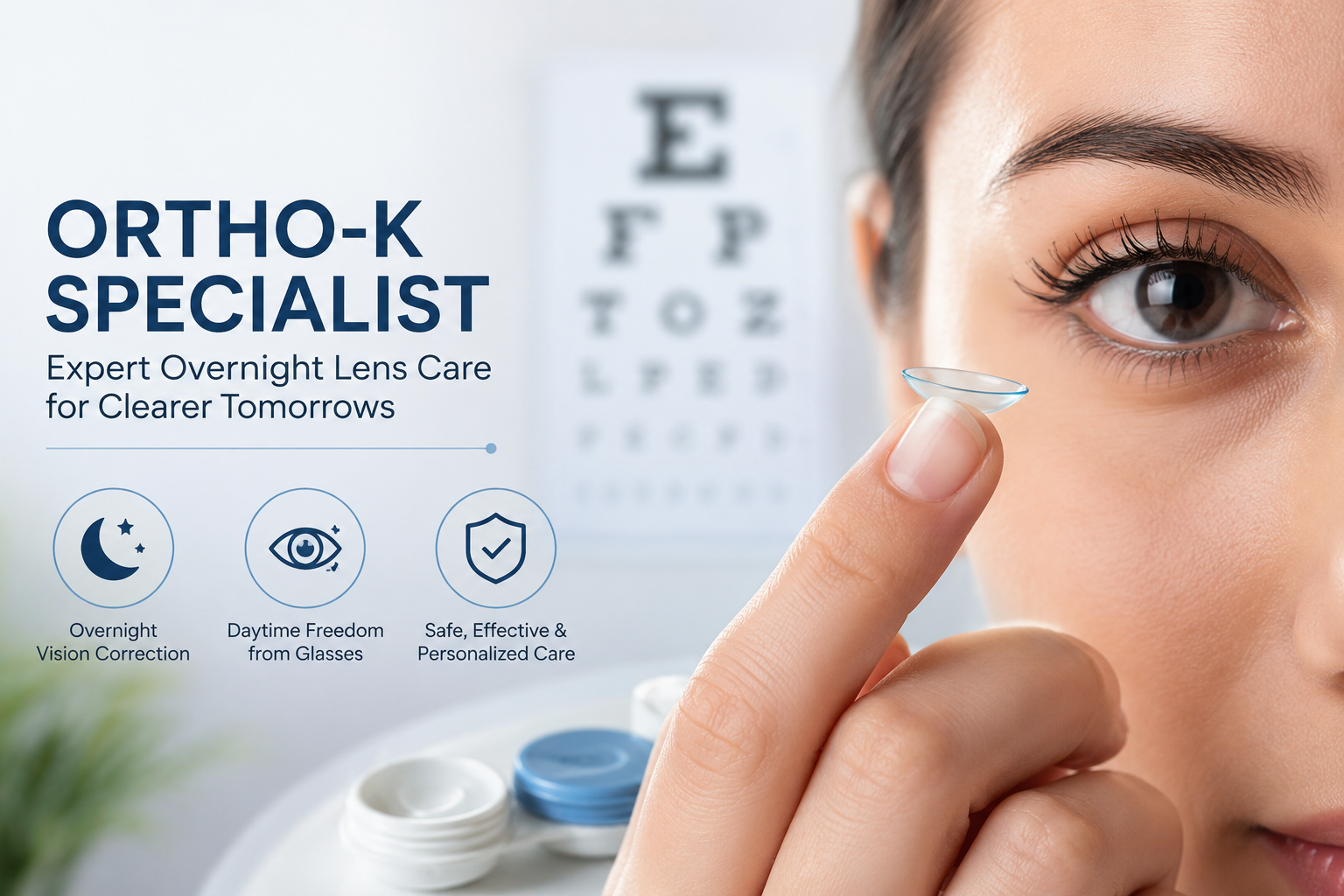
Best Ortho-K Specialist in Delhi NCR: Finding Expert Overnight Lens Care
"My son's glasses keep getting thicker every year. Is there anything we can do to stop this?" This question from a worried mother in Kaushambi perfectly captures why I became passionate about orthokeratology. Her 10-year-old had gone from -1.00 to -3.50 in just three years. Without intervention, he was heading toward high myopia and its associated lifetime risks.
Ortho-K — orthokeratology — offers something remarkable: clear daytime vision without glasses or contacts, achieved through specially designed lenses worn only during sleep. More importantly for growing children, it can slow myopia progression significantly. As the best eye specialist near Kaushambi, I have fitted hundreds of patients with these lenses and witnessed transformations that glasses simply cannot achieve.
What Is Ortho-K and How Does It Work?
Orthokeratology uses specially designed rigid gas-permeable contact lenses that you wear while sleeping. These lenses apply gentle, controlled pressure to reshape your cornea — the clear front surface of your eye — overnight. By morning, your cornea has temporarily reshaped enough to correct your vision. Remove the lenses, and you see clearly all day without any corrective eyewear.
The effect is temporary — your cornea gradually returns to its original shape over 24- 48 hours. This reversibility is actually reassuring. Unlike laser surgery, nothing permanent happens to your eye. Stop wearing the lenses, and your vision returns to baseline within days. This makes Ortho-K lenses particularly suitable for children whose eyes are still developing.
The technology behind Ortho-K has advanced dramatically. Modern computerised corneal mapping creates precise 3D models of your eye, allowing custom lens designs that achieve optimal reshaping while maintaining corneal health. The best eye doctor in Kaushambi uses advanced topography equipment to ensure each lens fits your unique eye perfectly.
The Myopia Control Benefit: Why Parents Are Choosing Ortho-K
Beyond correcting current vision, Ortho-K offers something glasses cannot — it slows myopia progression in children. Multiple long-term studies show that children wearing Ortho-K lenses experience significantly less myopia increase compared to those wearing standard glasses or soft contact lenses.
This matters enormously. High myopia (above -6.00 dioptres) carries increased lifetime risks: retinal detachment, glaucoma, macular degeneration. Slowing progression during childhood means potentially finishing with -4.00 instead of -8.00 by adulthood. That difference affects not just convenience but long-term eye health. Our myopia control clinic helps families understand and access these options.
The exact mechanism is still being researched, but evidence suggests Ortho-K changes how light focuses on the peripheral retina, sending signals that slow eyeball elongation. Whatever the precise mechanism, clinical results speak clearly: children in Ortho-K consistently show slower myopia progression than controls.
Who Is a Good Candidate for Ortho-K?
The ideal Ortho-K candidate has mild to moderate myopia — roughly up to -6.00 dioptres — with low to moderate astigmatism. Higher prescriptions can sometimes be addressed, but results become less predictable and require more experienced fitting.
Children between the ages of 8 and 14 often benefit most, particularly those showing rapid myopia progression. The child must be mature enough to handle lens care responsibly, though parents typically assist younger children with cleaning and insertion.
Athletes and active individuals find obvious appeal in daytime freedom from corrective eyewear. Swimmers, cricketers, and anyone for whom glasses or contacts pose practical challenges during activity appreciate the lifestyle benefits. Adults seeking alternatives to LASIK — perhaps due to dry eyes or thin corneas — find Ortho-K an excellent option.
The best eye specialist in Kaushambi evaluates each candidate individually. Not everyone is suitable, and an honest assessment upfront prevents disappointment later.
What to Look for in an Ortho-K Specialist
Ortho-K fitting requires specialised skills beyond standard contact lens fitting. Not every optometrist or ophthalmologist offers this service, and experience matters significantly for outcomes.
Look for practitioners with dedicated corneal topography equipment — precise mapping is essential for custom lens design. Ask about their experience specifically with orthokeratology: how many patients have they fitted? What success rates do they achieve? What happens if the first lenses need adjustment?
Follow-up protocols matter equally. Proper Ortho-K care involves frequent early visits — the morning after first wear, then at one week, one month, and regularly thereafter. Practitioners who rush this process or have limited availability for follow-up may not provide optimal care.
At our eye care clinic near Kaushambi, we invested specifically in advanced corneal mapping technology because Ortho-K demands it. Each lens must match your individual cornea's unique contours — generic approaches do not work.
The Ortho-K Fitting Process: What to Expect
A proper fitting begins with a comprehensive evaluation — overall eye health assessment, precise prescription measurement, and detailed corneal mapping. Medical history matters too; certain conditions may affect candidacy.
Custom lenses are then designed and manufactured. This takes one to two weeks — quality cannot be rushed. At the dispensing appointment, you learn insertion and removal techniques, proper cleaning protocols, and what to expect during adaptation.
The first few nights feel different — you are sleeping with rigid lenses after all. Most patients adapt within a week. Vision improvement often appears quickly, though optimal correction typically requires two to four weeks of consistent wear. The best eye doctor in Kaushambi monitors progress closely during this period, adjusting if needed.
Safety Considerations: What Parents Need to Know
Parents rightfully ask about safety. Overnight contact lens wear carries inherent risks — primarily corneal infection. These risks are real and should not be dismissed. However, with proper lens care and regular monitoring, Ortho-K has an excellent safety record comparable to other contact lens modalities.
Proper hygiene is non-negotiable. Hands must be washed before handling lenses. Only recommended solutions should be used with contact lenses. Cases must be cleaned and replaced regularly. Water — tap, bottled, any water — should never touch lenses.
Warning signs requiring immediate attention include eye pain, unusual redness, discharge, or vision changes. Removing lenses and seeking prompt evaluation prevent complications. Parents must know these warning signs and understand that hesitation can have consequences.
Frequently Asked Questions
Q: How quickly will I see results with Ortho-K?
A: Many patients notice improved vision after the first night. Optimal correction typically develops within one to two weeks of consistent nightly wear. Some prescriptions take longer to stabilise.
Q: What happens if I miss a night of wearing the lenses?
A: One missed night usually causes only slightly reduced clarity the next day. Consistent nightly wear produces the best results, but occasional lapses do not ruin the treatment.
Q: How long do Ortho-K lenses last?
A: With proper care, lenses typically last one to two years before requiring replacement. Prescriptions may change during growth years, necessitating new lenses regardless of physical condition.
Q: Is Ortho-K permanent?
A: No — this is a temporary correction requiring ongoing nightly lens wear. Stop wearing lenses, and vision returns to its original state. However, the myopia control benefits achieved during childhood provide lasting value.
Q: Will my child need backup glasses?
A: Initially, yes. Keep glasses available while the cornea adapts and for situations when lens wear is not possible. Some patients eventually go without backups entirely once stable.
Q: Where can I find an Ortho-K specialist near Kaushambi?
A: Dr. Shalini Jain at Samyak Eye Care — the best eye specialist near Kaushambi — has extensive experience fitting Ortho-K lenses. Our Vaishali clinic is easily accessible from Kaushambi.
Take the First Step Toward Glasses-Free Days
That mother from Kaushambi whose son's myopia was progressing rapidly? He has been wearing Ortho-K lenses for eighteen months now. His prescription has remained stable — the first time in years. More importantly, he plays cricket without worrying about glasses, swims without prescription goggles, and wakes up seeing clearly.
Ortho-K is not right for everyone, but for suitable candidates, it offers benefits that glasses and regular contacts cannot match. If you are interested in exploring this option, schedule a consultation to determine whether you or your child might benefit. Visit our clinic for a comprehensive evaluation.
Explore Ortho-K for Your Child
Dr. Shalini Jain | Samyak Eye Care Clinic | Vaishali, Ghaziabad
Call: 98999 60700


