
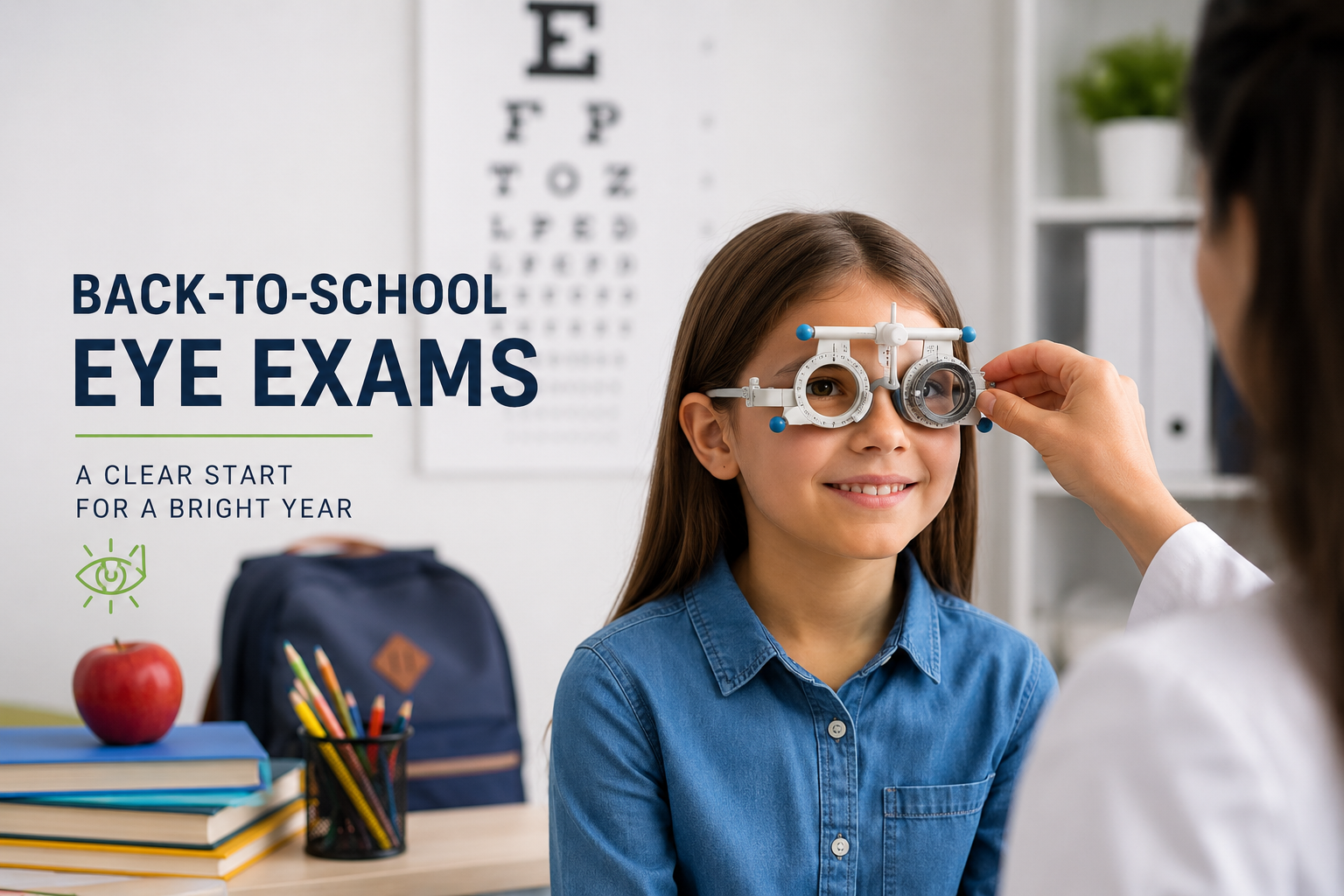
Back-to-School Eye Exams: Why Every Child Needs a Vision Check Before Classes Start
July signals something more than just peak summer heat for parents in Vaishali. It marks the beginning of back-to-school preparations — uniforms, books, supplies, and a checklist that seems to grow longer each year. Yet one critical item frequently gets overlooked until problems arise: your child's eye examination.
Last week, I met a Class 6 student from Vaishali whose grades had dropped steadily over the past year. His parents assumed he was distracted or uninterested. His teachers suggested he might need tutoring. The actual problem? A -2.50 prescription in both eyes that made the blackboard an unreadable blur. He had been memorising what his classmates said rather than reading what the teacher wrote.
As the best child eye specialist in Vaishali, Ghaziabad, I see variations of this story every July and August. Children who cannot see clearly cannot learn efficiently. A comprehensive eye examination before school starts can transform the upcoming academic year.
Why Back-to-School Eye Exams Matter More Than You Think
Vision is fundamental to learning. Experts estimate that 80% of what children learn in school comes through visual processing. Reading, writing, board work, computer use, sports — all demand clear, comfortable vision. A child struggling to see clearly expends enormous energy simply trying to perceive information, leaving less capacity for understanding and retention.
Children rarely complain about poor vision because they have no baseline for comparison. A child who has always seen blurry text at a distance assumes everyone sees the same way. They develop coping mechanisms — sitting closer, memorising rather than reading, avoiding detailed work — that mask the underlying problem while creating secondary issues.
The best eye doctor in Vaishali, Ghaziabad, understands that children's vision problems present differently from adults'. Children compensate silently. They do not articulate symptoms clearly. Professional examination reveals what children cannot express themselves.
What Problems Can a Pre-School Eye Exam Detect?
Refractive errors — myopia, hyperopia, and astigmatism — are the most common findings. Myopia (nearsightedness) makes distant objects blurry, affecting board visibility. Hyperopia (farsightedness) makes sustained near work exhausting, affecting reading and writing. Astigmatism causes general blur at all distances, affecting overall visual clarity.
Beyond simple focusing problems, comprehensive examinations assess eye coordination and tracking. Some children have eyes that do not work smoothly together, causing double vision, skipped words while reading, or loss of place. Our vision therapy programme addresses these coordination issues specifically.
Amblyopia (lazy eye) requires early detection for successful treatment. If one eye sees significantly better than the other, the brain may suppress the weaker eye entirely. Our lazy eye management works best when initiated during school years, before visual development is complete.
Eye health conditions, though less common in children, can affect vision development. The best child eye specialist in Vaishali, Ghaziabad, evaluates not just how well children see but whether their eyes are healthy and developing normally.
Signs Your Child May Need an Eye Examination
Certain behaviours warrant attention even if your child has not complained. Sitting unusually close to the television or holding books very close often indicates myopia. Frequent eye rubbing, especially during reading or homework, suggests eye strain. Squinting — which temporarily improves focus through the pinhole effect — indicates a refractive error needs correction.
Head tilting or turning consistently to one side may indicate one eye working harder than the other. Covering one eye while reading suggests possible double vision or a significant difference between the eyes. Complaints of headaches after school or during homework deserve investigation.
Academic warning signs include losing place while reading, using a finger to track text, skipping words or lines, poor reading comprehension despite adequate decoding, reluctance to read or complete written work, and messy handwriting with inconsistent letter spacing.
Behavioural signs sometimes attributed to attention problems may actually reflect visual difficulties. A child who cannot see comfortably will naturally avoid sustained visual tasks, appearing inattentive when the real issue is uncorrected vision.
What Happens During a Child's Eye Examination?
A comprehensive paediatric eye examination goes far beyond reading letters on a chart. We assess visual acuity at both distance and near, since a child may see the board perfectly but struggle with books on their desk.
We evaluate how the eyes focus and work together. Children should shift focus easily between the desk and the board. When this focusing system is weak, sustained reading becomes exhausting. Eye teaming — how well the eyes coordinate — affects depth perception and comfortable vision.
We check eye movement skills, including tracking (following moving objects) and saccades (jumping between fixed points, as when reading). Poor eye movements cause children to lose their place, skip words, or read slowly.
Eye health evaluation checks structures inside and outside the eye, identifying any conditions that might affect vision development. For a complete assessment, thorough eye examinations may include pupil dilation to view the retina fully.
At our clinic, we use age-appropriate testing techniques. Young children who cannot read letter charts respond well to picture tests, shape matching, and objective measurements requiring no verbal responses. The examination becomes a positive experience rather than a source of anxiety.
When Should Children Have Eye Examinations?
The best eye doctor in Vaishali, Ghaziabad, recommends comprehensive eye examinations at age 3, before school entry (age 5-6), and annually thereafter. Children with a family history of eye problems, developmental delays, or known risk factors may need earlier or more frequent evaluation.
Annual examinations matter because children's eyes change rapidly during growth years. Myopia in particular tends to progress during school age — what was adequate correction last year may be insufficient this year. Our myopia control clinic helps manage progressive nearsightedness that often accelerates during school years.
July timing makes practical sense. There is time to obtain glasses if needed and allow your child to adapt before school begins. If vision therapy is required, summer provides an opportunity for treatment without competing academic demands. Starting the school year with an optimised vision sets the foundation for academic success.
What If My Child Needs Glasses?
Many parents worry about glasses affecting their child's self-esteem or activities. Modern children's eyewear has evolved dramatically. Frames are lightweight, durable, and available in appealing designs that children genuinely want to wear.
For active children or those who resist glasses, alternatives exist. Ortho-K lenses worn overnight reshape the cornea during sleep, providing clear vision during the day without glasses or daytime contact lenses. Many school-age children adapt well to this approach, enjoying freedom during school and sports while managing their myopia.
Involving children in frame selection dramatically improves compliance. Children who choose their own frames feel ownership and are far more likely to wear them consistently. Modern lens materials are impact-resistant and lightweight — practical for active school days.
Beyond Glasses: When Additional Treatment Helps
Some children need more than simple glasses to see comfortably. Visual processing problems — difficulty making sense of what the eyes see — may require vision therapy. This supervised programme of exercises trains the visual system to work more efficiently.
Children with tracking difficulties, focusing problems, or poor eye coordination often show dramatic improvement with vision therapy. Academic performance frequently improves as visual efficiency increases, allowing more energy for comprehension rather than just perception.
For children with complex prescriptions or corneal irregularities, speciality contact lenses may provide clearer vision than standard glasses. The best child eye specialist in Vaishali, Ghaziabad, evaluates each child individually to determine optimal correction.
Frequently Asked Questions
Q: My child passed the school vision screening. Do they still need an eye examination?
A: School screenings are basic assessments that catch only obvious problems. They typically test only distance vision and may miss near vision problems, focusing difficulties, and eye coordination issues that significantly affect learning. A comprehensive examination provides much more information.
Q: How do I know if my child's vision problem is affecting their academics?
A: If your child avoids reading, complains of headaches during homework, loses their place while reading, has messy handwriting, or performs below potential despite effort, vision may be contributing. An examination can identify or rule out visual factors.
Q: Will wearing glasses make my child's eyes weaker?
A: No. This persistent myth has no medical basis. Glasses correct vision; they do not weaken eyes. Children's prescriptions often change during growth regardless of whether they wear glasses. Not wearing needed glasses causes eye strain without any benefit.
Q: At what age can children wear contact lenses?
A: There is no specific age requirement. Maturity and hygiene habits matter more than age. Some responsible eight-year-olds manage contacts well; some teenagers cannot. Ortho-K lenses worn only overnight are particularly suitable for children since parents can supervise the process.
Q: How long does a child's eye examination take?
A: Approximately 30-45 minutes for a comprehensive examination. If dilation is needed, add another 20-30 minutes for drops to take effect. Plan accordingly and bring activities to occupy waiting time.
Q: Where can I get a back-to-school eye exam in Vaishali?
A: Dr. Shalini Jain at Samyak Eye Care — the best child eye specialist in Vaishali, Ghaziabad — provides comprehensive paediatric eye examinations. Our Vaishali clinic is conveniently located near the metro station.
Start the School Year with a Clear Vision
That Class 6 student from Vaishali? With proper glasses, his academic performance improved within the first month of the new term. He could finally see what his teachers wrote. Reading became possible rather than painful. He described seeing leaves on trees for the first time — something he had not known he was missing.
Your child's vision is the foundation of their learning. Do not wait for problems to become obvious. Schedule a back-to-school eye examination now, while there is time to address any findings before classes begin. Visit our clinic to ensure your child starts the academic year seeing clearly and comfortably.
Book Your Child's Back-to-School Eye Exam
Dr. Shalini Jain | Samyak Eye Care Clinic | Vaishali, Ghaziabad
Call: 98999 60700


