
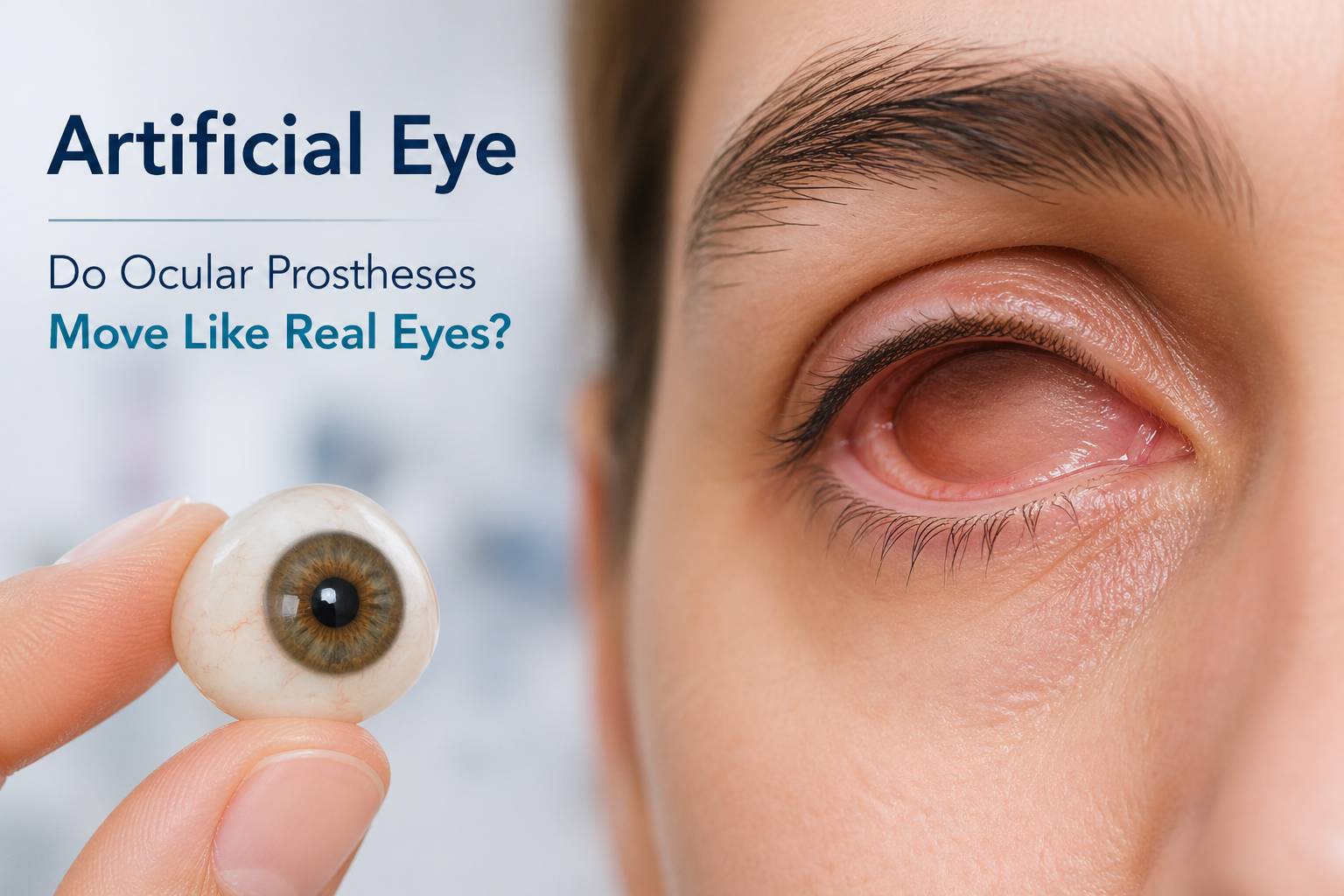
Artificial Eye Ocular Prosthesis: Do Ocular Prostheses Move Like Real Eyes?
It's one of the first questions people ask when they learn about artificial eyes: "But does it actually move?"
The idea of a prosthetic eye might conjure images from old films — a static glass ball that sits motionless while the person awkwardly avoids eye contact. But modern ocular prostheses are far more sophisticated than those outdated stereotypes suggest.
So, do artificial eyes move? The short answer is: yes, they can — but how much they move depends on several factors. The best eye specialist in Vaishali, Ghaziabad, can guide you through exactly how this works.
Understanding How Artificial Eyes Work
First, let's clear up a common misconception. An ocular prosthesis isn't a complete "eyeball" that fills the entire socket. Think of it more like a large, custom-fitted contact lens — a shell that sits over the existing tissue in your eye socket.
Here's an analogy that helps: Imagine a boat floating on water. The water moves, and the boat moves with it. Similarly, an ocular prosthesis sits on the tissue in your socket, and when that tissue moves, the prosthesis moves along with it.
When someone loses an eye, usually the outer shell is removed, but the muscles that control eye movement are preserved. These muscles attach to an implant placed in the socket. The prosthesis then sits over this implant, and when the muscles move the implant, the prosthesis moves too. The best eye doctor in Vaishali, Ghaziabad, can explain this process in detail during a consultation.
How Much Movement Can You Expect?
The degree of movement varies from person to person. Several factors influence how naturally a prosthetic eye moves:
The type of surgery performed: There are two main types of eye removal surgery — evisceration (where inner contents are removed but the outer shell is preserved) and enucleation (where the entire eye is removed). Generally, evisceration tends to result in better prosthesis movement.
The orbital implant: After eye removal, an implant is placed in the socket. Different implant types and sizes affect how much movement transfers to the prosthesis. Modern porous implants that integrate with surrounding tissue often provide better movement.
Prosthesis fit and design: A well-fitted, custom prosthesis that sits properly in the socket will move more naturally than a poorly fitting one. This is why custom prostheses, made specifically for your socket at an eye care clinic in Vaishali, Ghaziabad, outperform stock options.
In ideal circumstances, an artificial eye can achieve 50-70% of the movement of a natural eye. This means it moves enough that casual observers typically won't notice anything unusual.
Considering an ocular prosthesis? Patients from Indirapuram, Kaushambi, and Surya Nagar visit our eye care clinic in Vaishali, Ghaziabad for expert guidance. Call 98999 60700 to discuss your options.
How Realistic Do Modern Prosthetic Eyes Look?
Beyond movement, people naturally wonder about appearance. Today's custom ocular prostheses are remarkable in their realism.
Think of it like a master portrait artist at work. An ocularist (the specialist who creates prosthetic eyes) hand-paints each prosthesis to match your remaining eye precisely. They replicate the exact colour of your iris — including all the subtle variations, lines, and flecks that make each eye unique. They match the white of your eye (sclera), including the tiny blood vessels. The best eye specialist in Vaishali, Ghaziabad, can connect you with skilled ocularists.
The result is that most people cannot tell which eye is prosthetic during normal conversation. Even close friends and family sometimes forget which eye is artificial. The prosthesis reflects light naturally, has realistic depth, and appears lifelike.
What Limits Movement — And What Can Be Done?
Some patients experience less movement than they hoped for. Common reasons include:
→ Significant scar tissue from trauma or multiple surgeries
→ An implant that has shifted or is too small
→ Socket contracture (shrinkage of the socket over time)
→ Poorly fitted prosthesis that doesn't sit correctly
→ Damage to the muscles that control movement
Solutions exist for many of these issues. Socket surgery can address implant problems or contracture. A new, better-fitted prosthesis can improve movement if the current one isn't optimal. Regular follow-ups at the best eye care clinic in Vaishali, Ghaziabad, allow problems to be caught and addressed early.
The Emotional Side: Adjusting to Life With a Prosthetic Eye
Beyond the physical aspects, losing an eye involves significant emotional adjustment. Many patients experience grief, anxiety about appearance, and concerns about how others will perceive them. The best eye specialist in Vaishali, Ghaziabad, understands these concerns.
The good news is that most people adjust well over time. Having a natural-looking prosthesis that moves reasonably well helps enormously with confidence and social comfort. Many patients report that within a few months, they rarely think about their prosthesis during daily activities.
Support from family, friends, and healthcare providers makes a significant difference during the adjustment period. Remember that feeling apprehensive initially is completely normal — and it does get easier with guidance from the best eye doctor in Vaishali, Ghaziabad.
Living With an Ocular Prosthesis: Daily Realities
Comfort: A well-fitted prosthesis should be comfortable enough to forget you're wearing it. Initially, there's an adjustment period, but most people adapt within a few weeks.
Maintenance: Daily care is simple — usually just rinsing with saline solution. Professional polishing every 6-12 months at our eye care clinic in Vaishali, Ghaziabad, keeps the surface smooth and comfortable.
Physical activities: You can swim, exercise, and play sports with a prosthetic eye. Protective eyewear is recommended for activities that pose a risk to your remaining eye.
Longevity: A quality prosthesis typically lasts 5-7 years before needing replacement. Children need more frequent replacements as their sockets grow. The best eye specialist in Vaishali, Ghaziabad, monitors this over time.
Frequently Asked Questions About Artificial Eyes
Q: Where can I get guidance about ocular prostheses in Vaishali, Ghaziabad?
A: Dr. Shalini Jain at Samyak Eye Care — the best eye specialist in Vaishali, Ghaziabad — provides comprehensive guidance for patients needing ocular prostheses. We serve patients from Indirapuram, Kaushambi, Surya Nagar, and across Ghaziabad. Visit our Vaishali clinic.
Q: Can a prosthetic eye see anything?
A: No, an ocular prosthesis is purely cosmetic — it cannot restore vision. It replaces the appearance of the eye but has no visual function. The best eye doctor in Vaishali, Ghaziabad, can explain this during a consultation.
Q: Are artificial eyes made of glass?
A: The term "glass eye" is outdated. Modern prosthetic eyes are made from medical-grade acrylic (PMMA) — the same material used in some contact lenses. Acrylic is lighter, more durable, and allows for better customisation.
Q: Does it hurt to wear an artificial eye?
A: A properly fitted prosthesis should not cause pain. If you experience persistent discomfort, consult the best eye specialist in Vaishali, Ghaziabad, for adjustment.
Q: Can the artificial eye fall out?
A: A well-fitted prosthesis stays securely in place during normal activities. Accidental dislodgement is rare. If your prosthesis falls out frequently, it likely needs refitting.
Q: How long does it take to get used to wearing a prosthetic eye?
A: Most people adapt within 2-4 weeks. Initially, you'll be very aware of the prosthesis. Over time, it becomes natural to the point where you rarely think about it.
Q: Can I sleep with my artificial eye in?
A: Many people do sleep wearing their prosthesis, and this is generally safe. However, removing it at night allows the socket tissue to "breathe" and may reduce discharge. The best eye specialist in Vaishali, Ghaziabad, can advise based on your specific situation.
Expert Ocular Prosthesis Guidance in Vaishali, Ghaziabad
At our Vaishali clinic, Dr. Shalini Jain — the best eye doctor in Vaishali, Ghaziabad — provides comprehensive guidance for patients needing ocular prostheses. With over 25 years of experience and 37,500+ patients treated, we help patients understand their options, connect with skilled ocularists, and ensure proper fitting and follow-up care.
Losing an eye is emotionally challenging. Patients from Indirapuram, Kaushambi, Surya Nagar, and across Ghaziabad trust our eye care clinic in Vaishali, Ghaziabad, for compassionate, expert support. Having the right guidance makes the transition to a prosthetic eye much smoother — both physically and psychologically.
SCHEDULE YOUR CONSULTATION TODAY
Call: 98999 60700
Website: www.samyakeyecare.com
Location: Gaur Heights, Sector 4, Vaishali, Ghaziabad
Serving patients from Vaishali | Ghaziabad | Indirapuram | Kaushambi | Surya Nagar | Noida | East Delhi


