
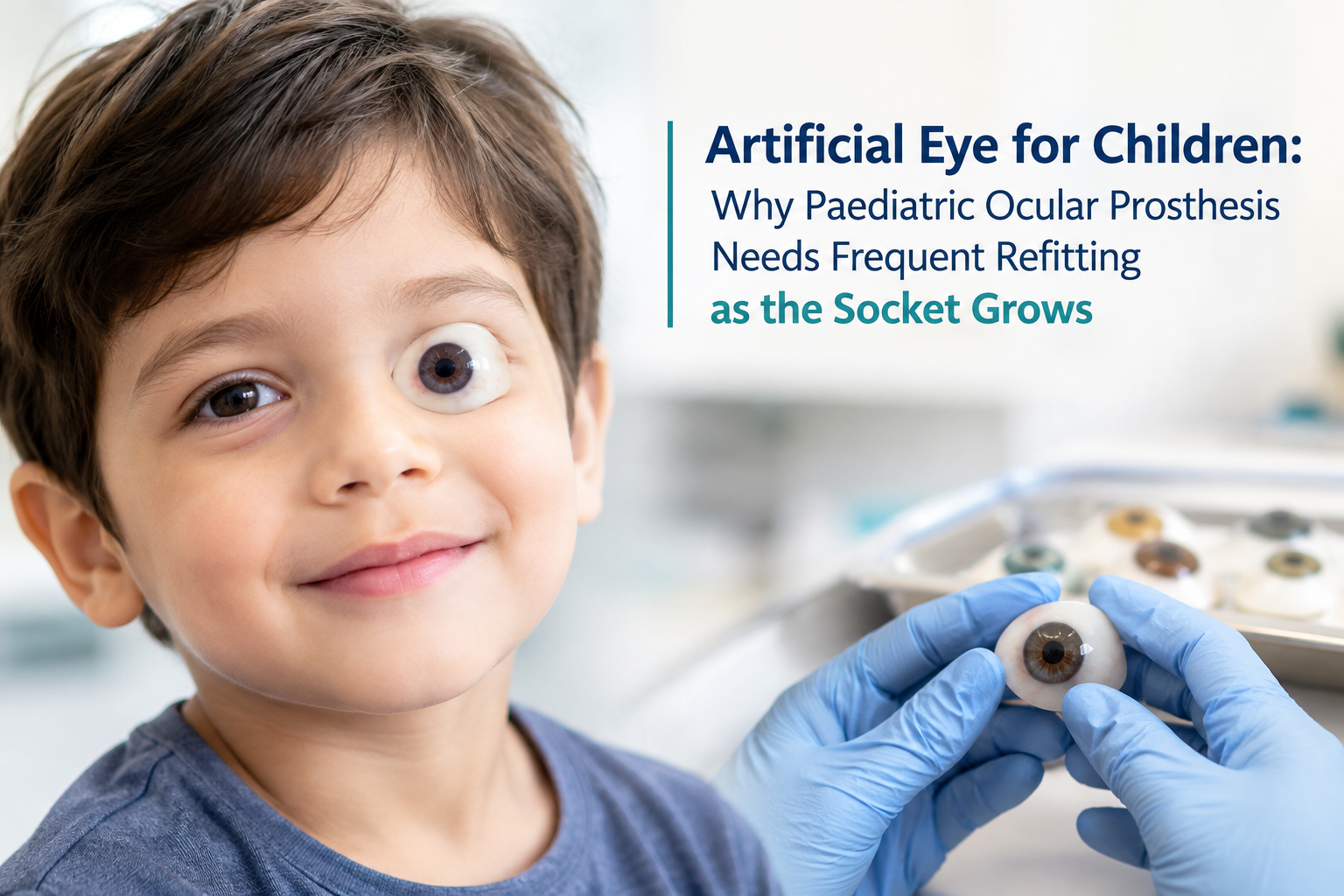
Artificial Eye for Children: Why Paediatric Ocular Prosthesis Needs Frequent Refitting as the Socket Grows
When a child loses an eye, the immediate clinical focus is rightly on the surgery and on the child's physical recovery. The question of an artificial eye feels secondary in those early weeks. But as the acute phase passes and the family begins to think about the long road ahead, a set of questions emerges that parents are often unprepared to navigate: When can a child have an artificial eye? Does a child's prosthesis work the same way as an adult's? How often does it need to be changed? And what happens if it is not managed correctly?
Paediatric ocular prosthesis is a genuinely specialised area of eye care that differs from adult prosthesis management in several fundamental ways. The most important difference: a child's eye socket is not static. It grows. The orbit, the bony cavity that contains the eye, develops rapidly during the first decade of life and continues to grow through adolescence. A prosthesis fitted at age 3 will not adequately fill the orbit at age 7. A prosthesis that does not grow with the socket will not only look wrong, it will also actively contribute to orbital developmental problems that become increasingly difficult to correct with time.
As the paediatric eye and ocular prosthesis specialist at Samyak Eye Care Clinic in Vaishali, Ghaziabad, I want to give families across India who are navigating this situation the clinical understanding they need to make informed decisions from the outset.
Why Children Need an Ocular Prosthesis: The Medical Reasons
Children require eye removal for several reasons, and the underlying condition matters for understanding what follows. The most common indications in India include:
Retinoblastoma: The most common intraocular malignancy of childhood. When the tumour cannot be managed with lens-sparing treatments, enucleation is necessary to prevent spread. Early fitting of a prosthesis after healing is part of the rehabilitation plan.
Severe ocular trauma: Injuries from fireworks, falls, or accidents that cause irreparable globe damage may require evisceration or enucleation. In India, paediatric firework injuries represent a significant proportion of this category.
Congenital anophthalmia or microphthalmia: Absence or severe underdevelopment of the eye from birth. Conformer fitting from infancy is essential to stimulate orbital development.
Painful blind eye: A severely damaged or chronically inflamed eye that cannot be salvaged but causes persistent pain may be removed for the child's comfort.
The Orbital Development Problem: Why Timing and Fit Matter
The orbit grows in response to the volume contained within it. In a normal eye, the growing eyeball itself provides the stimulus for orbital expansion. When the eye is absent from early infancy or childhood, the orbit does not receive this developmental stimulus and will not grow normally without intervention.
This is the central clinical rationale for early conformer and prosthesis fitting in children: the prosthesis or conformer provides the volumetric stimulus that the absent eye can no longer supply. Without it, orbital growth is stunted, leading to a progressively smaller orbit on the affected side, increasing facial asymmetry, and a socket that becomes more contracted and more difficult to fit as the child grows.
The clinical consequence of inadequate prosthesis management in childhood is not just cosmetic. Significant orbital asymmetry affects the position and function of the eyelids, the drainage of tears, and the structural support of the periorbital region. By the time a child reaches adulthood with a severely contracted, asymmetric orbit from inadequate childhood prosthesis management, the surgical and prosthetic challenges are substantially greater than they would have been with appropriate early care.
The Conformer: The First Step After Surgery
Before a definitive prosthesis can be fitted, the socket must heal. During this healing period, a conformer is placed in the socket. A conformer is a clear acrylic shell with no cosmetic detail, whose sole purpose is to maintain the socket shape, prevent contracture of the conjunctival lining, and provide the volumetric stimulus for orbital growth.
In infants and very young children, conformer fitting begins immediately or very shortly after surgery. The conformer is changed regularly, increasing in size as the child grows, to maintain appropriate orbital stimulation. This is one of the areas where paediatric prosthesis management differs most significantly from adult management: the conformer is not simply a placeholder; it is an active therapeutic device whose size must be managed as closely as a prescription lens would be in a child with myopia.
How Frequently Does a Child's Prosthesis Need to Be Changed?
This is the question parents most consistently ask at Samyak Eye Care Clinic, and the honest answer is: significantly more often than most families initially expect.
Infants and toddlers (0 to 3 years)
This is the period of most rapid orbital growth. Conformers and prostheses may need to be changed every 3 to 6 months to keep pace with socket development. The fitting process at this age requires patience and child-appropriate techniques, as toddlers cannot cooperate in the conventional sense. At Samyak Eye Care Clinic, we adapt our approach entirely to the child's developmental stage.
Young children (3 to 8 years)
Orbital growth slows somewhat but remains significant. Prosthesis review every 6 months is appropriate, with refitting when growth requires it. Children in this age group are also beginning school, making the cosmetic quality of the prosthesis increasingly important for their social development and confidence.
Older children and teenagers (8 to 18 years)
Orbital growth continues through adolescence, though at a slower rate than in early childhood. Annual review with refitting as needed is appropriate for most children in this age group. Teenagers may also have increasing input into decisions about their prosthesis, including the cosmetic details they want matched. This is entirely appropriate and supported.
What Parents Can Do at Home
The home care component of paediatric ocular prosthesis management is manageable once parents understand it clearly. The specific instructions provided at fitting should always be followed precisely, as they are tailored to the child's age, socket condition, and prosthesis type. General principles include:
Clean the prosthesis and socket as directed by the treating specialist. For children, this is typically gentle cleaning with saline or recommended solutions rather than soap.
Do not attempt to modify, adjust, or reshape the prosthesis at home. If the fit feels wrong, contact the clinic.
Keep all follow-up appointments. In paediatric management, skipping review appointments has cumulative consequences because socket growth during the interval between missed appointments is irreversible.
Watch for signs that the prosthesis is no longer fitting well: increased discharge, redness, the prosthesis appearing to protrude more than usual, or the child showing discomfort with the prosthesis.
Contact the clinic promptly if the prosthesis is dropped and damaged, becomes uncomfortable unexpectedly, or if the socket shows signs of infection.
The Psychological Dimension: Supporting Your Child
The adjustment to wearing an ocular prosthesis is a process, not a single event. For young children, the physical adaptation comes first, and the social adjustment follows as they enter educational settings. For older children who lose an eye during childhood, the psychological adjustment can be more complex, involving grief for the loss, concern about how peers will respond, and questions about identity and appearance.
A well-fitted, natural-looking prosthesis is one of the most effective practical supports for this adjustment. Children whose prostheses are a convincing match to their fellow eye are significantly more confident in social settings than those whose prosthesis is visibly different. This is one of the clinical arguments, beyond socket health, for prioritising high-quality custom prosthesis fitting and regular maintenance in children.
Parents are also often dealing with their own grief and adjustment alongside managing the child's care. At Samyak Eye Care Clinic, we take time with families, not just with the clinical procedure. Questions are always welcome, and concerns about the process or the outcome are always addressed directly.
Frequently Asked Questions
Q: Can a child wear an artificial eye?
A: Yes. Ocular prosthesis fitting in children begins from infancy when necessary, using conformers that provide the volumetric stimulus for orbital development. Custom prostheses can be fitted once the socket has adequately healed after surgery, typically 6 to 8 weeks post-operatively. Children of all ages can wear ocular prostheses, with the management adapted to their developmental stage.
Q: How often does a child's prosthetic eye need to be changed?
A: In infants and toddlers, conformers and prostheses may need to be changed every 3 to 6 months to keep pace with rapid orbital growth. In young children aged 3 to 8, review every 6 months with refitting as growth requires is typical. In older children and teenagers, annual review with refitting as needed is appropriate. Missing scheduled appointments during these growth phases has cumulative consequences for orbital development.
Q: Does an artificial eye affect facial growth in children?
A: Yes, in both directions. A well-managed prosthesis that appropriately fills the socket and is regularly upsized to keep pace with orbital growth helps maintain normal orbital development and facial symmetry. An absent or inadequate prosthesis allows the orbit to grow asymmetrically, leading to progressive facial asymmetry that is increasingly difficult to correct with age. This is why early fitting and regular refitting are clinically important, not just cosmetically desirable.
Q: What is a conformer and why is it used after eye removal?
A: A conformer is a clear acrylic shell placed in the socket after eye removal surgery, before a definitive prosthesis can be fitted. Its purpose is to maintain the socket shape during healing, prevent contracture of the conjunctival lining, and provide the volumetric stimulus for normal orbital development. In infants, conformers are placed as early as possible after surgery and changed regularly as the socket grows.
Q: Where can I find a paediatric artificial eye specialist in India?
A: Samyak Eye Care Clinic in Vaishali, Ghaziabad offers comprehensive paediatric ocular prosthesis services, including conformer fitting from infancy, custom prosthesis fabrication, and regular review and refitting through childhood and adolescence. We serve families from across Ghaziabad, Vaishali, Indirapuram, Kaushambi, and NCR. Visit our clinic for a consultation.
Begin the Right Way, Continue the Right Way
The families who see the best long-term outcomes for their children are those who begin the conformer or prosthesis process promptly after surgery, who attend every review appointment through the growth years, and who come to the clinic immediately rather than waiting when something changes. The orbital development that happens in the first decade of life cannot be recovered later. What is managed well in those years shapes the face and the confidence the child carries into adulthood.
If your child has experienced eye loss or has a congenital condition requiring ocular prosthesis management, visit our clinic at Samyak Eye Care, Vaishali, Ghaziabad. We are here to guide your family through every stage of this process.
Book Your Child's Paediatric Prosthesis Consultation Today
Dr. Shalini Jain | Samyak Eye Care Clinic | Vaishali, Ghaziabad
Call: 98999 60700


